
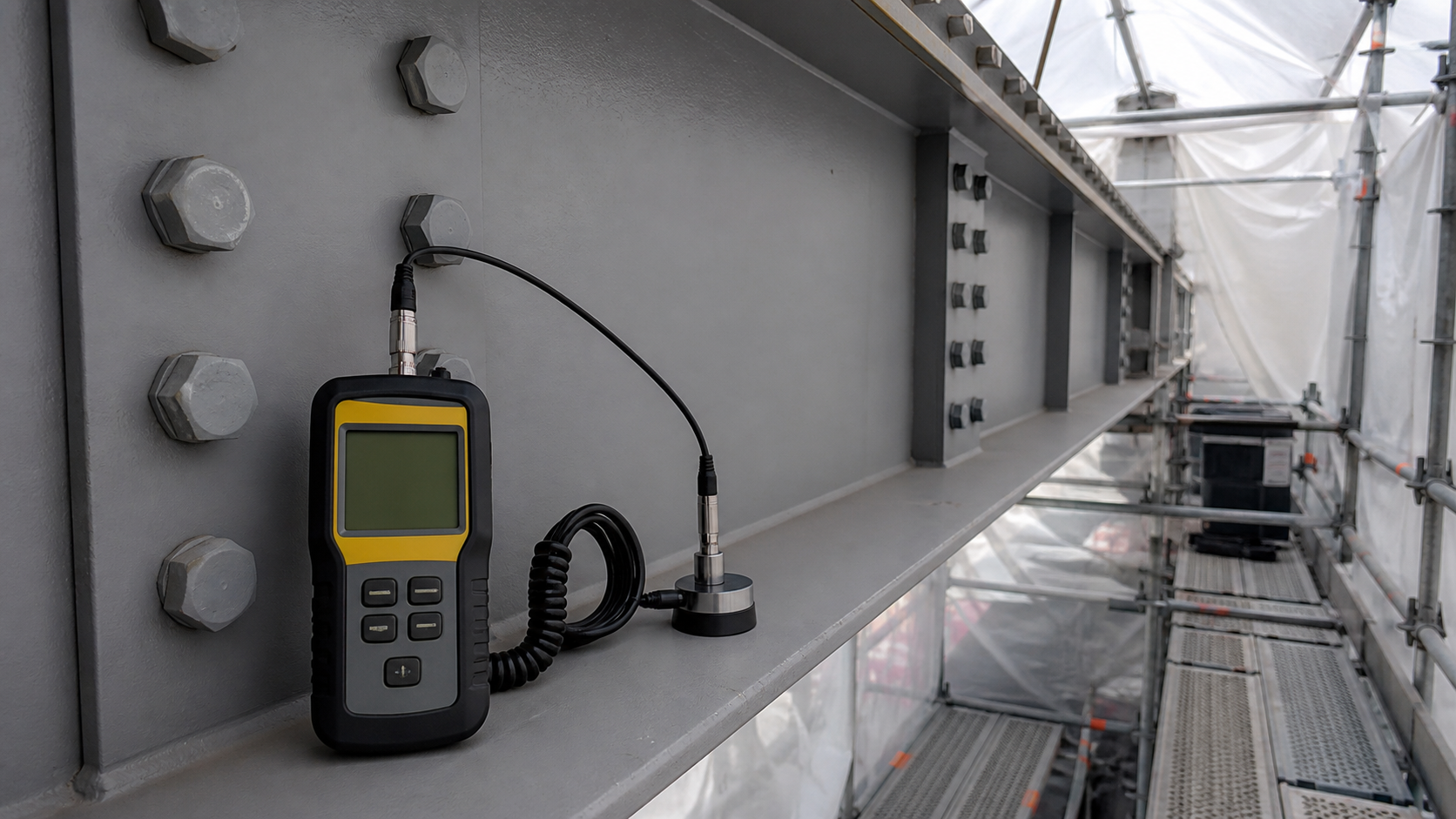
Protective coatings can fail even when the steel looks clean and the specified paint is correct. A thin, sometimes invisible film of moisture can form when steel approaches the air’s dew point. Temperature, relative humidity, ventilation, sunlight, and changing weather also affect application and cure. For that reason, dew point monitoring before steel coating is a production control—not paperwork completed after painting.
This guide explains how owners, engineers, and inspectors can define a practical environmental monitoring plan. It does not replace the project specification, coating manufacturer’s product data sheet, or a qualified coating inspector’s judgment.
Why dew point matters during steel coating
The dew point is the temperature at which air at its current moisture content becomes saturated. If a steel surface reaches that temperature, condensation may form. The surface can be colder than the surrounding air, particularly at night, after rain, near water, against shaded mass, or when conditioned air meets a cold member.
Moisture at the interface can interfere with adhesion, promote flash rusting, or create defects that appear only after the work has advanced. ISO 8502-4 provides guidance for estimating the probability of condensation before paint application. ASTM D3276 includes relative humidity and dew point among the key field-inspection subjects for metal substrates.
A common project rule requires steel temperature to remain at least 3°C (5°F) above dew point. FHWA bridge-painting guidance and current UFGS steel-coating specifications use that margin. It is not a universal permission to paint: the coating product data, contract limits, surface condition, cure requirements, and expected weather still govern.
Measure the environment that the coating actually experiences
An outdoor weather report is not enough. Conditions inside containment, beneath a bridge deck, beside heated equipment, or on the shaded face of a girder may differ substantially from readings at a distant station. Monitoring must represent the work face and the coldest credible steel location.
The essential readings
- Air temperature: measure near the work, away from direct radiant heating that would bias the sensor.
- Relative humidity: allow the sensor to stabilize and keep it clean. A rapidly moved instrument can lag behind changing conditions.
- Dew point: calculate it from reliable air-temperature and humidity measurements or use a suitable electronic meter.
- Steel surface temperature: check the member itself, including shaded, massive, low, or otherwise cold locations—not only the easiest point to reach.
- Dew-point spread: subtract dew point from steel temperature and compare the result with the governing limit.
Wind, precipitation, visible dampness, frost, ventilation, and the operating status of heating or dehumidification equipment should also be recorded when relevant. Surface temperature and freedom from moisture remain decisive even if calculated values appear acceptable.
Build a defensible inspection plan
1. Establish acceptance criteria before mobilization
The specification should identify the permitted air and surface temperature ranges, maximum relative humidity if applicable, minimum dew-point spread, measurement frequency, sensor locations, calibration requirements, stop-work rules, and required records. It should also resolve how manufacturer limits interact with project limits. Where requirements differ, obtain written direction rather than choosing the most convenient value in the field.
2. Select and verify instruments
Use instruments with ranges and accuracy appropriate to the expected environment. Document equipment identity, calibration or verification status, and any field checks. Contact probes require good contact with the steel; infrared thermometers require an appropriate emissivity setting and can be unreliable on shiny, reflective, very small, or obliquely viewed surfaces. When uncertainty matters, confirm with a contact method.
3. Map representative and worst-case locations
Before work starts, identify exposure zones: sun and shade, windward and sheltered faces, upper and lower elevations, thick and thin steel, interior and exterior containment, and areas near water or conditioned air. One convenient reading cannot represent a large structure with different microclimates.
4. Check before surface preparation and coating
Environmental control starts before paint reaches the steel. Condensation after abrasive blasting can contaminate or flash-rust a prepared surface. Record conditions before preparation, before mixing or application, during application, between coats, and through the specified initial cure. Current UFGS high-performance steel-coating guidance calls for continuous monitoring at pertinent locations during preparation, application, and initial cure on applicable projects.
5. Increase frequency when conditions are changing
A fixed interval is only a minimum. Repeat readings when weather approaches, daylight changes, ventilation stops, heaters cycle, doors open, fog develops, or the work moves to a different zone. FHWA’s field manual presents four-hour checks, but also emphasizes current and expected weather. Modern projects may require continuous logged monitoring.
A defensible environmental record links each coating operation to the conditions at the steel, not merely to a daily weather snapshot.
How to make a go/no-go decision
- Confirm the correct coating system, product data sheet, batch, mixing plan, induction time, and recoat window.
- Inspect the steel for visible moisture, frost, contamination, or loss of the specified surface preparation.
- Measure air temperature and relative humidity near the work and allow the instrument to stabilize.
- Measure steel temperature at representative points, including the coldest plausible location.
- Calculate or read dew point and determine the steel-to-dew-point spread.
- Compare every value with the project specification and manufacturer limits.
- Review the weather, work duration, and expected cure period. Conditions acceptable now may not remain acceptable long enough.
- Release the hold point only when the readings, physical surface, forecast, and documentation all support application.
If a limit is approached, pause and reassess. Do not “average” compliant and noncompliant locations. Improve ventilation or dehumidification, add safe controlled heating, isolate moisture sources, or wait for suitable conditions. After adjustment, allow the environment and steel to stabilize and take new readings.
Common monitoring failures
- Using air temperature as steel temperature: steel has thermal mass and can lag far behind changing air.
- Taking one reading at shift start: it misses sunrise, sunset, incoming weather, and equipment interruptions.
- Measuring only a warm location: the coldest surface controls condensation risk.
- Trusting a number over the surface: visible dampness or frost is a stop condition even if a meter appears acceptable.
- Ignoring cure conditions: environmental compliance must continue for the product’s required cure period.
- Undocumented instrument status: readings have weak evidentiary value when the device, location, time, and verification status are unknown.
- Applying a generic 3°C rule alone: some products or specifications impose tighter humidity, temperature, or dew-point limits.
Integrate environmental checks with coating QA/QC
Dew-point control is one link in the coating quality chain. Pair it with documented surface cleanliness, profile, dust and soluble-salt assessment, correct mixing, wet-film control, recoat timing, dry film thickness testing, and holiday detection where specified. The broader steel coating QA/QC plan should define hold points and responsibility for stopping work.
Environmental records should state date and time, exact location, coating activity, air temperature, relative humidity, dew point, steel temperatures, calculated spread, weather, equipment ID, inspector, and acceptance decision. Continuous logs are valuable, but they do not replace field observation or confirmation that sensors represent the active work.
Limitations and engineering judgment
Environmental monitoring estimates condensation risk; it does not prove adhesion, cleanliness, or long-term performance. Sensor accuracy, response time, placement, radiation, reflective steel, stratified air, and local moisture sources introduce uncertainty. Product-specific cure chemistry also matters: moisture-tolerant, moisture-cured, waterborne, zinc-rich, epoxy, and polyurethane products do not share identical limits.
For critical bridge, tank, marine, or industrial work, engage a qualified coating professional to develop the inspection plan and resolve deviations. If coating was applied outside limits, preserve records, quarantine the affected area, notify the responsible engineer and manufacturer, and agree on evaluation or corrective action before overcoating.
Owner’s acceptance checklist
- Are project and manufacturer environmental limits reconciled in writing?
- Are instruments suitable, identified, and within their required verification period?
- Do sensor locations cover the active work and worst-case steel surfaces?
- Are conditions recorded before, during, between coats, and through initial cure?
- Are stop-work and restart criteria clear?
- Can each coated area be traced to environmental records and coating batch data?
- Were deviations formally dispositioned rather than hidden by the next coat?
Frequently asked questions
Is 3°C above dew point always sufficient?
No. It is a widely used minimum margin, but the project specification and coating manufacturer may require additional temperature or humidity limits. Visible moisture, frost, incoming weather, or inadequate cure conditions can still prohibit application.
How often should dew point be measured?
Use the specified interval and increase frequency whenever conditions change. Large or controlled projects may require continuous logging. Measurements must also follow the work into new environmental zones.
Can a handheld electronic dew-point meter replace a sling psychrometer?
A suitable verified electronic instrument can provide efficient readings, but it must be used within its range, allowed to stabilize, protected from contamination, and checked as required. The contract may prescribe a particular method.
Where should steel temperature be measured?
At representative points and the coldest credible surfaces: shaded members, thicker sections, lower elevations, sheltered areas, or locations influenced by water or conditioned air. Record the locations, not just the values.
What should happen after an out-of-limit reading?
Stop affected preparation or coating work, protect the surface, identify the cause, restore control, allow conditions to stabilize, and retest. Evaluate any material already applied under noncompliant conditions before proceeding.
Authoritative sources
- ISO 8502-4:2017, probability of condensation before paint application
- ASTM D3276-21, Standard Guide for Painting Inspectors (Metal Substrates)
- UFGS 09 97 13.27, High Performance Coating for Steel Structures
- FHWA Field Manual for Bridge Painting Inspection
Plan the coating hold points before work starts
Structural Rehab helps owners turn coating specifications into practical inspection and acceptance plans for concrete and steel rehabilitation. Book a consultation to review environmental controls, coating QA/QC, or a repair scope before mobilization.
Need a professional structural assessment?
Book a consultation with Structural Rehab to evaluate repair priorities, corrosion risks, and rehabilitation options before damage escalates.
Book Consultation