Replacing a deteriorated high-strength bolt is not complete when the nut feels tight. Where a structural-steel repair requires pretensioned bolts, the project team must demonstrate that the specified bolt assembly was installed and inspected by an approved method. Direct tension indicators (DTIs) can provide that evidence, but only when the repair detail, installation sequence, verification test, and inspection record work together.
This guide explains a practical direct tension indicator inspection for structural steel repair workflow for owners, engineers, contractors, and inspectors. It applies to replacement or supplemental high-strength bolts in engineered repairs to bridges and buildings. It does not set a universal bolt tension, accept a connection design, or replace the responsible engineer’s repair drawings and governing specifications.
What a DTI does—and does not—confirm
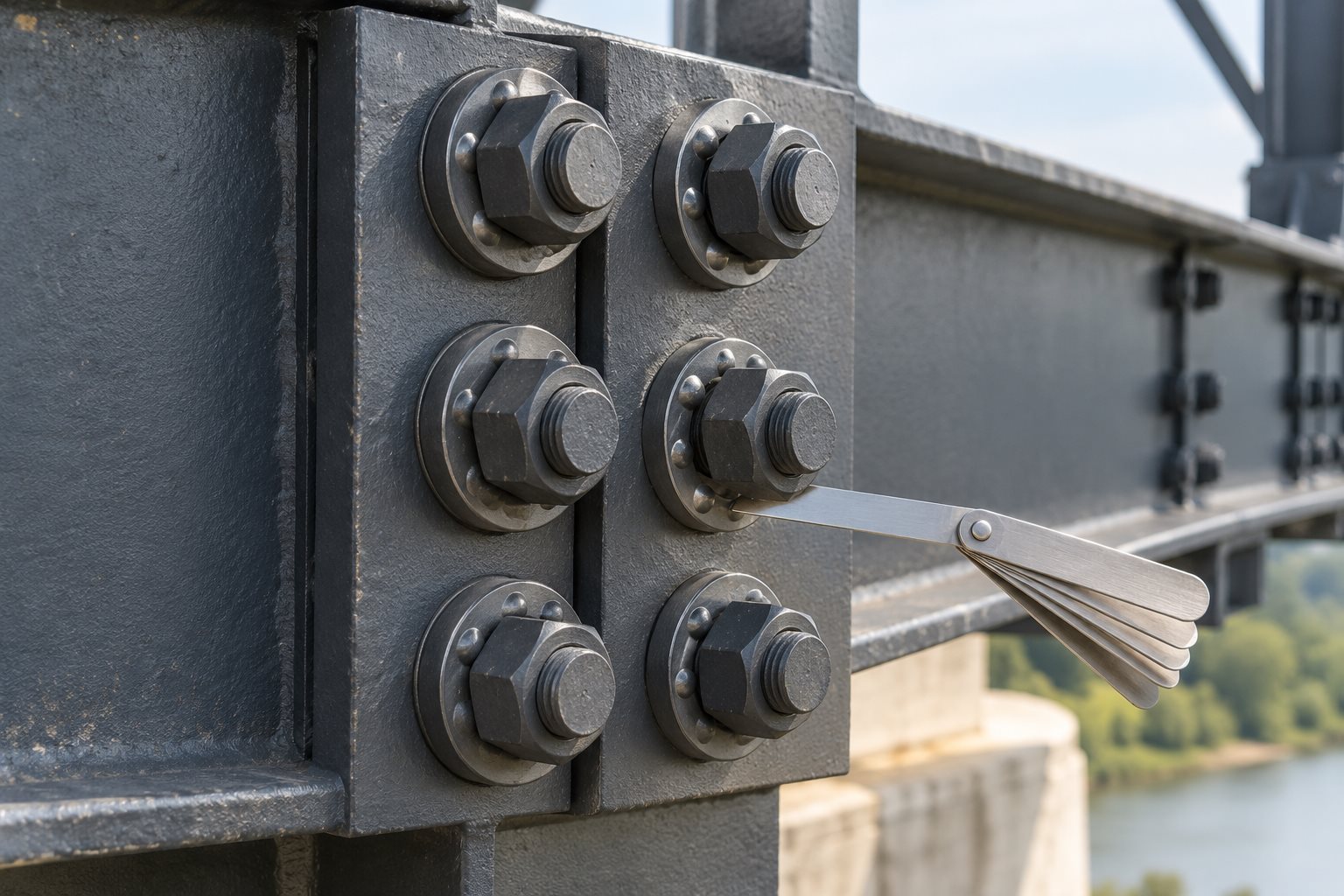
A DTI is a washer-like component with protrusions intended to compress as the bolt assembly is tightened. When used as part of an approved assembly and procedure, the remaining gap can be checked with a feeler gauge or a manufacturer-approved visual indication. That makes a DTI useful for verifying the installation condition of an individual fastener.
It does not prove that an existing connection has adequate plate thickness, sound welds, correct hole geometry, or a suitable load path. Nor does it make a generic torque value reliable. The RCSC Specification addresses installation and inspection of high-strength structural fastener assemblies, while the repair engineer remains responsible for the connection’s design assumptions and any changes to it.
That distinction matters in rehabilitation. A corroded splice can have enlarged holes, thin plies, distortion, pack rust, or water trapped between surfaces. Tightening new hardware before those conditions are assessed can hide the problem rather than restore a force-transfer system. Start with the condition and repair detail described in our guide to bolted steel connection repair, then select the approved installation and inspection method.
Set the repair hold points before bolts arrive
Confirm the connection and the repair sequence
Before removing a fastener or drilling a repair plate, identify what the connection does: bearing, slip-critical, pretensioned, bracing, moment transfer, splice, or a combination. Review drawings, load restrictions, access, fatigue demands, nearby work, and the sequence needed to keep the load path stable. Temporary support or a staged replacement sequence may be needed; a field crew should not decide that by observation alone.
At the pre-work hold point, the engineer or designated reviewer should accept the repair detail, fastener schedule, hole treatment, faying-surface requirements, coating removal limits, and any inspection or NDE required before the assembly is closed. If corrosion has reduced member or plate thickness, resolve that structural condition first; see structural steel section-loss repair for why measured remaining steel, location, and demand matter together.
Keep matched assemblies traceable
Record the bolt, nut, washer, and DTI product information specified for the repair. Storage and handling matter because lubrication, coating, damage, contamination, or casual mixing of components can change installation behavior. The contractor’s submittal should identify the intended assembly, lot information where required, installation method, DTI orientation, and the specific inspection criteria. Do not substitute a different washer, bolt length, lubricant, or DTI placement in the field without the required approval.
For bridge work, FHWA notes that pre-installation tests should be conducted in the same manner that the assemblies will be installed in the steelwork. That means the same components, configuration, tools, and practical access conditions—not a convenient bench demonstration using unrelated hardware.
Use a documented pre-installation verification test
Perform the required pre-installation verification before production installation and whenever the governing requirements call for it after a material, method, or condition change. The test establishes that the selected assembly and installation process can achieve the intended condition without unacceptable behavior. It is not an opportunity to invent a torque target or use a DTI outside its instructions.
Document the assembly identification, test setup, installer, inspector, method, date, observed results, and disposition. If the test is nonconforming, quarantine the affected material or procedure and escalate it. Re-lubricating, changing washers, or repeating the operation until it “looks right” without a documented resolution can destroy the evidence needed to diagnose the problem.
Install replacement bolts with a controlled sequence
Prepare and fit the joint
After the repair area is cleaned and accepted, verify that the steel plies bear as detailed and that holes, edge distances, fit-up, faying surfaces, and plate geometry match the approved repair. Where a repair includes plates or local reinforcement, follow the engineered drilling and installation sequence. AISC bridge-repair guidance cautions that repair work has to address cleaning, drilling debris, fit-up, tightening, and protective coating as connected steps.
Bring the joint to the required snug-tight condition using the specified sequence. The goal is to draw the plies together before final tightening, not to chase isolated bolts around a distorted connection. Work from the fixed or rigid part toward free edges when that is the project method, and avoid uncontrolled loosening and retightening. Stop if a bolt cannot be installed, if the plies will not draw together, or if an unexpected gap, crack, or deformation appears.
Place and inspect the DTI as specified
DTI placement is not interchangeable. The approved detail and product instructions must define which face receives the indicator and which element is turned. FHWA explains that positioning and the tightening arrangement affect what the device indicates; use the configuration that the governing repair documents and manufacturer instructions require. A DTI is also not a substitute for any hardened washer required by the approved assembly.
During final tightening, ensure the unturned element is held as required and preserve access for inspection. Measure remaining gaps with the specified feeler gauge or use the approved indicator method. Record each location or connection group in a way that ties it back to a drawing reference. “Bolts checked” is not a useful close-out record when a future inspector needs to understand which assembly was installed where.
QA/QC checklist for DTI-controlled repairs
- Before removal: accept the repair sequence, load controls, condition map, and fastener replacement limits.
- Before installation: verify accepted repair steelwork, matched fastener assemblies, storage, DTI configuration, and successful required verification testing.
- During snugging: confirm plies are drawn together and stop for unintended gaps, misfit, or changed field conditions.
- During final tightening: observe the approved method and inspect the DTI with the specified tool or indication.
- Before coating: accept completed connection work, repair edges, seal or drainage details, and any specified NDE.
- At close-out: retain inspection logs, test records, product records, photographs, deviations, and approved dispositions.
Protect the completed repair
Fastener installation cannot compensate for water that remains trapped at the joint. Restore drainage, eliminate debris shelves, detail edges as specified, and repair the protective system only after the steelwork has been accepted. Our steel surface-cleanliness guide and steel coating QA/QC hold-point guide explain why preparation, environmental controls, stripe coats where specified, and dry-film checks belong in the handover record.
Limitations and escalation triggers
Do not use a DTI reading to waive an engineering review of section loss, cracked steel, oversized or damaged holes, incompatible faying surfaces, plate separation, fatigue-sensitive details, or an altered load path. Escalate when the required pre-installation verification fails, when the plies cannot be drawn together as detailed, when the indicator cannot be inspected, or when field conditions differ from the repair documents. The appropriate response may be revised engineering, a different approved assembly, added access, or a change in repair scope—not an undocumented workaround.
Frequently asked questions
Can a DTI be used with any structural bolt?
No. Use only the approved, compatible assembly and configuration identified in the project documents and the applicable installation requirements. Components should not be casually mixed because their installation behavior can change.
Does a feeler-gauge check prove the connection is safe?
No. It supports inspection of the specified fastener installation condition. Safety and capacity still depend on the engineer’s evaluation of the connection, remaining steel, geometry, load path, and repair detail.
Can a crew tighten to a published torque value instead?
Not as a substitute for the approved project method and required verification. Torque is affected by many variables, including the assembly and lubrication. Follow the governing specification and the approved installation procedure.
Plan the record before the repair starts
A DTI inspection record answers whether the approved fastener assembly was installed and checked by the specified method. Pair that answer with condition assessment, engineered repair details, corrosion protection, and an accessible record for future inspection. If you need help turning field observations into a repair scope, book a Structural Rehab consultation. For broader owner guidance, our ebook materials are educational resources and do not replace project-specific engineering.
Sources
- FHWA: Use of Direct Tension Indicators in Bridge Structural Steel
- FHWA: Structural Fastener Questions & Answers
- FHWA: High-strength bolt construction review checklist
- AASHTO/NSBA: Guidelines for Field Repairs and Retrofits of Steel Bridges
Need a professional structural assessment?
Book a consultation with Structural Rehab to evaluate repair priorities, corrosion risks, and rehabilitation options before damage escalates.
Book Consultation