Carbon Fiber Reinforcement Versus Steel Jacketing
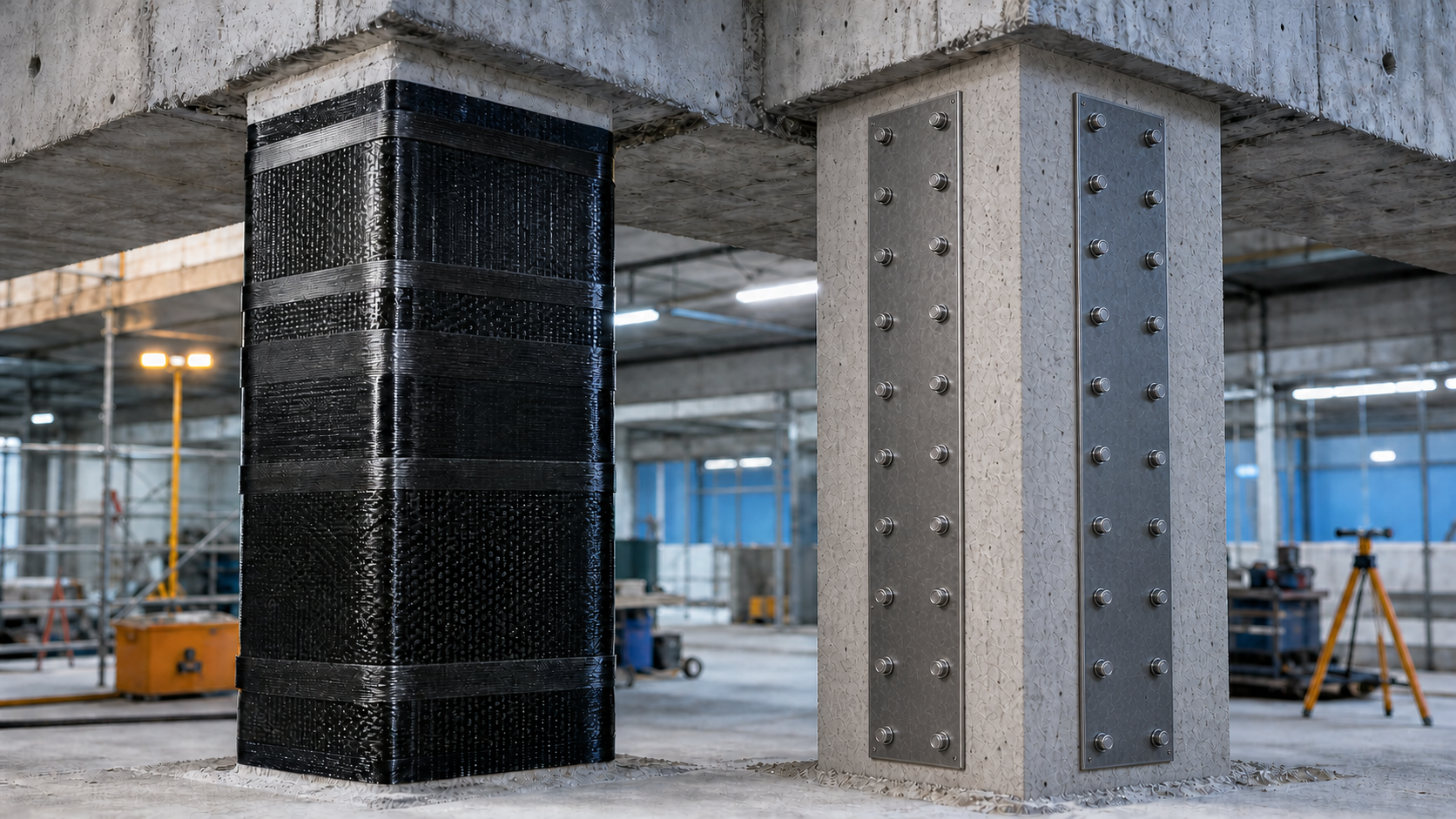
Carbon fiber reinforcement and steel jacketing are both proven strengthening methods, but they solve problems in different ways. The right choice depends on load demand, access, corrosion exposure, member geometry, fire requirements, budget, schedule, aesthetics, and how the strengthened element connects to the rest of the structure.
Owners often ask for the fastest or strongest option. Engineers usually ask a different question: what failure mode must be addressed? Flexural weakness, shear deficiency, column confinement, impact damage, corrosion-related section loss, seismic demand, and connection weakness may each require a different strengthening strategy. Sometimes the best answer is a hybrid solution.
What is carbon fiber reinforcement?
Carbon fiber reinforcement, often called FRP strengthening, uses high-strength fibers bonded to concrete, masonry, steel, or timber with a resin system. In structural rehabilitation, carbon fiber sheets, strips, plates, or wraps can add tensile capacity, improve confinement, enhance shear resistance, or strengthen members with minimal added weight. The material is thin, corrosion-resistant, and fast to install when the substrate is sound and properly prepared.
FRP is especially useful where added thickness must be limited. It can strengthen beams without greatly reducing headroom, wrap columns without major geometry changes, and improve capacity in occupied facilities where heavy equipment access is difficult. However, it depends on bond quality, substrate strength, fire protection requirements, anchorage details, and correct design. It cannot be treated as decorative fabric; it is an engineered structural system.
What is steel jacketing?
Steel jacketing uses plates, angles, channels, shells, or built-up steel sections to encase or reinforce an existing member. It is a traditional, robust method that can provide substantial strength, confinement, impact resistance, and connection opportunities. Steel jackets can be bolted, welded, grouted, or otherwise connected depending on the design.
Steel jacketing is often preferred for severe load increases, industrial impact risk, poor substrate condition, or situations where mechanical connection is needed. The tradeoffs are weight, corrosion protection, fabrication, access, fire protection, installation time, and space. A steel jacket can be extremely effective, but it changes dimensions and usually creates more disruption than FRP.
Head-to-head comparison
| Criteria | Carbon fiber reinforcement | Steel jacketing |
|---|---|---|
| Weight added to structure | Very low. Ideal where dead load must be minimized. | Moderate to high. Must be checked against foundations and existing capacity. |
| Speed of installation | Often fast after surface preparation, especially in occupied buildings. | Usually slower because of fabrication, lifting, welding, bolting, or grouting. |
| Cost | Material cost can be high, but labor and downtime may be lower. | Steel may be familiar and economical, but access and installation can increase cost. |
| Seismic retrofit suitability | Excellent for confinement and selected flexural or shear strengthening when detailed correctly. | Excellent for ductility, confinement, and connection upgrades when space allows. |
| Long-term durability | Corrosion-resistant, but needs UV, fire, and impact protection where exposed. | Strong and durable if corrosion protection and maintenance are properly designed. |
| Aesthetics | Thin profile can often be hidden below finishes. | More visible and bulky unless enclosed architecturally. |
When to choose carbon fiber
Choose carbon fiber reinforcement when access is limited, added weight must be minimized, headroom is valuable, corrosion exposure makes additional steel undesirable, or downtime must be reduced. It is well suited for strengthening slabs, beams, columns, walls, and openings in commercial buildings, parking structures, bridges, and industrial facilities.
FRP is also attractive when aesthetics matter. A thin laminate can often be concealed under fireproofing, plaster, cladding, or coatings. For corrosion-prone environments, FRP avoids adding another steel element that needs protection. The critical requirements are sound substrate, correct surface preparation, compatible resin, proper fiber orientation, quality installation, and engineering design that checks bond, anchorage, strain limits, and environmental exposure.
When to choose steel jacketing
Choose steel jacketing when the load increase is very high, when impact resistance is important, when the existing substrate is too poor for bonded FRP alone, or when the strengthening system must create a direct mechanical connection. Industrial columns, bridge piers, damaged columns, crane-supporting structures, and members exposed to vehicles or equipment may benefit from steel jackets.
Steel also gives designers familiar ductile behavior and connection detailing. If the repair requires new brackets, base plate strengthening, anchorage, or load transfer through bolts and welds, steel may be the better tool. The design must address corrosion protection, trapped moisture, weld access, fire protection, inspection access, and added weight.
When a hybrid solution is best
Many projects are not purely FRP or purely steel. A beam might receive carbon fiber reinforcement for flexure and steel plates near supports for anchorage. A column might use FRP wrapping for confinement and local steel hardware for connection repair. A parking structure might use patch repair and corrosion protection first, then FRP in selected spans where capacity is deficient.
Hybrid solutions work well when the engineer starts with the deficiency instead of the product. The question is not which material is more impressive. The question is what must be strengthened, how load will transfer, how the repair will be installed, how it will be protected, and how performance will be verified.
Conclusion
Carbon fiber reinforcement is lightweight, corrosion-resistant, thin, and fast. Steel jacketing is robust, mechanically direct, impact-resistant, and familiar. Both can be excellent choices, and both can fail if applied to the wrong problem. A professional assessment should define the structural deficiency, exposure, service conditions, installation constraints, and lifecycle maintenance before a method is chosen.
Review our repair and rehabilitation services, or book a consultation to compare strengthening options for your project.
Need a professional structural assessment?
Book a consultation with Structural Rehab to evaluate repair priorities, corrosion risks, and rehabilitation options before damage escalates.
Book Consultation