Steel can look ready for primer and still carry water-soluble salts that undermine coating durability. Chlorides, sulfates, and nitrates may remain in pits, crevices, or beneath corrosion products after ordinary cleaning. Once moisture reaches them through a coating defect or permeable film, they can support corrosion and contribute to osmotic blistering. Soluble-salt testing on steel before coating therefore belongs at a defined inspection hold point—not as an improvised check after the coating crew is waiting.
This guide explains how owners, engineers, and coating inspectors can plan extraction, conductivity testing, acceptance, washing, and retesting without treating one meter reading as a universal pass-or-fail answer. It complements broader steel coating QA/QC, dry-film thickness inspection, and holiday detection.
What soluble-salt testing actually measures
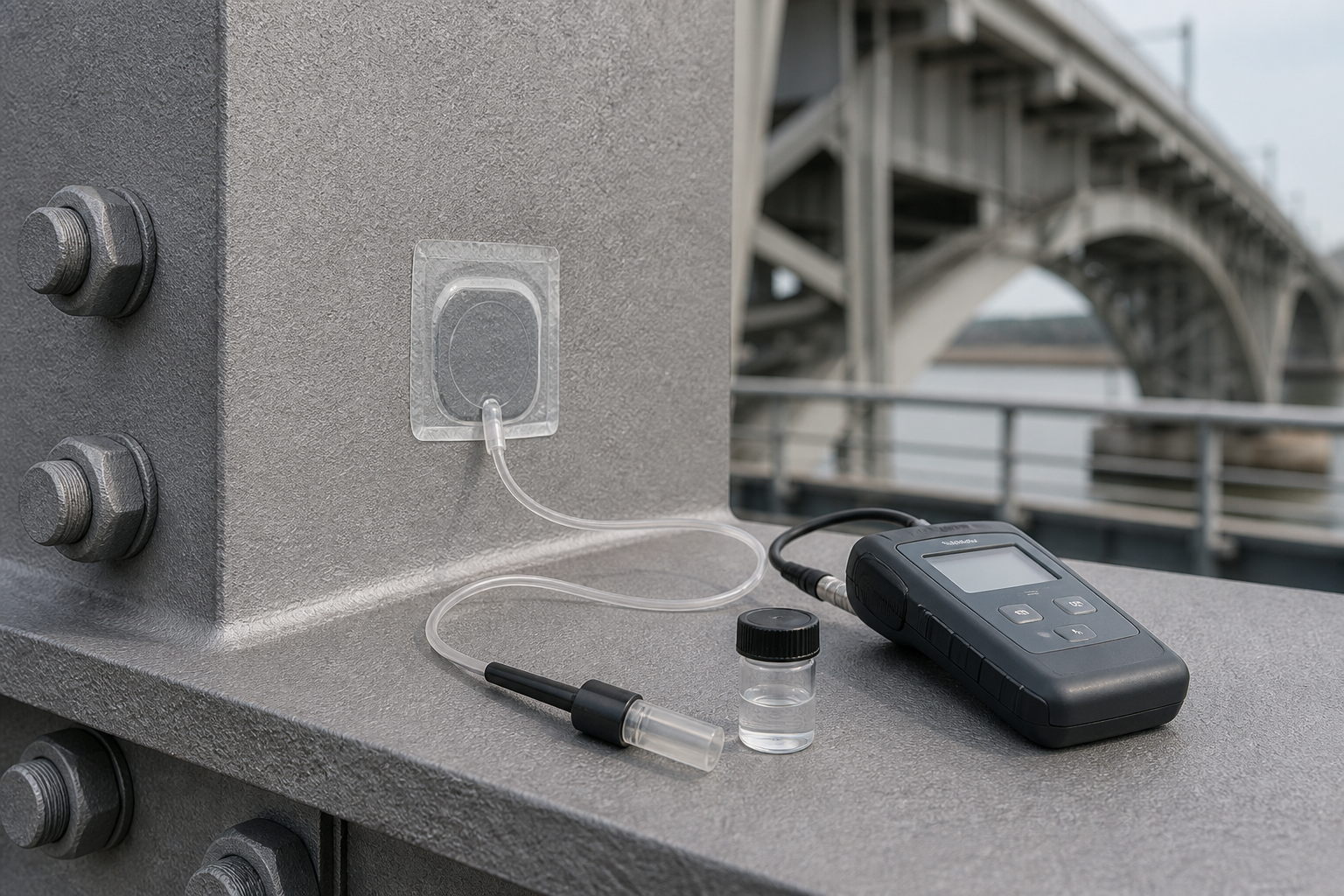
ISO 8502-6:2020 describes the Bresle method for extracting water-soluble contaminants from a defined surface area using an adhesive cell or sleeve. The extracted liquid must then be analyzed. ISO 8502-9:2020 covers a field conductivity method that estimates the surface density of water-soluble salts that form ions in water.
The distinction matters. The extraction step transfers some accessible contamination into water; the conductivity step measures the solution’s ability to conduct electricity. Conductivity does not identify individual chloride, sulfate, or nitrate concentrations. If a specification limits a particular ion, use a suitable ion-specific method or laboratory analysis rather than assuming a conductivity result is chemically selective.
Extraction is also not perfect. ISO notes that soluble material can remain hidden in crevices, beneath folds, under corrosion layers, or beneath oil and thin films. A low result is evidence about the sampled location and method—not proof that every part of a complex structure is salt-free.
Why salts remain after visible cleaning
Bridge steel, marine structures, industrial frames, and coastal facilities can accumulate salts from sea spray, deicing chemicals, process emissions, contaminated wash water, and abrasive media. The FHWA methodology study on soluble salts explains that chloride, sulfate, and nitrate commonly occur on bridge steel and that salts may persist in pits and crevices. Abrasive blasting alone may expose contamination without reliably removing it; contaminated abrasive can add another source.
This is why visual cleanliness, surface profile, dust testing, and soluble-salt testing answer different questions. A near-white blasted surface can still fail a salt criterion. Conversely, a salt reading does not confirm that rust, oil, dust, or inadequate profile has been corrected.
Build the requirement before work starts
Define the governing documents
The project specification should identify the extraction method, analytical method, reporting unit, acceptance limit, sampling frequency, lot definition, locations, retest rules, and who may release the hold point. Do not copy a limit from an unrelated coating system or exposure. FHWA’s coating-performance research shows that reported tolerable salt levels vary considerably with coating type, ion, exposure, temperature, and study method. The coating manufacturer’s written requirements and the owner’s durability objective must be reconciled by the responsible engineer.
Plan representative sampling
A defensible plan combines routine locations with risk-based locations. Include horizontal ledges, lower flanges, splash zones, leaking joints, drain paths, connection crevices, pitted steel, former pack-rust areas, and boundaries between old and newly prepared surfaces. Record grid references or photographs so failed areas can be found again. Avoid sampling only easy, flat, sheltered steel.
Define when a test represents a work area and what happens when it fails. A failed point should trigger an agreed investigation of adjacent steel, not an arbitrary declaration that either the entire structure or only the patch is unacceptable.
Set two logical checkpoints
Current UFGS 09 97 13.27 calls for testing and washing before abrasive blasting where appropriate, followed by final pre-application testing after preparation. Early testing identifies heavily contaminated zones while corrosion products are being removed. Final testing confirms that the prepared surface meets the specified acceptance condition immediately before coating.
Field procedure and QA/QC controls
- Confirm readiness. The test surface should be in the condition defined by the inspection plan. Remove barriers only by the specified process; do not wipe a test spot in a way that makes it unrepresentative.
- Check equipment and water. Verify meter calibration or performance checks, cell condition, water quality, volumes, temperature compensation, and expiry dates where applicable. Measure and document the blank when the method requires it.
- Fix the extraction area and volume. Apply the cell without leakage, introduce the specified water volume, agitate for the specified time and technique, and recover the solution completely enough for analysis. Deviations change the calculated surface density.
- Avoid contamination. Use clean gloves and tools. Keep test water, syringes, probes, and containers away from dirty surfaces. Do not reuse extraction liquid or mix samples unless the approved procedure requires a composite.
- Calculate in the specified unit. Record the raw conductivity, blank correction, cell area, solution volume, conversion factor, and final surface density. Unit errors between milligrams per square metre and micrograms per square centimetre can produce a tenfold or larger acceptance mistake.
- Document context. Capture member, elevation, exact location, preparation method, time since blasting, steel and air temperature, relative humidity, weather exposure, instrument ID, operator, result, criterion, and disposition.
A defensible soluble-salt result preserves the chain from sampled steel to acceptance decision. A lone photograph of a meter display is not enough because it omits the area, volume, blank, conversion, and location.
What to do when a location fails
Stop coating the affected lot or clearly bounded area. Confirm that the test was valid, then investigate the likely contamination pathway. Washing with clean water is often necessary because dry abrasive blasting is not a reliable desalination method. Depending on the specification and substrate, the corrective process may use pressure washing, wet abrasive cleaning, approved salt-removal cleaning, or repeated wash-and-test cycles. Any cleaner must be compatible with the substrate and coating system and must not leave an adhesion-inhibiting residue.
After washing, dry the steel under controlled conditions and restore the required visual cleanliness and surface profile if flash rust or other changes occur. Retest the corrected area and the agreed surrounding extent. Never average a failing high-risk result with several low readings to manufacture a pass unless the specification explicitly defines that statistical method.
Limitations that should appear in the report
- Conductivity represents total ionic contamination accessible to the extraction, not a chemical breakdown by ion.
- Pits, crevices, edges, riveted or bolted interfaces, and remaining corrosion products can reduce recovery or make patch sealing difficult.
- Different kits and extraction solutions may recover different fractions; results are not automatically interchangeable.
- Surface contamination can return after testing through condensation, spray, dust, handling, or contaminated water.
- Acceptance limits depend on the specified coating system and service exposure; there is no single universal safe value.
- Passing salt tests does not replace verification of oil and grease removal, visual cleanliness, profile, dust, environmental conditions, mixing, application, or curing.
Owner’s acceptance checklist
- Approved inspection and test plan identifies method, limit, frequency, lot, and hold point.
- Risk locations are included, not only convenient flat surfaces.
- Equipment checks, blank, water, cell area, volume, and calculations are recorded.
- Failed areas are bounded, cleaned, re-prepared where necessary, and retested.
- Steel remains protected from recontamination between acceptance and primer application.
- Salt acceptance is cross-checked with surface profile, dust, cleanliness, and environmental records.
- Final report maps every result to a physical location and records the disposition.
Frequently asked questions
Does abrasive blasting remove soluble salts?
Not reliably. Blasting can remove corrosion products and expose trapped contamination, but water-soluble salts may remain in pits and crevices. Heavily contaminated steel commonly needs washing followed by re-preparation and retesting.
Is the Bresle patch itself the salt test?
It is primarily an extraction technique. The recovered solution still requires an analytical method, commonly conductivity for total ionic contamination or a suitable ion-specific method when the specification controls chloride or another ion.
What salt limit should a project use?
The engineer should establish the limit from the owner’s specification, coating manufacturer’s written requirements, exposure, expected service life, and referenced test method. A value borrowed from another product or exposure may not be defensible.
Can a coating be applied immediately after a passing result?
Only if all other hold points pass and the surface remains within the permitted environmental window. A salt pass does not waive limits for dew point, humidity, cleanliness, dust, profile, or maximum time between preparation and priming.
How many tests are enough?
No universal number fits every structure. Frequency should reflect lot size, geometry, exposure history, variability, access, and consequence of failure, with extra tests at known salt traps and after any failed result.
Make the hold point meaningful
Soluble-salt testing is most valuable when it changes decisions: where to wash, when to re-prepare, whether to expand the test area, and whether primer application can proceed. Structural Rehab can help owners develop coating inspection plans, review rehabilitation evidence, and coordinate practical hold points for steel structures. Book a consultation to discuss a project-specific assessment, or use our repair-planning resources to prepare questions for your engineer and coating team.
Need a professional structural assessment?
Book a consultation with Structural Rehab to evaluate repair priorities, corrosion risks, and rehabilitation options before damage escalates.
Book Consultation