Steel structure repair succeeds when the repair method follows the defect mechanism. A corrosion pit, a fatigue crack, a weld discontinuity, and an impact-damaged connection may all appear as “steel damage,” but they do not require the same repair. The best result comes from a disciplined sequence: inspect, classify, engineer the repair, execute under controlled procedures, verify quality, and restore corrosion protection.
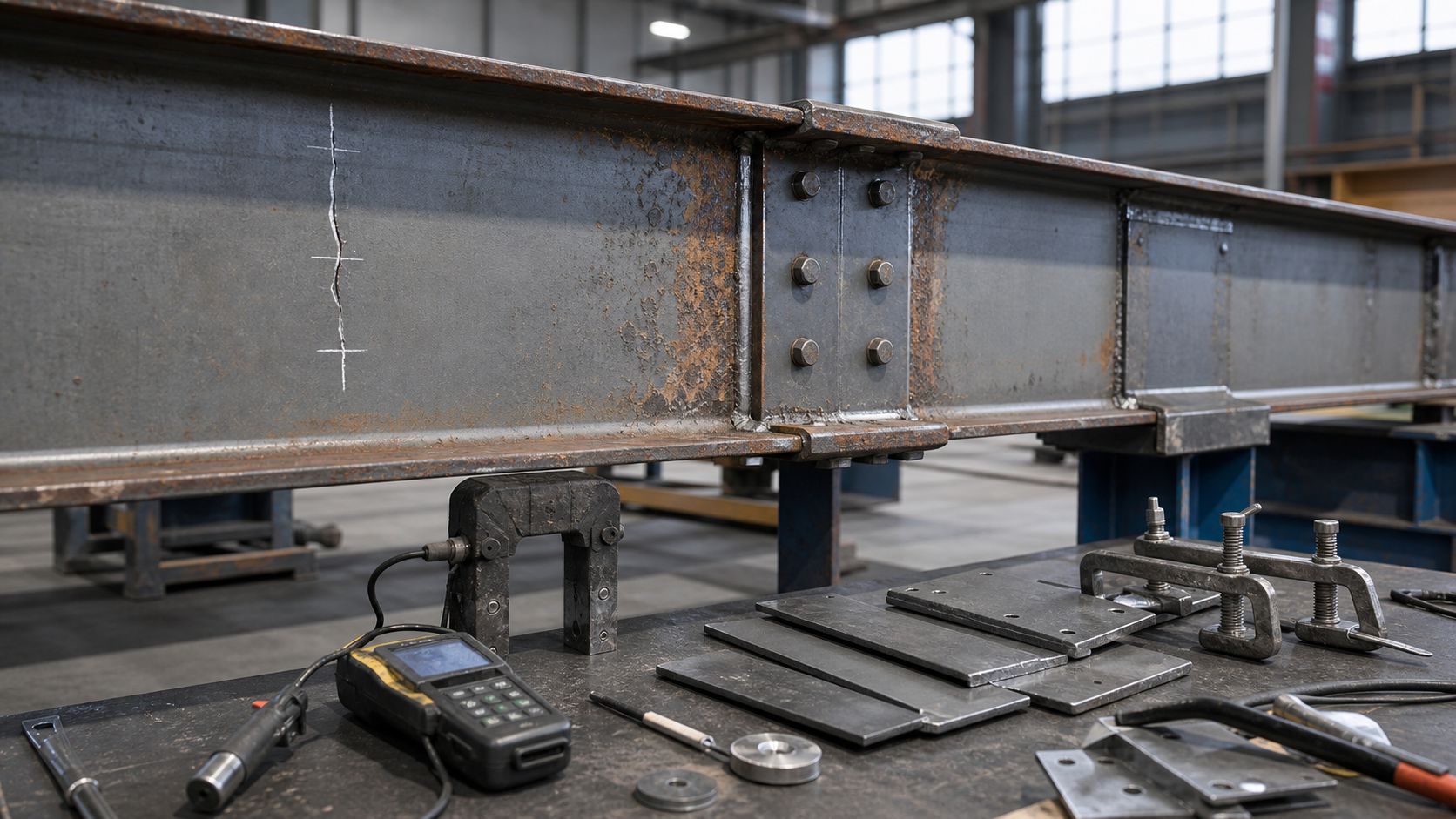
This guide explains practical steel structure repair options used for buildings, bridges, industrial platforms, pipe racks, canopies, and steel-framed assets. It covers conventional repairs such as grinding, stop holes, bolted splice plates, welded reinforcement, member replacement, and coating renewal, plus specialist methods such as CFRP bonding and laser cladding where project conditions justify them.
Start With the Failure Mechanism
A steel repair should not begin with a welder or a coating crew. It should begin with a defect classification. The repair team must determine whether the problem is section loss, fatigue cracking, brittle fracture risk, weld defect, coating breakdown, distortion, overload, vibration, or poor detailing. This distinction controls the inspection method and the repair design.
Corrosion and section loss
Corrosion repair normally starts with cleaning, measuring remaining thickness, checking whether section loss is local or widespread, and identifying the exposure source. For structural members, the engineer must confirm whether the remaining section still satisfies the required capacity before coating or plating decisions are made.
Fatigue cracks
Fatigue cracks usually start at stress concentrations: weld toes, cope holes, attachments, holes, notches, cover plates, and details with high vibration or repeated loading. A visible crack should be treated as a symptom of stress range, detail category, and load history. Simply welding over a crack can trap the defect or create a new stress concentration if the underlying fatigue detail is not improved.
Weld defects
Weld defects may include lack of fusion, undercut, porosity, cracks, poor profile, incomplete penetration, or repair weld defects from previous work. Repairs should follow qualified welding procedures, appropriate welder qualifications, preheat and heat input controls, and nondestructive testing requirements.
Inspection Methods Before Repair
Inspection should be selected based on the defect type and access. Common tools include visual inspection, thickness measurement, magnetic particle testing, liquid penetrant testing, ultrasonic testing, coating dry film thickness checks, surface profile checks, and bolt or weld inspection.
Magnetic particle testing is often useful for surface and near-surface discontinuities in ferromagnetic steel. Liquid penetrant testing can help identify surface-breaking flaws where the surface is suitable. Ultrasonic testing can support thickness checks and internal flaw detection when properly specified. Coating dry film thickness testing helps confirm that corrosion protection was restored after repair. For coating-related quality control, see our guide to dry film thickness testing for steel coatings.
Repair Option 1: Remove, Clean, and Restore Protection
For non-critical local corrosion with adequate remaining capacity, the repair may involve removing loose corrosion products, preparing the steel surface, replacing lost protective systems, and improving drainage or water traps. The coating specification should define surface cleanliness, surface profile, primer type, intermediate coat, topcoat, dry film thickness, stripe coating, curing, and inspection hold points.
AMPP standards and coating guidance are commonly used to control corrosion-protection work. The key point is practical: coating is part of the structural repair, not decoration. If coating repair is poor, the steel repair will age quickly.
Repair Option 2: Stop Holes and Crack Arrest Details
Stop holes may be used in some fatigue-crack situations to reduce the stress concentration at a crack tip and temporarily arrest crack growth. They are not a universal cure. The hole must be properly located, drilled, finished, inspected, and often combined with detail improvement or reinforcement. If the original detail continues to experience high stress range, cracking can restart.
Stop-hole repair should be treated as an engineered method, not a field shortcut. It is most defensible when the crack tip is accurately identified and the engineer confirms that the remaining member and detail can safely carry demand.
Repair Option 3: Bolted or Welded Reinforcement Plates
Bolted splice plates and welded reinforcement plates are common for restoring section loss or improving capacity. Bolted repairs are useful when field welding is restricted, heat input is a concern, or future inspection/removal is valuable. Welded repairs can be compact and strong, but they introduce heat, residual stress, and welding-quality requirements.
Repair plates must be designed for load path, eccentricity, slip, fatigue category, corrosion traps, access for coating, edge distance, bolt pretension where required, and inspection. Poor detailing can move the stress concentration rather than solve it.
Repair Option 4: CFRP Bonding for Steel Members
CFRP bonding can strengthen selected steel elements without adding much weight. It may be considered for tension flanges, fatigue-prone details, or members where access and shutdown time are limited. The challenges are surface preparation, adhesive performance, temperature exposure, fire protection, impact protection, edge detailing, and long-term inspection.
CFRP should be designed as a specialist bonded system with tested material data and project-specific acceptance criteria. It is not a substitute for cleaning corrosion, stopping active cracking, or restoring protective coating around the repair zone.
Repair Option 5: Laser Cladding and Additive Metal Repair
Laser cladding can deposit compatible metal onto a worn or locally damaged steel surface with controlled heat input and good metallurgical bonding when performed under suitable procedures. It is most relevant for specialized industrial components, local wear zones, and repair scenarios where precision and controlled deposition are valuable.
For building and bridge structures, laser cladding is still a specialist method rather than a default field repair. It requires metallurgical review, procedure qualification, heat-affected-zone control, inspection, and confirmation that the repaired component meets structural and durability requirements.
Weld Repair Controls That Matter
Weld repairs should be governed by a written repair procedure. At minimum, the procedure should define joint preparation, removal limits, preheat, consumables, welding sequence, interpass temperature, inspection points, NDT method, acceptance criteria, and coating restoration after welding.
AWS standards and publications are important references for welding requirements. The project specification should identify the applicable code, because building steel, bridge steel, stainless steel, sheet steel, and repair-specific work can fall under different requirements.
Quality Control Checklist
- Confirm defect type and repair objective before starting work.
- Record baseline photos, crack maps, thickness readings, and weld/bolt condition.
- Verify whether temporary support, unloading, or vibration control is required.
- Use qualified welders, approved procedures, and appropriate NDT.
- Avoid new corrosion traps at repair plates, lap joints, and welded attachments.
- Restore coating system with specified surface preparation and dry film thickness.
- Keep repair records for future inspection and maintenance planning.
When Repair Is Not Enough
Repair may not be economical or safe when section loss is extensive, cracking is widespread, connections are repeatedly failing, fatigue demand remains high, fire damage has changed steel properties, or access prevents reliable inspection. In those cases, partial replacement, member strengthening, load reduction, or structural redesign may be the better decision.
FAQ
Can a cracked steel beam simply be welded?
Not without diagnosis. The crack tip must be found, the cause must be understood, and the repair must address stress concentration, fatigue demand, weld quality, and inspection. Welding over a fatigue crack without detail improvement can lead to repeat cracking.
When is CFRP useful for steel repair?
CFRP can be useful where additional tensile capacity or fatigue improvement is needed with low added weight. It requires excellent surface preparation, adhesive compatibility, environmental protection, and specialist design.
Is laser cladding suitable for every steel structure?
No. Laser cladding is a specialist repair method. It may be valuable for precise local metal restoration, but it requires metallurgical procedure control and verification. Conventional bolted, welded, or replacement repairs are often more practical for ordinary structural steel.
What should be inspected after steel repair?
Typical checks include weld inspection, NDT where specified, bolt installation, alignment, remaining thickness, coating surface preparation, coating dry film thickness, and final repair documentation.
Source Links
- FHWA steel bridge publication HIF-16-002
- FHWA steel bridge publication IF-12-052
- American Welding Society standards and publications
- AMPP standards information
- AMPP: What is corrosion?
- ASTM E709 magnetic particle testing guide
- ASTM E165/E165M liquid penetrant testing practice
Need a Steel Repair Strategy?
Structural Rehab helps owners and engineers assess steel deterioration, compare repair methods, prepare practical repair scopes, and restore corrosion protection. Start with our structural rehabilitation services, review why steel structure protection is vital, or book a consultation for project-specific guidance.
Need a professional structural assessment?
Book a consultation with Structural Rehab to evaluate repair priorities, corrosion risks, and rehabilitation options before damage escalates.
Book Consultation