Acid-damaged concrete repair needs two decisions: what concrete can safely remain, and how the repaired structure will be protected from the exposure that damaged it. Replacing an eroded surface with a stronger mortar does not, by itself, answer either question.
This guide is for owners and engineers assessing concrete containment walls, process-area slabs, equipment foundations and similar structural elements. It focuses on investigation and repair acceptance, rather than prescribing a universal acid-resistant product. The checklist below is a suggested project workflow; the responsible engineer must adapt it to the structure, operating conditions and applicable requirements.
Start with the exposure, not the repair bag
ACI’s guidance on precautions against acid attack distinguishes mild exposure from strong-acid conditions, where protective barriers are commonly needed. This is an important limitation on a material submission: ordinary concrete strength data are not proof that a repair will resist the site’s chemicals.
Ask operations staff to prepare an exposure record before requesting quotations. Identify the chemical or mixture, concentration range, temperature, contact duration, cleaning products and whether contact is occasional or continuous. Include credible abnormal events, such as an overflow or a concentrated cleaning cycle. A supplier cannot meaningfully assess compatibility against the description “industrial water” alone.
Make the operating envelope explicit
Record where the information came from and which values remain uncertain. A single pH reading describes one sample at one time; it is not a complete specification for chemical resistance. Ask the laboratory and process specialist which additional measurements matter for the actual mixture. Where conditions vary, provide the range and sampling dates rather than averaging away the most demanding exposure.
Distinguish immersed surfaces, splash zones, drainage routes and normally dry areas that receive spills. Put those zones on the same drawing as the distress survey. This allows the repair designer to explain why different areas may require different protection details without treating every discolored surface as equally damaged.
Establish what the concrete has lost
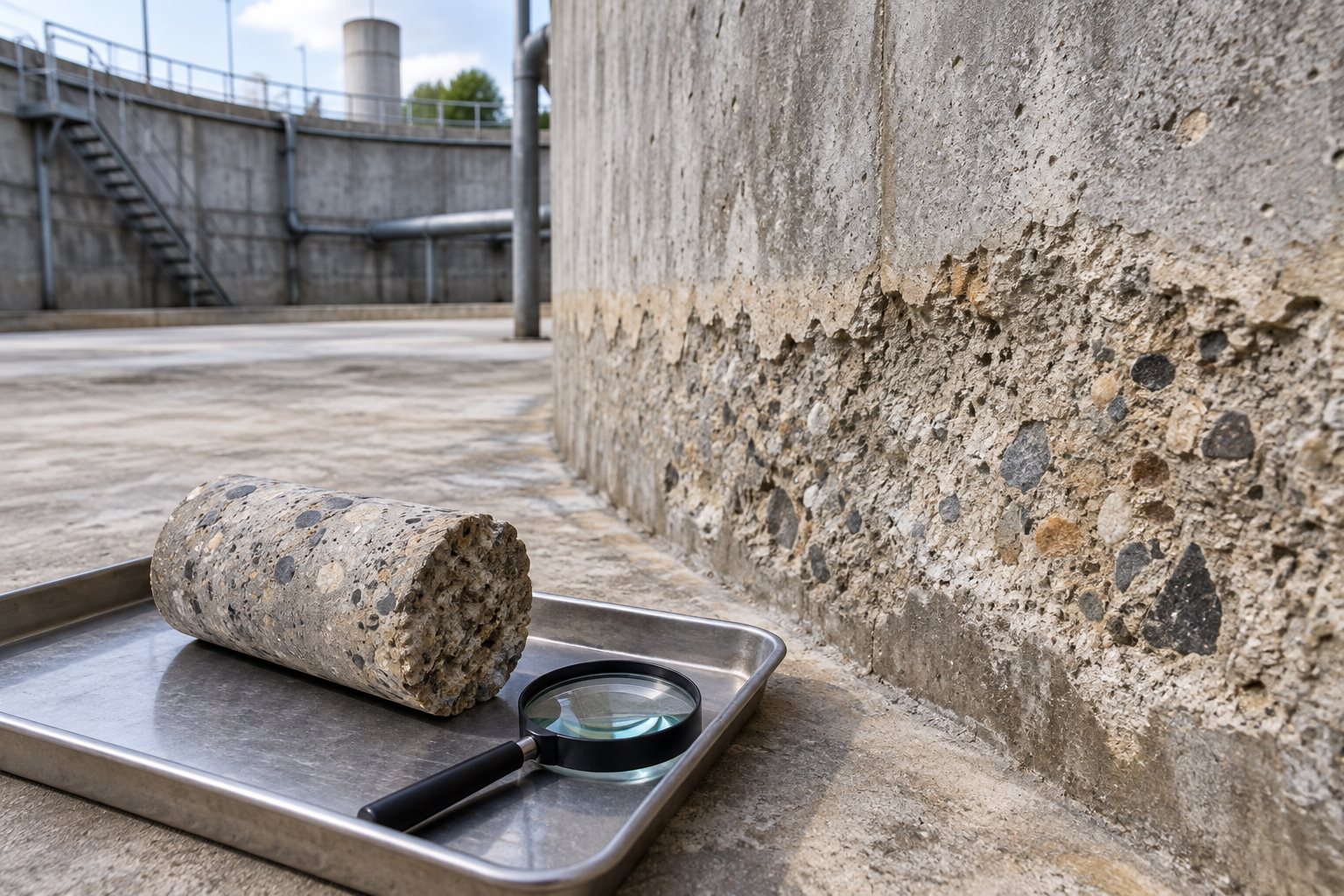
Surface recession, softened paste and exposed aggregate justify investigation, but appearance alone does not establish the chemical mechanism or remaining capacity. Abrasion, poor original concrete and other deterioration can coexist with acid exposure. Compare current geometry with drawings or reliable reference areas, and record the uncertainty where the original surface cannot be reconstructed confidently.
For each survey zone, the owner should request a record of surface condition, estimated section loss, cracks, exposed reinforcement, previous repairs and leakage. Structural consequences depend on the member and load path. Loss from a load-bearing wall, a slab support region or an anchorage zone requires more than a cosmetic patch assessment.
Plan samples around a decision
Agree sampling locations with the engineer and laboratory before extraction. Include severely affected areas, transitions and comparison locations when those samples can change the repair boundary. Preserve depth and orientation information, and allocate specimens so one test does not consume material needed for another. The site’s concrete core testing guide explains broader investigation planning and extraction precautions.
ASTM C856/C856M-25 provides the practice for petrographic examination of hardened concrete. Ask the petrographer to relate observed material alteration to depth and exposure history, and to identify where further analysis would be needed. A petrographic report supports diagnosis; it does not replace the engineer’s evaluation of the remaining structural section.
The investigation deliverable should show which findings support each proposed repair zone. If the evidence is sparse, state that limitation and specify how the design will be checked when the concrete is exposed. Avoid presenting an interpolated damage-depth map as though every point had been sampled.
Separate structural restoration from chemical protection
A chemical-resistant surface cannot turn weakened retained concrete into a reliable structural substrate. The repair design must first establish the retained member’s adequacy, the required restoration and any temporary support. It must then define the barrier or exposure-control measures needed for durability.
Consider a containment wall whose damaged inner face will be reinstated. The repair mortar may restore the specified profile, while a separate lining provides chemical resistance. Both components need acceptance criteria. A successful lining inspection does not demonstrate restored load capacity, and a satisfactory repair-strength result does not establish the lining’s suitability for immersion.
Require drawings to resolve interfaces: repair edges, corners, penetrations, joints and terminations. Show how movement will be accommodated and how the system connects to adjacent retained work. Where removal could affect reinforcement anchorage or stability, require an engineered sequence and defined review points before extending the excavation.
Qualify the complete repair system
ACI PRC-515.2-24 addresses selection of concrete protection against aggressive substances. Its introduction considers concrete mixture choices, protective barriers and modification of exposure. It also emphasizes evaluating bonded protection and selecting systems with regard to the particular application. The public preview is guidance, not a project acceptance specification or a blanket endorsement of a coating family.
Use that framework to organize a supplier submission. Identify the repair material, primer, lining, joint products and preparation requirements as one proposed assembly. Request written compatibility information for the actual components and service envelope. If a component changes, ask which evidence must be revisited before approving the substitution.
Read chemical-resistance test reports carefully
ASTM C267-20(2026) evaluates chemical resistance of specified mortar, grout, surfacing and polymer-concrete materials. Its scope includes changes in specimen mass, appearance, test medium and compressive strength following exposure. ASTM explicitly cautions that these results are not the sole basis for material selection and that the strength values are not the appropriate basis for determining the material’s compressive strength.
For the proposed repair, ask what formulation was tested, which chemical and concentration were used, the exposure temperature and duration, and what project criterion the result is intended to satisfy. Identify differences between the test and service conditions. A favorable result for one chemical should not silently become approval for a mixed process stream.
Do not convert a laboratory exposure period into a promised number of service years. Ask instead for a reasoned assessment of the evidence, relevant service experience and the inspection plan that will manage remaining uncertainty. Where evidence does not cover a consequential exposure, resolve the gap before procurement.
Define preparation and removal acceptance
Specify how the contractor will demonstrate that the retained surface is suitable for the approved repair. The work plan should address weakened material, contamination, existing coatings, cleaning residues and the required substrate condition. A surface that looks clean may still need further investigation before it is accepted.
Avoid a generic instruction to “neutralize and coat” without an approved procedure and acceptance checks. Chemical treatment can introduce additional residues or handling issues. Require the designer, material supplier and site safety team to agree the process, waste handling and evidence of readiness. Do not use this article as an instruction for chemical cleaning or entry into a tank.
Before lining, confirm the repair has reached the specified cure and substrate condition for that system. Moisture requirements are product- and application-dependent; the guide to concrete moisture testing before coatings explains why the selected test and its limitations need to be stated. Define how test locations represent both repaired and retained concrete.
Use hold points that produce reviewable evidence
For each hold point, name the reviewer, required record and action when the result is unacceptable. The following structure can help an owner assess the inspection plan:
- Investigation release: exposure zones, damage-depth evidence, structural implications and unresolved uncertainties are accepted.
- Removal release: boundaries, sequence, temporary support and reinforcement precautions are approved before work starts.
- Substrate release: exposed conditions agree with the design, and preparation and contamination checks satisfy the specified requirements.
- System release: supplied components and chemical-resistance evidence match the approved submission.
- Application release: substrate condition, environmental limits, mixing controls and access permit the specified installation.
- Return-to-service release: inspection results, repaired defects and the required cure for chemical exposure are documented.
The lining inspection plan may include thickness, adhesion and continuity checks where appropriate to the selected system. Define methods and acceptance limits in advance; avoid importing a test setting from an unrelated substrate or product. Record failed locations and their reinspection so a summary marked “passed” remains traceable.
Plan for the next operating cycle
At handover, retain photographs, location drawings, batch records, preparation checks, application conditions and final inspection results. Identify who will inspect joints, terminations and high-exposure zones, and what changes require engineering review. Align inspection timing with actual operations and the consequence of deterioration.
Include an action for process changes. A new cleaning chemical or a higher operating temperature can move the structure outside the conditions used to qualify its repair. The owner should review that change before relying on the existing protection. For the wider options, see concrete surface protection after repair.
Frequently asked questions
Can acid-damaged concrete simply be patched?
A localized repair may be appropriate after confirming sound retained concrete, structural adequacy and a suitable durability strategy. Repeated exposure must be addressed in the repair design; replacing the visible loss alone may leave the cause active.
Does sulfate-resistant cement prove acid resistance?
No. Sulfate-resistance evidence should not be treated as qualification for a specified acid exposure. Ask for evidence relevant to the actual chemical, concentration, temperature and proposed repair system.
Is epoxy always the right protective lining?
No. A material-family name is not a service specification. Review the particular formulation, exposure limits, substrate requirements, movement details and supporting evidence with the designer and supplier.
How deep should damaged concrete be removed?
There is no universal depth. Use investigation results and observations during removal to establish acceptable retained concrete, while respecting structural stability and the engineered sequence.
Discuss the investigation before committing to repairs
Bring the exposure record, photographs, drawings and available test reports to a Structural Rehab consultation. These records help frame the questions that the project engineer and materials specialists need to resolve before a repair system is approved.
Need a professional structural assessment?
Book a consultation with Structural Rehab to evaluate repair priorities, corrosion risks, and rehabilitation options before damage escalates.
Book Consultation