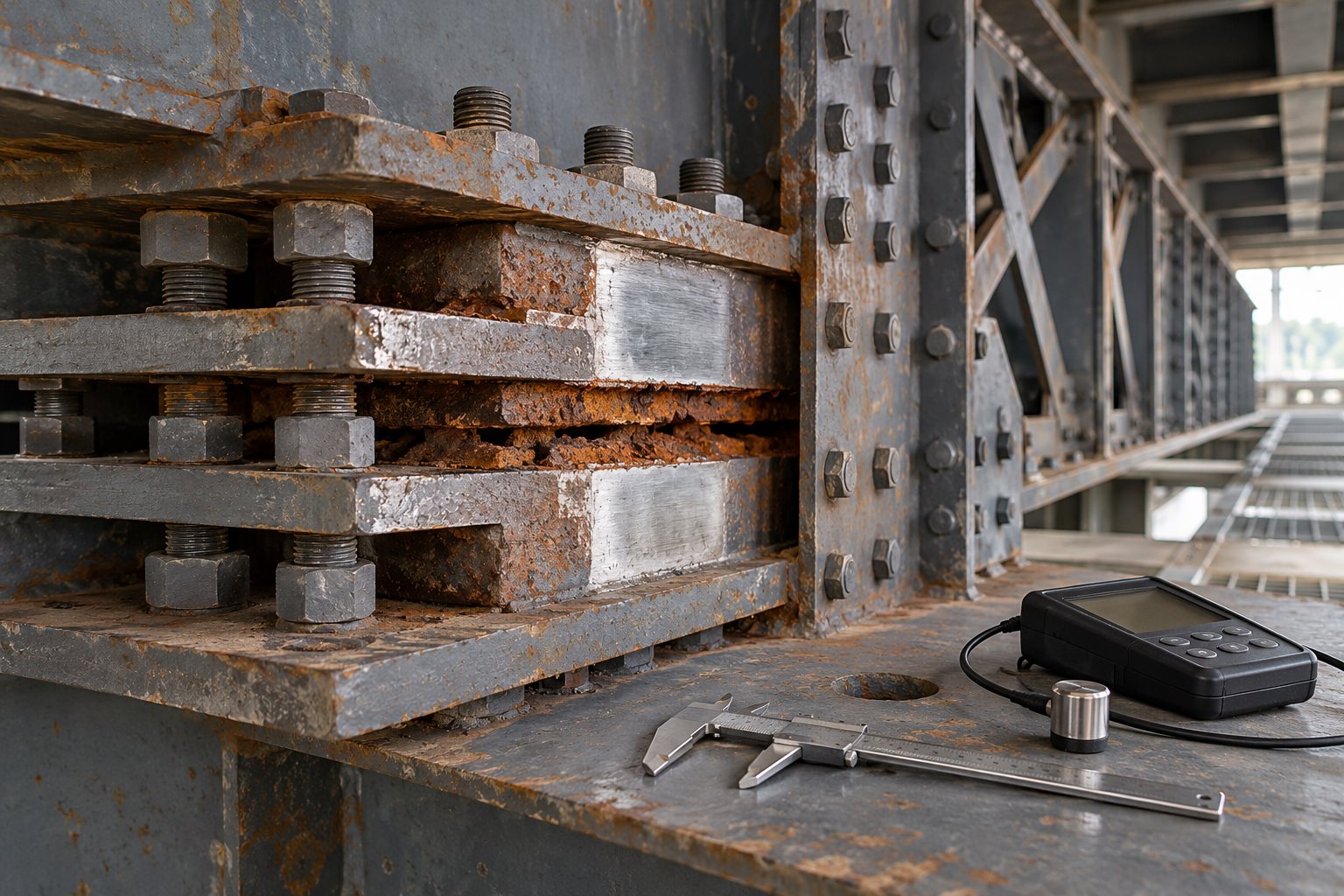
Pack rust is corrosion that grows between overlapping steel surfaces. It can force plates apart, open joints, hold moisture, distort connection geometry, and hide section loss where an ordinary visual survey cannot see it. On older bridges, industrial frames, and built-up members, it is tempting to treat the rust at a plate edge as a coating defect. That shortcut can miss a structural problem.
Structural steel pack rust repair starts with a condition investigation, not with a needle gun, sealant, or replacement bolts. The repair team needs to establish which plates are connected, whether they transfer load through bearing, friction, or welds, how much thickness remains, and why water is staying in the interface. This guide gives owners, engineers, contractors, and inspectors a practical QA/QC framework for that decision. It does not replace project-specific analysis, temporary-works design, or repair drawings prepared by the responsible engineer.
Why pack rust is different from exposed surface corrosion
Corrosion product occupies more volume than the steel consumed to create it. Between lapped plates, cover plates, built-up sections, angles, diaphragms, and connection components, that expansion can wedge the surfaces apart. The result may be a widened interface, broken coating edges, loosened fasteners, trapped debris, a changed bearing path, or a crevice that remains wet after the visible surface has dried.
A paint failure on a single accessible face may be addressed through a compatible surface-preparation and coating repair. Pack rust needs a broader question: is the steel below and between the plates still adequate for its intended force path? The answer cannot come from rust color, a single spot reading, or a hammer blow. Our guide to structural steel section loss repair explains why remaining thickness, location, buckling behavior, and demand all matter together.
Water is usually the continuing cause. Leaking deck joints, failed drainage, standing water at base details, unsealed laps, debris, and inaccessible coating interfaces can keep the crevice active. Repairing the steel while preserving the water trap is a predictable way to create a repeat repair.
Start with safety, load path, and a condition map
Stabilize before opening a distressed interface
Do not assume a built-up member can be dismantled one plate at a time. Removing a cover plate, releasing bolts, cutting an attachment, or heat straightening a distorted piece can redistribute load and reduce restraint. The engineer should first identify the member function, current loads, connection forces, fatigue-sensitive details, nearby utilities, access limits, and the need for traffic control, shoring, jacking, or load restriction. Field-repair guidance from AASHTO/NSBA emphasizes that repair work follows any necessary stabilization or restrictions; it is not a substitute for that planning.
Record the condition before cleaning removes evidence
Give each affected location an identifier and photograph it with scale and orientation. Map plate edges, fasteners, welds, drain paths, coating breaks, distortion, gaps, staining, and visible rust jacking. Record the member dimensions and accessible plate thicknesses. Where appropriate, use calibrated ultrasonic thickness readings, direct measurements at exposed edges, and engineered exploratory openings. A thickness grid should be tied to a sketch or coordinate system so a later reviewer can distinguish a general condition from a local pit.
Do not equate a clean reading on an outer plate with an intact inner plate. Document which surface each reading represents and what access was unavailable. The FHWA steel-superstructure corrosion protocol calls for locating and documenting corroded areas and the extent and depth of pitting; that discipline is useful for repair decisions as well as inspection records.
Decide whether the interface must be opened
The repair detail should be driven by evidence, not by a default preference for sealing, welding, or bolt replacement. An engineer may decide that local cleaning and protection are adequate where measurements, geometry, and load analysis demonstrate that the interface remains sound. More extensive opening, plate replacement, a designed splice, or member replacement may be necessary when there is meaningful section loss, plate separation, inaccessible corrosion that affects a force path, cracked components, distorted geometry, or uncertainty that cannot be resolved by nondestructive evaluation.
Exploration needs explicit limits. The repair package should state who can authorize an opening, the maximum initial opening, how load is controlled, what measurements are taken after exposure, and which findings trigger an engineering hold point. This keeps a field discovery from becoming an unreviewed connection alteration. If corroded fasteners or plates are part of the problem, coordinate the investigation with the connection workflow in bolted steel connection repair.
Develop a repair that restores capacity and stops the cause
Separate structural repair from corrosion protection
Cleaning, coating, and sealing can be necessary durability work, but they do not by themselves reinstate lost steel area or connection capacity. Where loss is material, the engineer may specify replacement material, a bolted or welded reinforcement, a splice, a redesigned detail, or replacement of the affected component. The chosen solution must account for the existing steel, load sequence, attachment method, inspection access, fatigue behavior, fit-up tolerance, and coating restoration.
Field welding deserves particular caution. Existing steel chemistry, thickness, restraint, service loading, access, procedure qualification, preheat, sequencing, inspection, and coating repair all affect the outcome. Use an engineered repair procedure rather than converting an uncertain field condition into an ad hoc weld. See welded steel connection repair for the broader repair-control sequence.
Remove the water trap
Durability measures should address the route by which water, salts, and debris reached the lap. Depending on the structure, this may mean repairing a deck joint, restoring drainage, cleaning debris pockets, correcting a detail that ponds water, sealing a lap only where the engineered coating system permits it, or adding drainage and ventilation to an enclosed space. A sealant is not automatically appropriate: a poorly detailed seal can trap moisture behind an apparently neat edge.
Review the complete protection system after the structural work. Surface cleanliness, profile, soluble-salt controls where specified, stripe coating, dry-film thickness, cure, and touch-up compatibility should be documented. The site’s steel surface cleanliness guide and steel coating QA/QC guide can help teams turn that requirement into hold points rather than a final visual check.
QA/QC hold points for pack-rust repairs
A concise inspection-and-test plan should assign responsibility and acceptance evidence for each phase:
- Pre-repair release: approved drawings, condition map, load-control plan, access plan, material traceability, and defined exploration limits.
- After exposure: measured remaining thickness, photographs, revised geometry, corrosion extent, and an engineer’s disposition if field conditions differ from assumptions.
- Before attachment or replacement: verified fit-up, prepared interfaces, bolt or weld procedure, inspection access, and a confirmed sequence that does not overload the remaining steel.
- After structural work: documented fastener installation or weld examination, dimensional checks, repair material records, and acceptance of any changed detail.
- Before close-out: drainage correction, surface-preparation record, coating inspection, marked-up drawings, final photographs, and a future inspection interval.
A useful record states what was observed, where it was observed, how it was measured, who accepted the next step, and what remains inaccessible. A closed interface must not be treated as evidence that all corrosion was removed. Pack rust is not accepted merely because the plate edges look clean after surface preparation.
Limitations and owner decisions
Pack-rust conditions can be difficult to quantify without opening the interface, and opening an interface may itself create construction risk. The appropriate exploration method, repair extent, and acceptance criteria depend on the member’s role, demand, redundancy, condition, age, steel properties, and exposure. Bridge owners should also consider traffic staging and inspection access; building and industrial owners should consider operational loads, fire protection, utilities, and shutdown constraints. When findings exceed the design assumptions, pause at the hold point and obtain the engineer’s disposition instead of improvising.
For a project-specific review of corrosion evidence, repair options, QA/QC records, and scope priorities, book a consultation with Structural Rehab. This educational guidance supports better questions and documentation; it is not a repair design.
Frequently asked questions
Can pack rust be sealed without separating the plates?
Sometimes, but only after the responsible engineer determines that concealed loss, geometry change, and the load path have been adequately evaluated. Sealing is a durability measure, not proof of structural adequacy.
Does rust jacking always mean the member needs replacement?
No. The response may range from controlled cleaning and protection to a designed local repair or replacement. The decision depends on measured loss, location, force transfer, stability, and the cause of moisture exposure.
What should be retained in the close-out file?
Keep the condition map, thickness data, photographs, approved repair and deviation records, material and fastener or weld records, coating QA/QC evidence, drainage corrections, and future inspection recommendations.
Sources
- AASHTO/NSBA G14.2-2023, Guidelines for Field Repairs and Retrofits of Steel Bridges
- FHWA LTBP protocol: steel superstructure corrosion
- FHWA Technical Advisory 5140.22: uncoated weathering steel in structures
- FHWA-HRT-20-065: coating performance on existing steel bridge superstructures
Need a professional structural assessment?
Book a consultation with Structural Rehab to evaluate repair priorities, corrosion risks, and rehabilitation options before damage escalates.
Book Consultation