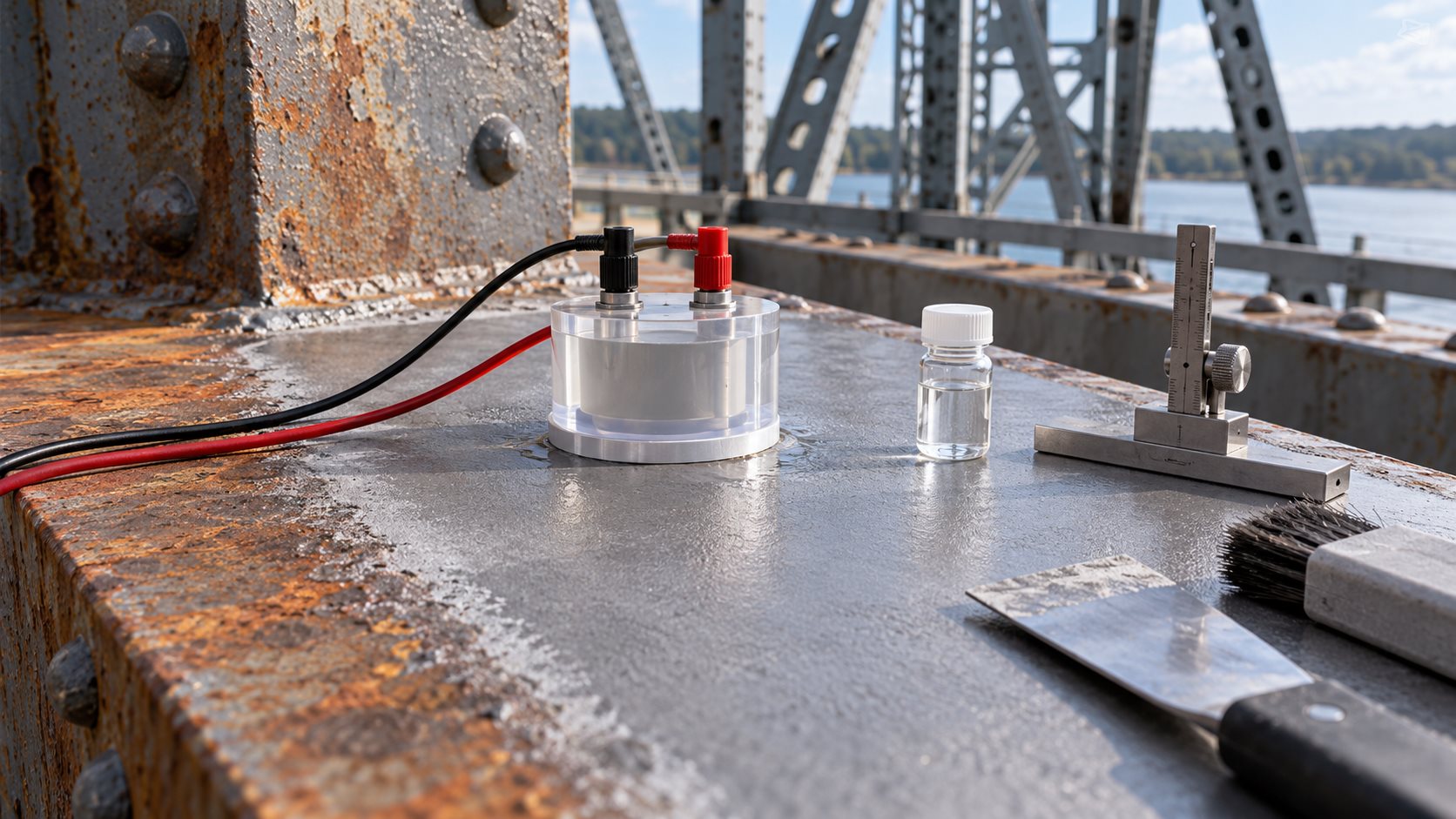
Soluble-salt testing is a small but consequential hold point in structural-steel repair coating work. Chloride, sulfate, and nitrate deposits can remain on steel after weather exposure, washing, or abrasive cleaning, including in pits and crevices. A surface may look clean and still carry contamination that undermines a coating system. The practical aim is not to chase a universal number: it is to verify the project requirement, use a repeatable method, and give the coating manufacturer and engineer a defensible record before primer is applied.
Why soluble salts matter in steel repair coating QA/QC
Steel repair often concentrates work where moisture, leakage, deicing chemicals, old coating edges, and corrosion products have already accumulated. Those are exactly the conditions in which water-soluble salts can persist. The FHWA methodology study identifies chloride, sulfate, and nitrate as common adverse anions on steel bridge surfaces and notes that washing or abrasive blasting may not remove salts held in corrosion pits. That makes a visual cleanliness check necessary, but not sufficient, when the specification calls for salt control.
A coating system is a designed assembly, not a generic paint layer. Its acceptable substrate condition, surface-preparation grade, application window, and test method should come from the contract documents and the selected coating manufacturer’s current data. FHWA testing of coating systems on chloride-contaminated bridge steel reinforces the point that contamination and coating performance are connected, while the result for any one product or exposure must not be generalized to another system.
Start with an engineered repair and a written acceptance plan
Before testing, the owner, engineer, coating supplier, contractor, and inspector should resolve five items in writing:
- the repair limits, coating system, required surface preparation, and any special areas such as crevices, faying surfaces, and weld transitions;
- the applicable salt limit, units, extraction method, and whether it applies to chloride only or to multiple ions;
- the location logic and minimum number of readings, including areas with visible corrosion, splash, drainage, deck-joint leakage, or old coating breakdown;
- the response when a result exceeds the requirement, including re-cleaning, washing, re-testing, and who can release the area; and
- the records that tie each reading to a specific repair area, date, instrument, and coating-release decision.
This planning step keeps a field kit from becoming a pass/fail substitute for engineering judgment. It also distinguishes salt testing from other essential controls such as stripe-coat QA/QC, dry-film-thickness inspection, and atmospheric-condition checks.
A field workflow for soluble-salt testing
1. Define representative test locations
Mark the repair zone on drawings or a location sketch before the final cleaning pass. Include both typical areas and credible worst-case locations: lower flanges beneath leaking joints, steel adjacent to drainage paths, corrosion pits, overlap edges, and interfaces with retained coating. Avoid silently moving a failed location to a cleaner-looking spot. If access limitations prevent representative testing, record that limitation and obtain direction before coating.
2. Confirm the test method and instrument condition
Different extraction methods recover salts differently. FHWA compared paint test cell, sleeve, and boiling methods and found that surface condition and extraction method affect recovery. Use the contract-specified method or the method accepted by the coating system documentation; follow its area, extraction fluid, dwell time, temperature, calibration, and conversion instructions exactly. Record kit lot information when relevant, instrument identification, calibration or functional-check status, operator, and any departure from the written procedure.
3. Test after the required preparation stage
The timing must match the specification. Testing before final cleaning may be useful for diagnosis, but it does not demonstrate final readiness. Test after the preparation stage named in the plan and before contamination can recur. The AASHTO/NSBA field repair guidance similarly emphasizes cleaning contact surfaces to the surface-preparation level required for the coating manufacturer’s performance requirements and priming promptly to avoid renewed contamination.
4. Make each result traceable
Record the exact location, substrate condition, test area, measured ion or equivalent value, units, method, operator, time, temperature where required, and acceptance criterion. Photograph the location only when permitted and useful; the log must still stand on its own if the photograph is unavailable. A reading without units or a location cannot support a release decision.
A salt result earns its value only when the repair location, extraction method, units, acceptance criterion, and release decision are recorded together.
5. Resolve failures without improvisation
If a reading exceeds the project criterion, stop the coating release for that affected area and follow the documented corrective path. That may involve washing, localized re-cleaning, abrasive selection review, drying, or an expanded sampling plan directed by the responsible parties. Do not assume another blast pass removes contamination: FHWA notes that abrasives themselves can introduce detrimental salts. Re-test the corrected location and any additional locations justified by the failure pattern, then document the disposition.
How to interpret numbers responsibly
Published studies contain values that can help frame questions, but they are not automatic project limits. FHWA’s coating-performance report discusses multiple reported chloride and sulfate thresholds and shows why coating system, environment, and test method matter. Its research panels were evaluated at selected contamination levels; that does not authorize a field team to replace a project specification with a single research value. Use the approved limit for the specified coating system, then consult the engineer and coating manufacturer when the documents are silent or conflict.
Unit control deserves special attention. A conversion error can change the apparent result dramatically. Keep the instrument’s original output, the test area, any conversion factor, and the final reported unit in the daily record. If two methods are compared, say so explicitly rather than placing their results in one unlabeled table.
Coordinate salt testing with the rest of repair quality control
Salt testing is one link in a release sequence. A sensible work package connects it to repair design approval, substrate examination, surface profile and cleanliness, ambient conditions, coating mixing and pot life, stripe coats, wet- and dry-film thickness, cure, and final visual inspection. The sequence should also coordinate with structural interventions. For example, do not let coating preparation obscure a bolt-hole condition that still needs an engineer’s disposition; see this guide to steel repair bolt-hole damage QA/QC.
Owners can improve outcomes by requiring a concise hold-point form rather than a stack of disconnected test sheets. The form should identify the repair area, planned coating system, surface-preparation release, salt-test results, corrective actions, atmospheric readings, and authorization to coat. This is particularly useful on bridge repairs where staging, traffic windows, and weather can pressure crews to proceed before the record is complete.
Limitations and safety boundaries
Soluble-salt testing does not establish member capacity, remaining section, fatigue suitability, weld quality, coating adhesion, or the adequacy of a repair design. It cannot see every contaminant in every pit, and a compliant result at sampled locations does not prove the entire structure is clean. Sampling density and corrective action need engineering and specification judgment. Existing coating removal, lead-containing paint, containment, ventilation, fall protection, traffic control, and waste handling remain separate safety and regulatory obligations.
When corrosion or coating breakdown may involve section loss, pack rust, or a load-path concern, pause and obtain a structural assessment rather than treating coating work as a structural repair. Our structural steel pack-rust repair guide explains why configuration and section condition need their own assessment.
FAQ
Can a clean-looking steel surface skip salt testing?
No. Appearance may guide where to inspect, but it cannot measure soluble contamination. Test whenever the project requirements, exposure history, or coating supplier’s instructions call for it.
What is the acceptable salt level for every steel repair?
There is no single universal value. Use the project specification and the accepted coating-system documentation, with the required method and units. Escalate unclear requirements before primer application.
Does blasting always remove salts?
No. Salts can remain in pits and crevices, and contaminated abrasive can create another problem. Verify the prepared substrate using the approved procedure.
Who should authorize coating after a failed result?
The authority should be identified in the project’s QA/QC plan. Typically it is the responsible party designated by the owner or engineer, with input from the coating manufacturer when product requirements are involved.
Make the release decision auditable
For structural-steel repair, a good salt-testing program is modest in scope but strict in documentation: test the right locations, use the specified method, record units and limits, correct failures deliberately, and release coating only through the agreed hold point. If you need help organizing repair scope, inspection records, and decision points for an existing structure, Structural Rehab’s rehabilitation services can help you frame the conversation with the responsible design and coating professionals.
Sources
- FHWA-HRT-14-026: Methodology for Analysis of Soluble Salts From Steel Substrates
- FHWA-HRT-20-065: Coating Performance on Existing Steel Bridge Superstructures
- AASHTO/NSBA: Guidelines for Field Repairs and Retrofits of Steel Bridges
- AISC: Painting and Surface Preparation
Need a professional structural assessment?
Book a consultation with Structural Rehab to evaluate repair priorities, corrosion risks, and rehabilitation options before damage escalates.
Book Consultation