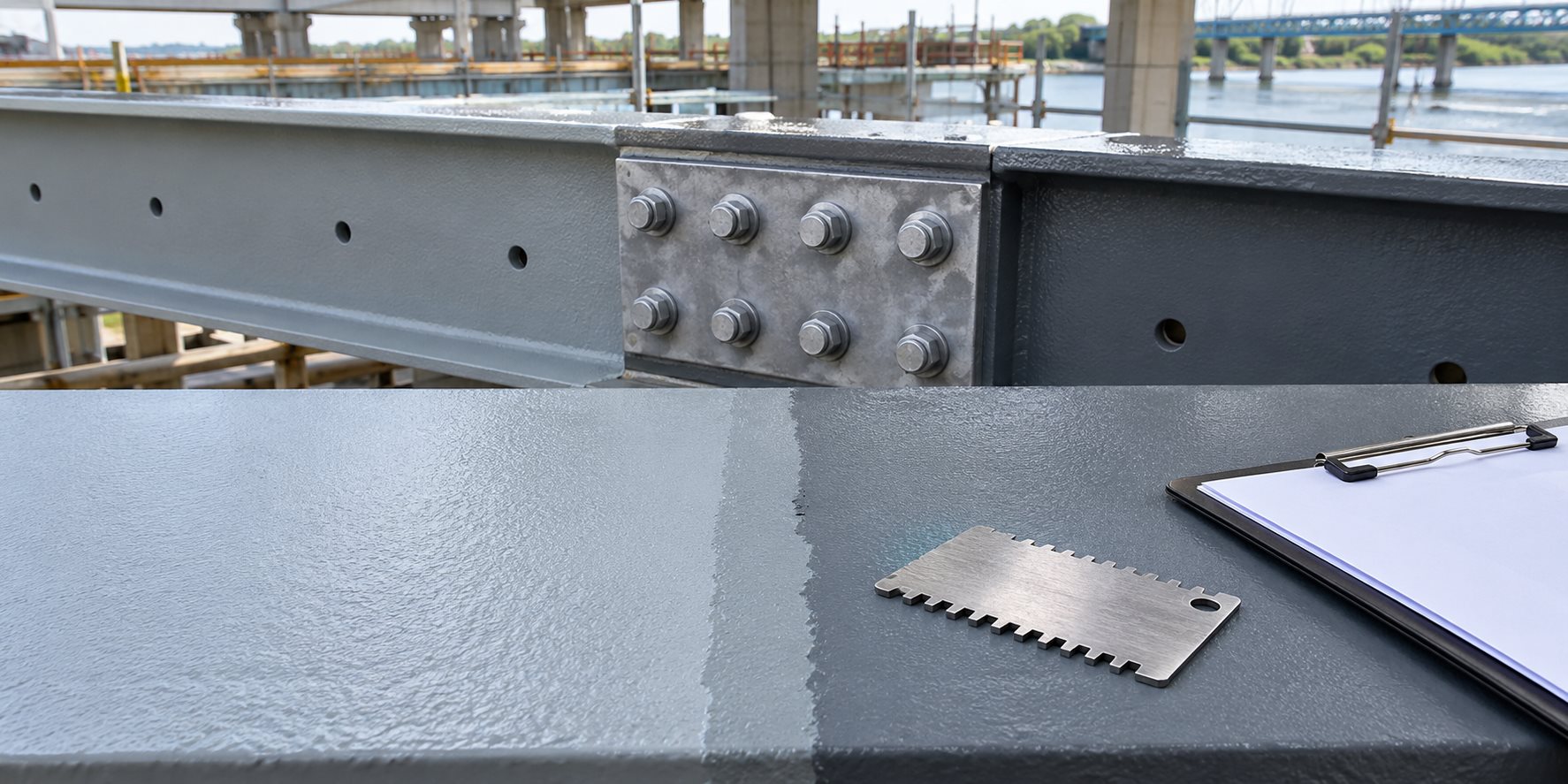
Steel repair coating work often crosses a shop-to-field boundary: a component may arrive primed, a splice may be assembled in the field, and the final coats may be applied after bolting, welding, or touch-up. That handoff is a common quality risk because each coating layer has a manufacturer-specific minimum and maximum recoat interval. A surface can look dry and still be unsuitable for the next coat, or it can sit too long and need additional preparation before overcoating.
The practical goal is not to invent a universal waiting period. It is to identify the approved coating system, capture the actual application and exposure conditions, and release every transition through the project’s written requirements. This guide outlines a QA/QC workflow for structural-steel repair coating recoat windows without substituting field records for the engineer, specification, or coating manufacturer.
What a recoat window means in a steel repair
A recoat window is the period in which the next specified coat may be applied over the preceding coat under stated conditions. Product data commonly ties that interval to substrate temperature, ambient conditions, film thickness, ventilation, cure mechanism, and whether the surface has been exposed or contaminated. “Dry to touch,” “tack free,” “dry to handle,” and “dry to recoat” are not interchangeable. The FHWA bridge-paint inspection manual distinguishes dry-to-recoat from other drying descriptions; that distinction matters when a repair is trying to reconnect a shop-applied primer with a field-applied intermediate or finish coat.
On structural repairs, the issue is often localized rather than uniform. A girder repair plate may have a shop primer on broad faces, field-prepared edges at a splice, weld-adjacent touch-up, and retained old coating nearby. Each interface needs the coating-system requirements and the repair documents to define what may be coated, how it must be prepared, and who authorizes the release.
Begin with a coating-transition plan
Before work begins, the owner, engineer, coating manufacturer, contractor, and inspector should resolve the following in the approved work package:
- the exact primer, intermediate, and topcoat products, compatible thinner if any, and approved data sheets;
- the required surface preparation at new steel, damaged shop coating, field welds, bolt areas, and retained coating edges;
- minimum and maximum recoat limits for the expected temperature range, including what happens after the maximum is exceeded;
- the observations that must be recorded: batch, mix ratio, induction time where applicable, application time, steel temperature, ambient temperature, relative humidity, dew point, wet-film checks, and exposure conditions; and
- the designated hold point and the authority that can accept a transition or direct corrective work.
This plan must follow the project specification and current manufacturer instructions. AISC notes that painting requirements and responsibility for field touch-up should be assigned in the contract documents, rather than assumed in the field. Its painting and surface-preparation guidance also highlights that welding residues incompatible with the coating system require attention before painting.
A practical QA/QC workflow
1. Map each coating interface before application
Mark shop-coated areas, bare repair steel, field-weld zones, bolt details, damaged areas, and termination lines on the repair sketch. Note where the next coat will overlap an existing coat and where the boundary will remain visible after completion. This prevents a crew from treating the whole member as one uniform substrate. It also creates a traceable route from a repair drawing to daily inspection records.
For bridge work, separate coating questions from structural disposition. Coating removal can reveal greater section loss than expected; the AASHTO/NSBA field-repair guide advises that observed section loss after removal may warrant supplemental evaluation. Do not hide a capacity concern under primer or assume coating acceptance approves the structural repair.
2. Capture the actual start time and conditions
Start the recoat clock from the event defined in the data sheet—normally completion of the previous coat’s application—not from a shift-change estimate. Record the product, batch, mixed time, application start and finish, steel temperature, air temperature, relative humidity, dew point, and the required interval for those conditions. If conditions vary materially across a large repair, use locations or time blocks that reflect the actual work rather than one reading from a convenient location.
A numerical log is useful only when it preserves units and context. The relevant temperature may be the steel temperature, not the forecast high. Similarly, a film applied thicker than planned can change cure behavior. If the records do not support the product’s stated recoat conditions, pause the release and obtain direction.
3. Protect the surface during the interval
The interval between coats is not a storage exception. Keep the surface free of rainwater, condensation, overspray, salts, dust, abrasions, mud, and handling damage. Plan access and lifting so slings, chains, blocking, and erection equipment do not damage a shop-applied coating without a recorded repair. The coating state should be inspected again before the next layer even when the calendar interval appears acceptable.
Where exposure creates a contamination concern, coordinate this inspection with the project’s surface-cleanliness controls. Soluble-salt testing for steel repair coatings is a separate, specification-driven control; it is not replaced by a recoat-time calculation.
4. Inspect before releasing the next coat
Before overcoating, inspect the prior coat and the transition zone for visible defects, mechanical damage, moisture, contamination, incomplete coverage, and coating edges that need preparation. Confirm that the minimum recoat time is met and that the maximum has not been exceeded. Recheck environmental limits at the time of the next application. Where the system requires a surface treatment after an elapsed maximum interval, use the exact approved preparation and document it; do not improvise a generic sanding or solvent wipe.
A recoat window is a controlled release condition: the recorded prior coat, real exposure interval, present surface condition, and next-coat requirements must agree before the crew proceeds.
5. Treat expired windows as a documented nonconformance
An expired maximum recoat interval is not automatically a failed repair, but it is a reason to stop and follow the approved corrective path. Depending on the selected system, that path may require washing, abrading, sweep blasting, checking for contamination, applying a tie coat, performing a test patch, or consulting the manufacturer and engineer. The project documents should identify who can approve the disposition. Record the observed condition, corrective preparation, inspection result, and release decision for the specific repair area.
Do not extend one corrective decision to every area of a bridge or building without evidence that the substrate, exposure, products, and elapsed intervals are equivalent. Older coatings can introduce compatibility and adhesion questions. FHWA’s overcoating technical note recommends assessing the existing system and using representative patch testing where compatibility is uncertain.
Coordinate recoat control with repair hold points
The recoat log belongs in a connected inspection sequence. A good sequence identifies repair limits; obtains engineer disposition for steel damage; completes surface preparation; verifies cleanliness and atmospheric conditions; records mixing and application; checks each recoat release; measures film thickness at the required stage; and documents cure and final visual acceptance. A stripe coat is a related but separate control for edges, welds, bolts, and transitions; use the project’s detail-specific plan and see our guide to structural-steel repair stripe-coat QA/QC.
For a bolted repair, do not allow coating timing to bypass connection inspection. If a hole, fastener, or faying-surface issue remains unresolved, retain the hold point and seek the responsible engineer’s direction. The process described in steel repair bolt-hole damage assessment and QA/QC is an example of why a coating record cannot replace an engineered connection decision.
Common recordkeeping failures
- Using a weather forecast instead of measured conditions. Record steel and ambient conditions at the work location and time required by the product data.
- Logging only a date. A date does not establish the elapsed interval, product batch, film condition, or whether the maximum window was met.
- Calling a coat “dry” without defining the criterion. The relevant requirement is the system’s stated recoat condition.
- Ignoring handling damage after a shop application. Inspect and repair it through the approved touch-up procedure before the next coat.
- Letting a schedule pressure replace a release. Weather windows and traffic closures make advance planning important, but they do not waive compatibility or surface-preparation requirements.
Limitations and safety boundaries
This article does not provide a universal recoat time, a coating-system design, or permission to overcoat a material outside its documentation. It does not determine section capacity, fatigue suitability, weld acceptance, lead-paint controls, containment, ventilation, fall protection, traffic control, or waste handling. Follow the project’s safety plan, applicable regulations, contract requirements, and manufacturer instructions. Escalate conflicting requirements before coating rather than selecting the least restrictive value.
FAQ
Can the next coat go on when the prior coat feels dry?
Not by that observation alone. Confirm the stated minimum recoat condition for the exact product and the measured conditions, then inspect the surface and release it through the project’s QA/QC process.
What if the maximum recoat interval is exceeded?
Stop and use the coating system’s documented corrective procedure. The appropriate response depends on the product, exposure, and project requirements; document the disposition for the affected area.
Can field touch-up use any compatible-looking paint?
No. Compatibility, preparation, thickness, and cure requirements should come from the approved system and contract documents. A visually similar material is not evidence of compatibility.
Who releases a repair area for the next coat?
The QA/QC plan should identify the authority. It is commonly a designated inspector or owner representative, with engineer and manufacturer input when the records or system requirements require it.
Make coating transitions auditable
Reliable steel repair coating work makes each transition visible in the record: identify the system, measure the actual conditions, protect the surface, inspect it before the next coat, and document any expired-window disposition. If you need help organizing repair scope, inspection records, and decision points for an existing structure, Structural Rehab’s rehabilitation services can help frame the conversation with responsible design and coating professionals.
Sources
- FHWA: Field Manual for Bridge Painting Inspection
- AISC: Painting and Surface Preparation
- AASHTO/NSBA: Guidelines for Field Repairs and Retrofits of Steel Bridges
- FHWA: Overcoating (Maintenance Painting)
Need a professional structural assessment?
Book a consultation with Structural Rehab to evaluate repair priorities, corrosion risks, and rehabilitation options before damage escalates.
Book Consultation