Bridge bearings are small compared with girders, decks, and substructures, but they control how load, movement, rotation, temperature effects, braking forces, and restraint pass through the bridge. When a bearing is frozen, tilted, crushed, corroded, displaced, or buried in debris, the problem rarely stays local. It can damage girder ends, crack seats, overload anchorages, jam expansion joints, and change the intended load path. For that reason, bearing rehabilitation is a load-path operation, not a hardware swap.
This article gives owners and engineers a practical framework for bridge bearing assessment, jacking, replacement, bearing-seat repair, protection, and documentation. It is written for rehabilitation planning, not as a universal jacking procedure. Every live bridge needs project-specific engineering, temporary works design, traffic control, and inspection.
What a Bridge Bearing Must Control
A bearing transfers vertical reaction to the substructure while allowing or restraining movement and rotation according to the bridge design. Elastomeric pads, pot bearings, disc bearings, rocker bearings, roller bearings, sliding bearings, and guided assemblies behave differently. A rehabilitation plan must identify the bearing type, the movement direction, the fixity arrangement, the original design intent, and the actual condition before deciding whether to clean, reset, modify, or replace.
FHWA bridge design guidance treats bearings as part of the structural design process, and bridge preservation guidance emphasizes systematic preventive maintenance rather than late emergency replacement. In practice, that means bearing work should be linked to joints, drainage, girder ends, seats, anchorages, and access. Structural Rehab’s guide on bridge expansion joint leakage repair explains why water control is often the first durability decision around bearings.
Assessment Before Jacking
Start by recording the bridge geometry and the bearing condition in a way that can be compared after work. The assessment should include bearing type and dimensions, seat condition, masonry plate condition, anchor bolt condition, keeper or guide condition, corrosion, elastomer bulging or cracking, sliding surface condition, debris, water staining, girder end condition, joint leakage, and measured offsets. If the bearing is supposed to move, compare the observed position with temperature and expected movement range.
Movement problems can be caused by more than the bearing itself. A joint may be locked. Debris may block movement. A pier may have shifted. A bearing seat may have deteriorated. A girder end may have section loss. Repairing only the bearing can leave the bridge with the same restraint problem. The companion Structural Rehab articles on steel girder end repair and repair-versus-replace decisions cover adjacent issues that often appear during bearing projects.
Decide Whether to Clean, Reset, Repair, or Replace
Not every bearing distress requires replacement. Cleaning and drainage correction may be enough where debris and leakage are the dominant problems and the bearing still functions. Resetting may be needed where the bearing has walked, rotated, or lost alignment. Seat repair may be needed where the bearing is sound but the support concrete or grout has failed. Replacement is appropriate when deterioration, deformation, missing movement capacity, obsolete detailing, or access limitations make continued use unreliable.
WSDOT’s bearing replacement provisions highlight an important design principle: bridges should be detailed so hydraulic jacks can be installed and operated for bearing replacement where required. That principle matters during rehabilitation too. If the original bridge was not detailed for easy jacking, the temporary works may become the controlling design problem.
The Jacking Plan Is the Core Safety Document
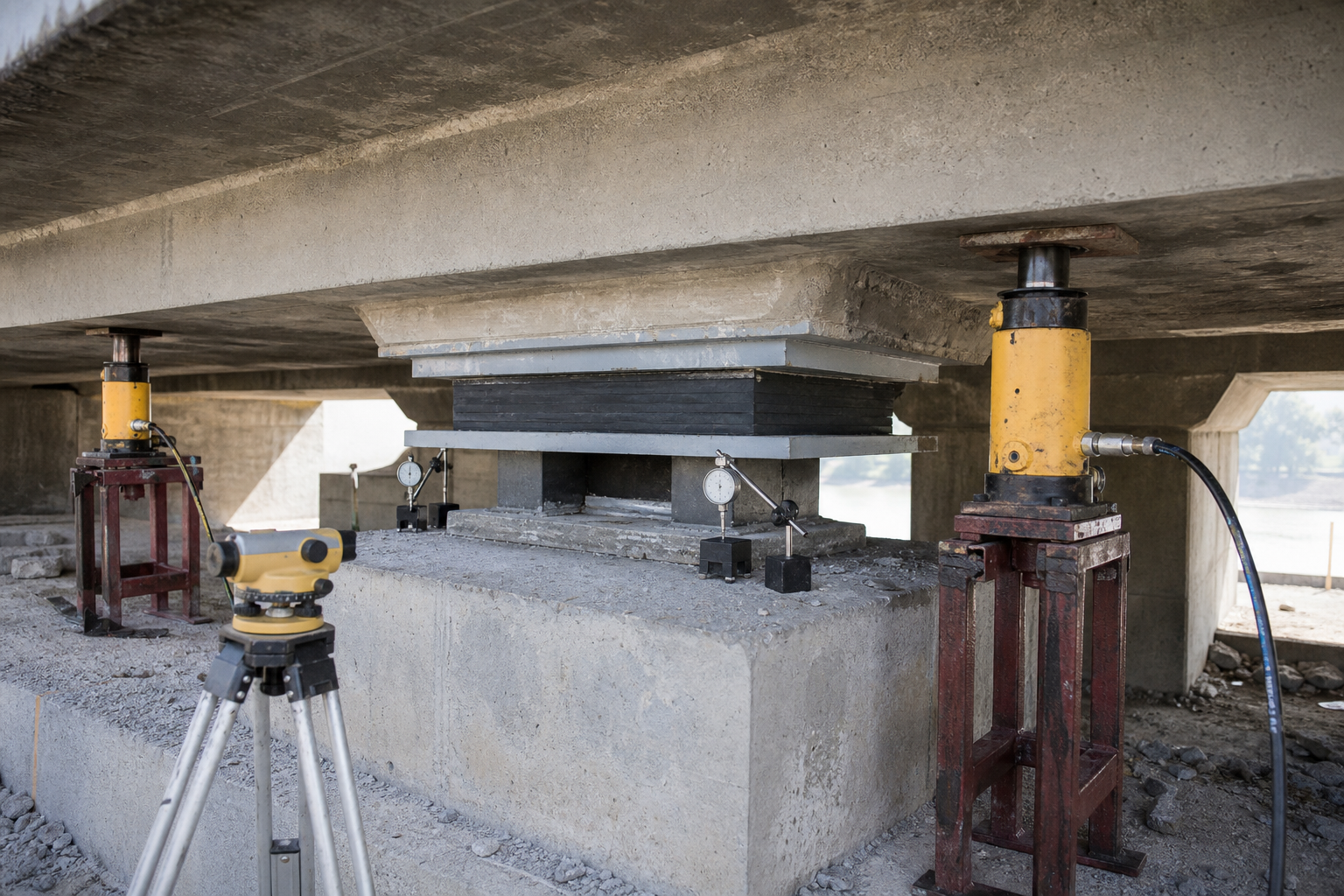
A bridge jacking plan should define the loads, jack locations, support stools, grillages, load distribution, allowable lift, sequencing, monitoring points, traffic restrictions, temperature assumptions, lock-off method, contingency actions, and communication protocol. The plan must also account for the existing condition. Corroded girder ends, cracked diaphragms, weak seats, or unknown reinforcement can make the theoretical jacking point unsafe.
Jacking should be monitored with more than pump pressure. Dial gauges, survey readings, tell-tales, and visual inspection help confirm that the structure is lifting as intended and that adjacent components are not cracking or binding. Austroads’ flat-jack bearing replacement resource notes that tight control of jacking displacement and final bearing levels is important to avoid damage and restore bearing reactions. The same principle applies even when conventional hydraulic jacks are used.
Traffic loading can change the risk profile. Some projects require lane closures, full closures, night work, load posting, or staged jacking. Temporary supports should be designed and inspected as structural elements, not as contractor means left outside the engineering review.
Repair the Bearing Seat and Load Interface
Bearing replacement often exposes damaged concrete, cracked grout, corroded sole plates, uneven seats, or old shim stacks. These conditions must be corrected before the new bearing is loaded. The seat should provide a sound, level, durable load interface. Repairs may include concrete removal, reinforcement cleaning, patching, grout pad replacement, plate replacement, anchor repair, or drainage improvements.
Do not ignore leakage. If a failed deck joint continues to discharge water and chlorides onto the bearing shelf, a new bearing can begin deteriorating immediately. Sealants, joint replacement, drainage redirection, drip details, coating systems, and access for future cleaning may be part of the bearing rehabilitation scope.
Specify the Replacement Bearing Carefully
The replacement bearing should match the bridge’s required load, movement, rotation, restraint, durability, and constructability needs. The specification should include design loads, movement range, rotation, material standards, plate details, anchorage, corrosion protection, tolerances, identification, shop drawings, testing or certification requirements, installation temperature considerations, and inspection requirements. Substituting a bearing type without checking the global bridge behavior can create unintended restraint or excessive movement elsewhere.
Where bearings are replaced one at a time, the sequence should preserve stability and avoid forcing one support line to carry unintended reaction. Where several bearings are replaced across a pier or abutment, final elevations and reactions should be checked so the bridge is not left with uneven load distribution.
Protection After Installation
Protection is more than paint. It includes joint water management, seat drainage, debris access, corrosion-resistant details, compatible grout, coating of exposed steel components where appropriate, and a future inspection route. Bearing shelves often fail because they trap water, sand, salts, and vegetation. A good rehabilitation makes future cleaning and inspection easier.
After work, record final bearing type, serial or identification information, installed orientation, final elevations, temperature, offsets, jacking loads, lift readings, repaired seat areas, material batch information, photographs, and inspection sign-offs. This record helps the next inspector distinguish normal movement from new distress.
When to Escalate the Assessment
Escalate beyond routine bearing maintenance when several bearings are frozen, girder ends show corrosion or buckling, seats are cracked, reactions appear uneven, the bridge has settlement or rotation, joints are locked, or previous repairs have failed. In some cases, load testing or refined analysis may help validate the bridge response before or after rehabilitation; see Structural Rehab’s article on load testing existing concrete structures for the broader decision logic.
FAQ
Can bridge bearings be replaced without closing the bridge?
Sometimes, but only after engineering review. Traffic restrictions depend on bridge type, jacking sequence, temporary support capacity, inspection access, and agency requirements.
Is a frozen bearing an emergency?
It can become one if restraint damages girders, seats, joints, or piers. The urgency depends on observed distress, movement demand, temperature range, traffic, and load path redundancy.
What should be inspected after bearing replacement?
Inspect bearing alignment, contact, anchor condition, seat condition, final offsets, joint leakage, coating damage, and any cracking or movement that occurred during jacking.
Sources
- FHWA Federal Lands PDDM Chapter 10, structural design and bearings
- WSDOT bridge bearing replacement provisions
- Austroads bridge bearing replacement using flat jacks
- FHWA guide to cost-effective bridge preservation article
Planning a bearing replacement, jacking sequence, or bearing-seat repair? Book a Structural Rehab consultation to review the load path, access constraints, and protection details before field work begins.
Need a professional structural assessment?
Book a consultation with Structural Rehab to evaluate repair priorities, corrosion risks, and rehabilitation options before damage escalates.
Book Consultation