Repair vs replace is one of the most expensive decisions an owner can make for an aging concrete or steel structure. A patch may look economical, replacement may look conservative, and rehabilitation may sit somewhere between them. The correct decision depends on safety, deterioration cause, remaining service life, inspection findings, construction access, disruption, future maintenance, and the owner’s risk tolerance.
The queued claim that repair can always reduce cost by a fixed percentage is not a safe engineering statement without project-specific evidence. The better approach is life-cycle thinking. The right question is not whether repair is cheaper today, but whether the selected action responsibly manages risk over the next service interval. This guide gives owners and facility teams a structured way to decide when repair is enough, when replacement is justified, and when staged rehabilitation is the best practical path.
Start With the Repair Objective
Every decision should begin with the objective. Are you trying to restore lost capacity, stop active corrosion, control leakage, reopen a bridge lane, extend a parking structure’s service life, protect a facade, or prepare an asset for a change in use? A repair that is excellent for durability may not increase load capacity. A replacement that removes risk may also create major operational disruption. Without a clear objective, the cheapest option and the safest option are both easy to misunderstand.
For concrete structures, ACI 562 is a useful reference point because it frames repair and rehabilitation around assessment, design basis, repair documents, durability, and quality assurance. Our guide to ACI 562-2025 concrete repair requirements explains how owners can prepare before design begins.
When Targeted Repair Can Be the Right Decision
Targeted repair is often appropriate when damage is localized, the root cause is understood, the remaining structure is sound, and the repair can be inspected and maintained. Examples include isolated spalling caused by local cover loss, a leaking joint with a clear water path, a small steel section-loss area that can be plated and protected, or a coating failure that has not yet produced structural distress.
Good targeted repair is not cosmetic. It removes unsound material, treats the cause, restores the section or protection system, and documents quality. For example, a concrete spall repair should address reinforcement corrosion, chloride exposure, cover depth, patch compatibility, and coating or waterproofing needs. For more detail, see concrete spalling repair diagnosis and patching.
Repair is usually strongest when:
- Damage is limited in area and severity.
- The structural load path remains clear and verifiable.
- The cause can be corrected, not merely covered.
- The repaired area can be inspected later.
- The repair material is compatible with the existing structure.
- The owner can accept a defined inspection and maintenance plan.
When Replacement Should Be Considered Early
Replacement deserves serious consideration when deterioration is widespread, hidden, difficult to inspect, or tied to a fundamental design or service problem. Severe corrosion at primary load-carrying members, repeated failed repairs, frozen bearings, fatigue cracks, major settlement, extensive chloride contamination, or loss of redundancy can all push the decision beyond patching.
Replacement may also be practical when access costs dominate the project. If scaffolding, closures, containment, traffic management, or shutdown time is expensive, a larger replacement scope can sometimes reduce repeated mobilizations. That does not make replacement automatically best; it means first cost must be weighed against future interventions, disruption, and risk.
Bridge owners already live with this reality. FHWA’s bridge inspection and inventory programs emphasize condition, inspection intervals, and data-driven bridge management. A steel girder end with corrosion and buckling risk, for example, may be repairable in some cases and a replacement candidate in others. See our article on steel girder end repair for a member-level example.
Life-Cycle Cost Is More Than Initial Cost
FHWA’s life-cycle cost analysis primer explains the basic principle: compare alternatives over an analysis period, not just on the bid day. For structural rehabilitation, that means the owner should consider design cost, investigation cost, construction cost, access and staging, downtime, maintenance, inspection, risk of earlier-than-expected failure, user impacts, and the value of preserving service.
A small repair may have the lowest initial cost but require frequent repeat work. A full replacement may have the highest initial cost but reset many deterioration mechanisms. A staged rehabilitation may manage risk while spreading spending over time. The best answer depends on the asset’s condition and the owner’s constraints.
Costs owners often miss
- Temporary shoring, jacking, traffic control, containment, or access platforms.
- Business interruption, tenant disruption, lane closures, or production downtime.
- Investigation and testing needed to reduce uncertainty.
- Future inspection access for concealed repairs.
- Failure of adjacent unrepaired areas after a narrow intervention.
- Permits, code upgrades, fire protection, waterproofing, drainage, and coating renewal.
Durability Data Should Drive the Choice
Many poor repair-versus-replace decisions happen because the visible defect is mistaken for the whole problem. Chloride testing, carbonation depth, cover survey, half-cell potential, resistivity, delamination survey, ultrasonic thickness testing, coating assessment, and drainage review can reveal whether deterioration is local or systemic. If corrosion risk extends beyond the visible spall, a patch-only repair may be a short-term appearance fix.
For reinforced concrete, chloride testing before concrete repair is especially useful in marine, parking, bridge, and industrial exposures. The data can show whether a local repair should be paired with corrosion mitigation, waterproofing, cathodic protection, or larger rehabilitation.
A Practical Decision Matrix
Owners can make the decision clearer by scoring each alternative against the same criteria. Use repair, staged rehabilitation, and replacement as columns. Then rate each option for safety, remaining service life, root-cause control, construction disruption, inspectability, code implications, environmental exposure, access difficulty, future maintenance, and total life-cycle cost. The point is not to turn engineering judgment into arithmetic. The point is to expose hidden assumptions before money is committed.
- Safety and capacity: Does the option restore the required load path with adequate reliability?
- Cause control: Does it stop water, chlorides, carbonation, fatigue, movement, overload, or coating breakdown?
- Durability: What service interval is realistic for the exposure?
- Constructability: Can it be built safely with available access and staging?
- Inspection: Can future inspectors see or monitor the repaired area?
- Disruption: How does it affect occupants, traffic, production, or operations?
- Future flexibility: Does it support planned changes in loading, use, or code requirements?
Do Not Ignore the No-Action Alternative
A responsible decision also defines what happens if no work is done. That may include more frequent inspection, temporary load limits, barricades, monitoring, drainage control, or emergency planning. “Do nothing” is rarely a neutral choice for actively deteriorating structures; it is a decision to accept a documented level of risk for a defined time.
How Structural Rehab Helps Owners Decide
Structural Rehab supports owners by turning field symptoms into decision-ready repair options. That can include reviewing inspection photos and drawings, identifying missing tests, separating cosmetic distress from structural risk, comparing repair and replacement alternatives, and preparing a phased rehabilitation strategy. Learn more on our structural rehabilitation services page or start with a focused consultation.
FAQ
Is repair usually cheaper than replacement?
Often, but not always. Repair may have lower initial cost, while replacement may reduce repeat access, maintenance, or risk. The decision should compare life-cycle cost, safety, disruption, and durability.
When is replacement better than structural repair?
Replacement becomes more attractive when deterioration is widespread, the cause cannot be controlled, inspection access is poor, load capacity is uncertain, repeated repairs have failed, or operational disruption favors one larger intervention.
What information is needed before choosing repair or replacement?
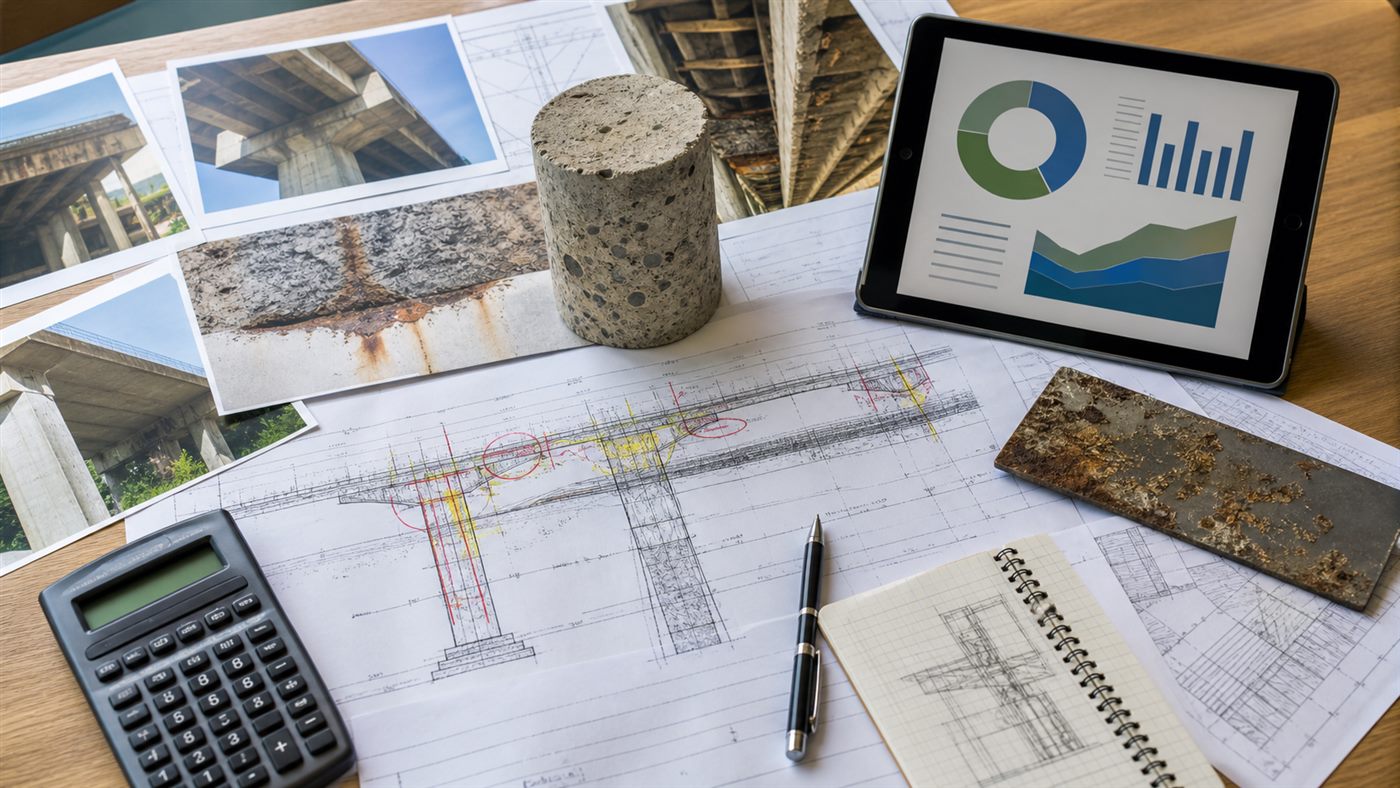
Useful information includes drawings, load history, inspection reports, photos, material testing, corrosion data, crack maps, section-loss measurements, exposure conditions, access constraints, and the owner’s required service life.
Can staged rehabilitation be better than both options?
Yes. Staged rehabilitation can address urgent safety or durability risks first while planning larger work around budget, access, shutdown windows, or future asset strategy.
Sources
- FHWA: Life-Cycle Cost Analysis Primer
- FHWA: Bridge Preservation Guide
- FHWA: National Bridge Inspection Standards
- ACI CODE-562-25: Assessment, Repair, and Rehabilitation of Existing Concrete Structures
Need a professional structural assessment?
Book a consultation with Structural Rehab to evaluate repair priorities, corrosion risks, and rehabilitation options before damage escalates.
Book Consultation