ACI 562-2025 matters because concrete repair is no longer just a patching decision. When an existing concrete structure has corrosion, cracking, spalling, fire damage, overload, poor previous repairs, or a proposed change in use, the repair team needs a code-based path for assessment, design, construction documents, and quality control.
The American Concrete Institute publishes ACI CODE-562-25 as Assessment, Repair, and Rehabilitation of Existing Concrete Structures: Code Requirements and Commentary. ACI describes the document as being developed to provide design professionals with code requirements and commentary for existing concrete structures. This article explains how to use that idea on real repair projects without turning code compliance into a paperwork exercise.
What ACI 562-2025 covers
ACI 562 applies to existing concrete structures that need assessment, repair, rehabilitation, or strengthening. In practical terms, it helps the engineer define what condition information is required, what design basis applies, how the repair should be documented, and how the completed work should be accepted.
The code does not replace engineering judgment. It gives the repair team a common framework so decisions are traceable. That is especially important when the existing structure has hidden deterioration, incomplete drawings, nonstandard materials, previous repairs, or changed loading.
Why the 2025 edition matters for owners
Owners often ask for a fast repair after a visible defect appears. ACI 562-2025 reinforces a more disciplined sequence: assess the structure, define the objective, choose the design criteria, prepare repair documents, execute the work, and verify results. Skipping the early steps can produce a repair that looks complete but leaves the cause of deterioration active.
For example, patching a spalled beam without measuring chloride contamination, cover depth, corrosion activity, and delamination extent may only reset the failure clock. The repair may need corrosion mitigation, waterproofing, cathodic protection, a changed drainage detail, or strengthening rather than a cosmetic patch. Structural Rehab’s guide to concrete spalling repair explains why diagnosis must come before material selection.
The repair workflow ACI 562 pushes teams to document
1. Define the project objective
Start by writing down what the repair must accomplish. The objective may be life safety, restored strength, reduced leakage, improved durability, change of use, fire-damage recovery, seismic improvement, service-life extension, or temporary risk reduction. Different objectives lead to different acceptance criteria.
A crack injection scope, for example, may be acceptable if the objective is water control in a nonstructural wall. It may be inadequate if the same crack crosses a primary load path. See the related Structural Rehab article on concrete crack repair methods for a practical distinction between sealing, bonding, and experimental repair approaches.
2. Assess the existing structure
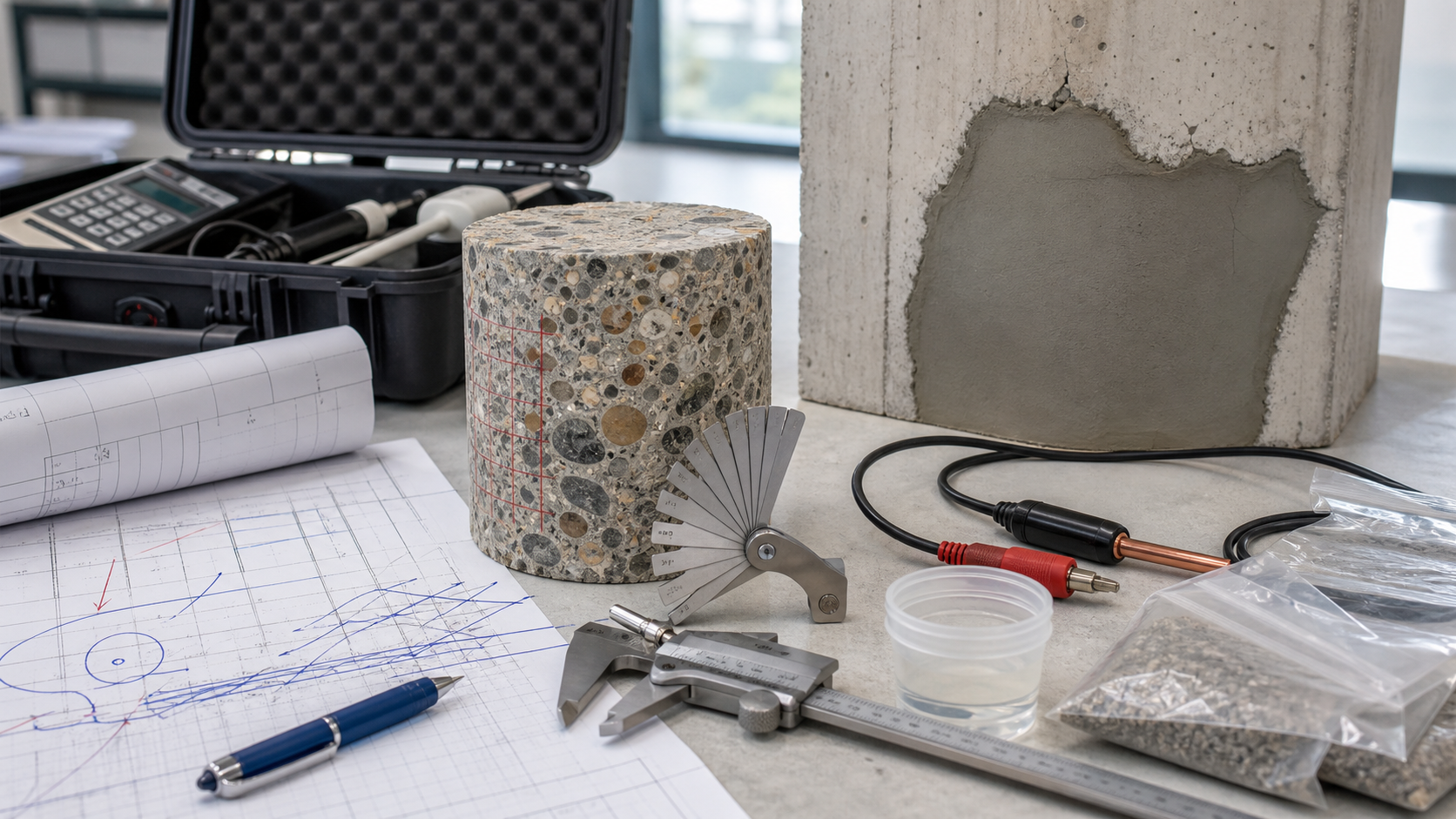
Assessment should collect enough information to support the repair decision. That may include drawings, previous repair records, visual mapping, sounding, cover measurement, material testing, corrosion testing, concrete strength testing, carbonation or chloride testing, load history, and exposure conditions.
Testing should be selected because it answers a design question, not because it is familiar. For corrosion-related concrete repair, useful supporting methods can include chloride testing, half-cell potential mapping, and concrete resistivity testing. Each method has limits, so the engineer should interpret them together rather than treating one reading as a complete diagnosis.
3. Establish the design basis
Existing structures rarely match new-construction assumptions perfectly. The engineer must decide which loads, material properties, member capacities, deterioration allowances, and acceptance criteria apply. ACI 318-2025 remains the principal ACI building code for structural concrete design in new buildings, while ACI 562 addresses the repair and rehabilitation context for existing concrete.
That distinction matters. A repair design may need to consider measured in-place strength, reduced section, damaged reinforcement, load redistribution, temporary works, construction-stage loads, and compatibility between existing and new materials.
4. Select repair materials and systems
The code framework does not tell the owner to choose one branded product. It pushes the team to match the system to the condition and objective. Repair mortar, cast-in-place replacement concrete, shotcrete, epoxy injection, polyurethane injection, bonded overlays, FRP, steel jacketing, corrosion inhibitors, cathodic protection, and protective coatings can all be valid in the right context.
For strengthening decisions, the engineer should compare load path, ductility, fire exposure, bond, corrosion risk, access, inspection, and future maintenance. Structural Rehab’s comparison of CFRP and steel plate strengthening for RC beams shows how different systems can solve different constraints.
5. Prepare construction documents and quality requirements
Repair drawings and specifications should define removal limits, surface preparation, reinforcement cleaning or replacement, repair material requirements, curing, protection, inspection points, testing frequency, acceptance criteria, and hold points. Vague notes such as “repair damaged concrete as required” are not enough for high-risk work.
ACI SPEC-563-25 is a companion reference specification for concrete repair in buildings. ACI describes it as a reference specification that an architect or engineer can apply to structural concrete repair and rehabilitation projects. Used correctly, it can help convert assessment findings into enforceable construction requirements.
Common mistakes ACI 562-2025 helps prevent
- Repairing visible damage without identifying the deterioration mechanism.
- Using new-construction assumptions without checking the existing member condition.
- Choosing a repair material before defining the repair objective.
- Ignoring temporary stability during demolition, shoring, and repair placement.
- Leaving quality-control testing out of the repair documents.
- Specifying strengthening without checking bond, anchorage, fire exposure, and inspection access.
- Relying on a previous repair detail that failed under the same exposure.
Owner checklist before hiring a repair contractor
| Question | Why it matters |
|---|---|
| Has an engineer defined the repair objective? | Prevents confusion between cosmetic repair, durability repair, and structural strengthening. |
| Is the deterioration mechanism documented? | Repairs fail early when corrosion, leakage, overload, movement, or chemical exposure remains active. |
| Are drawings, specifications, and acceptance criteria complete? | Contractors need clear limits, materials, preparation, testing, and hold points. |
| Are temporary works and construction-stage risks addressed? | Removing damaged concrete or reinforcement can reduce capacity before the new repair is active. |
| Is post-repair protection included? | Durability often depends on waterproofing, coatings, drainage, corrosion control, and maintenance. |
Limitations and local-code reality
ACI 562-2025 is not a permit by itself, and this article is not a substitute for the code document or local legal requirements. The governing building code, authority having jurisdiction, project location, occupancy, risk category, and contract documents may impose additional requirements.
Some projects also involve nonconcrete systems such as steel framing, foundations, facade anchors, waterproofing, mechanical penetrations, or fire protection. In those cases, the concrete repair design must coordinate with the wider structure and building operation.
Sources and further reading
- ACI CODE-562-25: Assessment, Repair, and Rehabilitation of Existing Concrete Structures
- ACI SPEC-563-25: Repair of Concrete in Buildings
- ACI CODE-318-25: Building Code for Structural Concrete
- International Concrete Repair Institute: repair guidelines and resources
FAQ
Is ACI 562-2025 only for major structural failures?
No. It is most important when repair decisions affect strength, serviceability, durability, life safety, or future use. Even moderate corrosion or repeated spalling can need a code-based assessment if structural performance or durability is at stake.
Does ACI 562-2025 tell me which repair product to buy?
No. It provides a framework for assessment, design, documentation, and acceptance. Product selection should follow the repair objective, exposure, substrate condition, load path, installation constraints, and quality requirements.
Can a contractor use ACI 562 without an engineer?
Contractors can follow repair specifications and quality requirements, but code-based assessment and structural repair design should be led by a qualified design professional where the work affects structural performance or regulated building requirements.
How does ACI 562 relate to ACI 318?
ACI 318 is the building code for structural concrete design, while ACI 562 addresses assessment, repair, and rehabilitation of existing concrete structures. A repair project may need both, but they answer different questions.
What should an owner prepare before an ACI 562-based assessment?
Collect drawings, previous repair records, inspection photos, leak history, loading changes, maintenance records, and access information. The engineer may still need field testing, but better records reduce uncertainty and help target the investigation.
Need a code-ready repair plan?
Structural Rehab can review visible defects, test results, repair objectives, and proposed specifications before concrete repair work begins. Book a consultation if you need an assessment plan, repair scope, quality-control checklist, or second review of a contractor proposal.
Need a professional structural assessment?
Book a consultation with Structural Rehab to evaluate repair priorities, corrosion risks, and rehabilitation options before damage escalates.
Book Consultation