CFRP vs steel plate strengthening is not a simple material contest. For reinforced concrete beams, the better option depends on the deficiency you are correcting, the existing concrete condition, how the added tension force will anchor into the member, and what the owner can tolerate during installation and future maintenance.
The older question, “carbon fiber or steel?” is too broad for beam repair. A beam strengthening design has to answer narrower questions: is the problem flexure, shear, deflection, cracking, local damage, corrosion-related loss, or a change in use? Is the soffit concrete sound enough for bonded reinforcement? Will the system need mechanical anchorage, fire protection, impact protection, or corrosion protection? This guide compares externally bonded CFRP laminates with bonded or mechanically anchored steel plates for RC beams.
Start With the Beam Deficiency, Not the Product
Before choosing CFRP or steel plate bonding, confirm what the beam actually lacks. A strengthening layer placed on the tension face can increase flexural capacity, but it will not automatically solve shear distress, poor bearing, inadequate development of internal bars, active corrosion, settlement, or a weak load path into adjoining members.
A practical assessment should include crack mapping, concrete cover checks, corrosion screening where exposure suggests risk, delamination sounding, review of drawings if available, and capacity calculations for the existing member. When corrosion or chloride exposure is suspected, connect the strengthening decision to the wider repair plan; our guide to reinforced concrete structural repair and corrosion control explains why strengthening alone should not hide an active durability problem.
How CFRP Strengthening Works on RC Beams
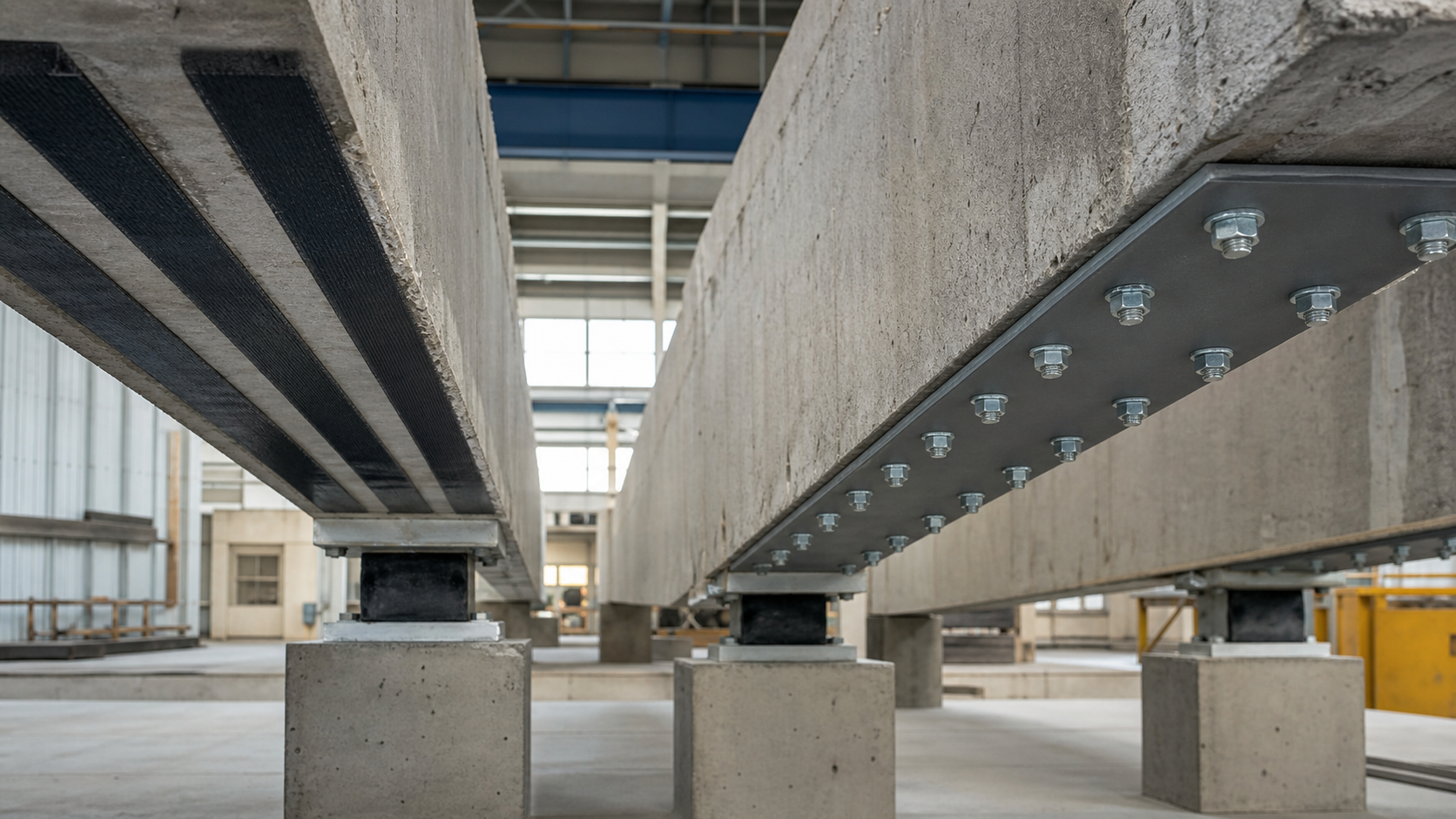
CFRP strengthening normally uses carbon fiber sheets, strips, or prefabricated laminates bonded to the concrete surface with a compatible resin. On RC beams, CFRP is often placed on the soffit for positive-moment flexural strengthening or wrapped around the web for selected shear upgrades. The system is light, thin, corrosion-resistant, and fast to install when the substrate is sound.
Current design practice for externally bonded FRP systems is commonly aligned with ACI PRC-440.2-17, which addresses design and construction of externally bonded FRP systems for strengthening concrete structures. The key design issue is not only the tensile capacity of carbon fiber. The engineer must check concrete strain limits, FRP strain limits, serviceability, debonding risk, fire exposure, environmental reduction factors, and the anchorage or termination detail.
Where CFRP Usually Fits Best
- Projects where added dead load must stay very low.
- Beams where headroom, architectural clearance, or services below the soffit limit added thickness.
- Occupied buildings where fast installation and low disruption matter.
- Moderate flexural or shear strengthening where concrete surface quality and pull-off strength are adequate.
- Corrosive environments where adding exposed steel would create another maintenance item.
How Steel Plate Strengthening Works on RC Beams
Steel plate strengthening typically adds plates, angles, channels, or built-up steel elements to the tension face, sides, or bearing zones of an RC beam. Plates may be bonded with adhesive, clamped or bolted, welded to supplemental steelwork, or detailed as part of a larger mechanical load-transfer system. Steel is familiar, ductile, inspectable, and often attractive when the strengthening demand is high or when mechanical anchorage is needed.
Steel plate systems are less forgiving of corrosion exposure, hidden moisture traps, poor detailing around plate ends, and added weight. If post-installed anchors are used, the anchor design should be checked for steel failure, concrete breakout, pullout, pryout, edge distance, spacing, cracked concrete assumptions, and sustained or seismic demands under the applicable code basis. ACI CODE-318-19(22) remains a key reference for structural concrete requirements, including anchor design provisions where applicable.
Where Steel Plates Usually Fit Best
- High strengthening demand where a larger, mechanically direct section is needed.
- Beams exposed to impact, abrasion, or hard industrial service.
- Repairs that need bolted brackets, bearing seats, or direct connection to supplemental framing.
- Cases where the concrete surface is too uncertain for a purely bonded FRP solution without additional anchorage.
- Projects where future visual inspection of steel hardware is valued and corrosion protection can be maintained.
CFRP vs Steel Plate Strengthening: Beam-by-Beam Comparison
| Decision factor | CFRP laminates or sheets | Steel plate strengthening |
|---|---|---|
| Added weight | Very low, usually favorable for existing beams and supports. | Higher; check member, supports, and handling loads. |
| Added depth | Thin profile, useful where headroom is limited. | Greater thickness, bolt projection, cover plates, or edge details may affect clearance. |
| Corrosion exposure | Carbon fiber does not corrode, but resin and coating protection still matter. | Requires coating, sealing, drainage detailing, and maintenance access. |
| Fire and heat | Resin properties can govern; fire protection may be required. | Steel retains familiarity but may still need fire protection and temperature checks. |
| Anchorage | Bond and termination detailing are critical; anchors or wraps may be needed. | Can use mechanical anchors, clamps, or supplemental framing, but anchor failures must be checked. |
| Installation disruption | Often lower after preparation, with lighter handling. | Often higher because of fabrication, lifting, drilling, bolting, welding constraints, or grouting. |
| Inspection | Bonded surface may need tap testing, thermal imaging, or planned access to coatings. | Hardware is visible, but corrosion under plates or at interfaces can be hidden if detailing is poor. |
| Ductility and failure mode | Needs strain limits and debonding checks; FRP is linear elastic to rupture. | Steel can yield, but the full system can still fail brittlely if anchors or concrete breakout govern. |
Bond and Surface Preparation Decide More Than Marketing Claims
Both methods depend on the concrete surface. CFRP needs clean, sound, profiled concrete with compatible moisture and temperature conditions. Bonded steel plates also need reliable surface preparation and adhesive control. If the surface is weak, contaminated, carbonated, delaminated, or damp beyond the adhesive limits, the theoretical strengthening capacity may never reach the beam.
Use surface preparation criteria rather than visual appearance alone. Our article on concrete surface profile before repair explains why roughness and laitance removal matter. For bonded systems, direct tension testing can help verify surface strength and failure mode; ACI PRC-546-14 Guide to Concrete Repair is a useful concrete repair reference when planning substrate assessment, repair material selection, and quality control for bonded work. See also our practical guide to pull-off adhesion testing before concrete repair.
Anchorage and Plate Ends Are Common Failure Points
Many beam strengthening failures start near plate ends, laminate terminations, cracks, or load introduction zones. A CFRP strip that terminates in a high-shear region can debond prematurely if the design assumes perfect bond. A steel plate can also concentrate stresses at its ends, around anchor holes, or where stiffness changes abruptly.
The repair detail should manage the force transfer gradually. Options may include longer development lengths, staggered laminate terminations, U-wraps, mechanical anchors, transverse clamps, tapered plates, supplemental shear strengthening, or local concrete repair before strengthening. These choices are engineering decisions, not field improvisations.
Fire, Impact, and Exposure Can Change the Answer
CFRP can be the right structural choice but still need protective coating, fire-resistant board, sprayed fireproofing, or impact protection. Steel plate systems may tolerate some abuse better, but exposed steel can become a long-term corrosion liability if drainage, sealant, coating thickness, and inspection access are weak. For steel protection quality control, dry film thickness testing for steel coatings is a useful verification step.
For existing concrete structures, ACI CODE-562-25 is relevant because it frames assessment, repair, and rehabilitation around existing-member conditions rather than treating the repair as isolated new construction. That mindset is important: the strengthening system must work with the actual beam, not an idealized beam.
Cost: Compare Installed Lifecycle Cost, Not Material Price
CFRP material can look expensive by unit price, but installation may be faster, lighter, and less disruptive. Steel plate material can look economical, but fabrication, access equipment, drilling, lifting, fireproofing, corrosion protection, and shutdown time can dominate the actual project cost.
For owners, the most useful comparison is installed lifecycle cost: engineering, access, surface preparation, repair of unsound concrete, material, labor, protection, inspection, maintenance, and downtime. A method that costs less on day one can become expensive if it traps moisture, requires frequent recoating, or cannot be inspected.
When a Hybrid Detail Is Better
Some beams need a hybrid solution. CFRP may provide efficient flexural strengthening along the span, while steel hardware improves anchorage near supports or ties the beam into adjacent framing. Conversely, steel plates may handle a major local demand while CFRP wraps improve shear or confinement in selected zones.
The earlier site article on carbon fiber reinforcement versus steel jacketing gives a broader comparison across member types. For RC beams specifically, the deciding issue is usually the load path from internal reinforcement to concrete, adhesive or anchors, external strengthening, supports, and the rest of the structure.
A Practical Selection Checklist
- Define the deficiency. Separate flexure, shear, deflection, crack control, local damage, corrosion, and support problems.
- Confirm concrete condition. Check delamination, pull-off strength, moisture, contamination, cover, and active corrosion risk.
- Model the strengthened section. Include existing reinforcement, concrete strength, load combinations, serviceability, and realistic strain limits.
- Design anchorage. Check bond, laminate or plate ends, post-installed anchors, edge distances, and concrete breakout where relevant.
- Check exposure. Include fire, heat, UV, moisture, chlorides, impact, abrasion, and inspection access.
- Plan quality control. Include surface profile, ambient conditions, adhesive batch records, pull-off testing where appropriate, coating checks, and final documentation.
- Connect the strengthening to maintenance. A beam upgrade should include inspection intervals and protection details, not just installation photos.
FAQ
Is CFRP stronger than steel plate strengthening?
Not in a simple project-wide sense. CFRP has very high tensile strength and low weight, but stiffness, bond, strain limits, fire protection, and debonding control matter. Steel plates can add robust strength and mechanical connection options, but they add weight and need corrosion protection.
Can CFRP stop active corrosion in an RC beam?
No. CFRP can strengthen a beam, but active reinforcement corrosion needs diagnosis and treatment. If corrosion is still active, hiding the surface with a strengthening system can make future deterioration harder to detect.
Do steel plates always need anchors?
Not always, but anchors or mechanical restraints are often considered when bond demand is high, the plate ends are critical, the substrate is uncertain, or direct load transfer is needed. Anchor design must check concrete and steel failure modes, not just bolt strength.
Which method is faster to install?
CFRP is often faster because it is light and thin, but surface preparation, curing, access, and protective layers still take time. Steel plate work may need fabrication, drilling, lifting, bolting, welding restrictions, coating, or fireproofing.
Can an owner choose CFRP or steel before hiring an engineer?
An owner can identify preferences such as low disruption, corrosion resistance, or inspectable steel hardware. The final method should follow an engineering assessment because the governing issue may be shear, anchorage, corrosion, support conditions, or serviceability rather than flexural strength alone.
Get the Beam Assessed Before You Commit
If you are comparing CFRP and steel plate strengthening for an existing RC beam, start with a diagnostic assessment and a repair design that checks capacity, durability, anchorage, fire, and constructability together. Structural Rehab can review the member condition, identify the governing deficiency, and help select a strengthening approach that fits the real structure. Review our structural repair and rehabilitation services or book a consultation for project-specific guidance.
Need a professional structural assessment?
Book a consultation with Structural Rehab to evaluate repair priorities, corrosion risks, and rehabilitation options before damage escalates.
Book Consultation