Pull-off adhesion testing before concrete repair is one of the most practical ways to confirm whether a prepared concrete surface can bond reliably to a repair mortar, overlay, coating, or protective system. A repair can use the right material and still fail early if the substrate is weak, contaminated, too smooth, too wet, poorly cleaned, or incompatible with the selected system.
The test is valuable because it does more than produce a number. It shows the failure mode. A good result may fail inside the concrete substrate, inside the repair material, at the adhesive, or at the interface. That failure location tells the engineer whether the problem is substrate quality, surface preparation, repair material performance, adhesive setup, or workmanship.
What pull-off adhesion testing measures
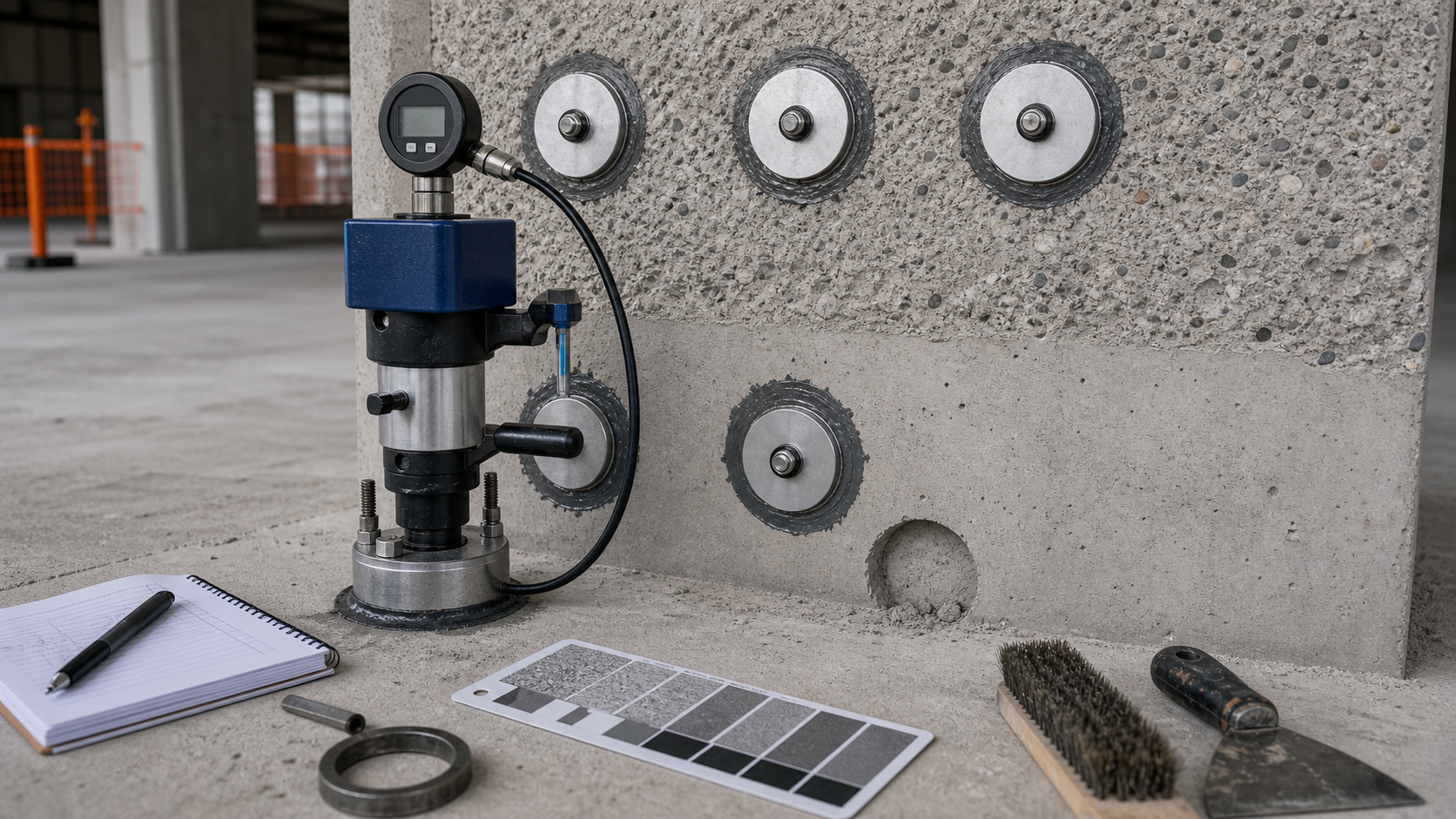
The method uses a bonded loading fixture, often called a dolly, attached to the concrete or repair surface. A pull-off tester applies tensile force perpendicular to the surface until failure occurs. The measured stress and observed failure mode help evaluate bond strength and surface integrity. A widely referenced standard is ASTM C1583/C1583M, tensile strength of concrete surfaces and bond strength or tensile strength of concrete repair and overlay materials by direct tension.
For repair planning, the key question is not only what the pull-off value was. The better question is where it failed, and whether that failure mode matches the repair objective.
When to use pull-off testing before repair
Use pull-off testing when bond is critical: concrete overlays, patch repairs in load-sensitive zones, protective coatings, waterproofing membranes, carbon fiber strengthening substrates, industrial floors, parking decks, tanks, marine structures, and any repair where premature delamination would create safety, durability, or service interruption risk.
If reinforcement corrosion is driving spalling or delamination, pull-off testing should be used with diagnosis methods, not instead of them. For corrosion mapping workflows, see chloride testing before concrete repair, half-cell potential testing, and concrete resistivity testing.
A practical field workflow
1. Define the repair system and acceptance objective
Before testing, define what needs verification: substrate tensile strength, repair material tensile strength, bond at the interface, coating adhesion, or overlay bond. Acceptance criteria should come from the engineer, project specification, manufacturer guidance, and service condition. Do not copy a generic number without checking the actual repair system.
2. Prepare representative test areas
Test areas should represent the real repair conditions: same substrate, same surface preparation method, same cleaning process, same moisture condition, same primer or bonding agent, and same cure period. If the project has different exposure zones, test each critical zone separately.
3. Bond dollies correctly
Use the correct adhesive, alignment, cure time, and dolly preparation. Poor dolly bonding can create false low results. If failure occurs mostly in the dolly adhesive, the test may not represent the concrete repair bond and should be reviewed carefully.
4. Core or isolate the test area where required
Depending on the test objective and standard procedure, the test area may need to be isolated by coring or cutting around the dolly. This helps ensure the tensile load is applied to the intended surface area, not distributed through surrounding material in an uncontrolled way.
5. Record both value and failure mode
Report the pull-off stress, test location, surface preparation method, concrete condition, repair material, adhesive, cure time, equipment, and failure mode. Photos of the failed surface are important. A number without failure-mode documentation is weak evidence.
How to interpret the result
If failure occurs inside sound concrete at an acceptable stress, the bond may be stronger than the substrate. If failure occurs at the interface, surface preparation, cleaning, moisture condition, primer selection, or application timing may be the issue. If failure occurs inside the repair material, check material selection, mixing, curing, and age at testing. If failure occurs in the adhesive layer, the test setup may need review.
For concrete spalling and patch repair sequencing, review Concrete Spalling Repair: How to Diagnose, Patch, and Prevent Reinforcement Corrosion. For broader repair and protection support, see Structural Rehab’s structural rehabilitation services.
Common mistakes that weaken the test
- Testing only easy-to-access areas while ignoring high-risk zones.
- Using test areas that do not match the actual repair preparation.
- Reporting pull-off values without failure mode photos.
- Testing too early before repair material, primer, or adhesive has cured properly.
- Assuming one successful test proves the whole structure is ready.
- Ignoring moisture, contamination, laitance, dust, weak paste, or incompatible surface profile.
Limitations to document
Pull-off testing is localized. It does not prove that every square meter has the same bond quality. It does not diagnose chloride contamination, carbonation, corrosion activity, steel section loss, or structural capacity. It should be combined with visual inspection, delamination survey, moisture review, surface profile checks, and corrosion testing when durability risk is involved.
Repair planning for existing concrete should also fit within code-aware assessment and rehabilitation requirements. A relevant reference is ACI CODE-562, Assessment, Repair, and Rehabilitation of Existing Concrete Structures. Surface preparation and repair workmanship should also be aligned with recognized concrete repair guidance, including ICRI technical guidelines.
Recommended decision path
- Define the repair system and required bond performance.
- Prepare representative trial areas using the actual field method.
- Run pull-off testing after the required cure period.
- Document stress values and failure mode photos.
- Adjust surface preparation, cleaning, moisture control, primer, or repair material if the result is weak.
- Proceed to full-scale repair only after the trial result supports the specification.
If the structure already shows urgent deterioration signs, review 7 Critical Signs Your Concrete Structure Needs Immediate Repair before deciding whether pull-off testing alone is enough.
FAQ
Is pull-off adhesion testing destructive?
Yes, it is localized destructive testing. The tested spot fails and must be repaired afterward. The benefit is that it gives direct evidence of tensile bond or surface strength.
Can one pull-off test approve a whole repair area?
No. One test is only a local result. The number and distribution of tests should match the structure size, risk level, repair system, and specification.
What matters more: value or failure mode?
Both matter. The value shows tensile resistance. The failure mode explains what failed and whether the repair bond or substrate is controlling performance.
Should pull-off testing be done before or after repair?
It can be used on trial repairs before full work and on completed repair areas for quality control. Pre-repair trials are useful when surface preparation or bond performance is uncertain.
Need repair QA before full-scale work?
Structural Rehab helps owners and engineers verify repair readiness before expensive full-scale execution. For concrete repair trials, surface preparation review, bond testing plans, corrosion assessment, waterproofing, coatings, strengthening, or durability planning, book a structural repair consultation. The free guide and full ebook on the home page can also support preventive maintenance and repair planning.
Affiliate note: No affiliate links are included in this article because no approved Structural Rehab affiliate URLs were available at publishing time.
Sources
- ASTM C1583/C1583M, pull-off tensile strength and bond strength testing
- International Concrete Repair Institute technical guidelines
- ACI CODE-562, Assessment, Repair, and Rehabilitation of Existing Concrete Structures
Need a professional structural assessment?
Book a consultation with Structural Rehab to evaluate repair priorities, corrosion risks, and rehabilitation options before damage escalates.
Book Consultation