Half-cell potential testing before concrete repair is a practical way to locate areas where reinforcement corrosion is more likely to be active. It does not measure steel loss directly, and it does not replace engineering judgement, but it gives repair teams a fast map of electrochemical corrosion risk across slabs, beams, columns, parking decks, marine structures, and industrial concrete assets.
For owners, facility managers, and engineers, the value is simple: a repair area should not be chosen only by what is visibly cracked or spalled. Corrosion often extends beyond the obvious defect. Half-cell testing helps define where to repair, where to protect, and where to monitor so the project does not become a cycle of repeated patch failures.
What half-cell potential testing tells you
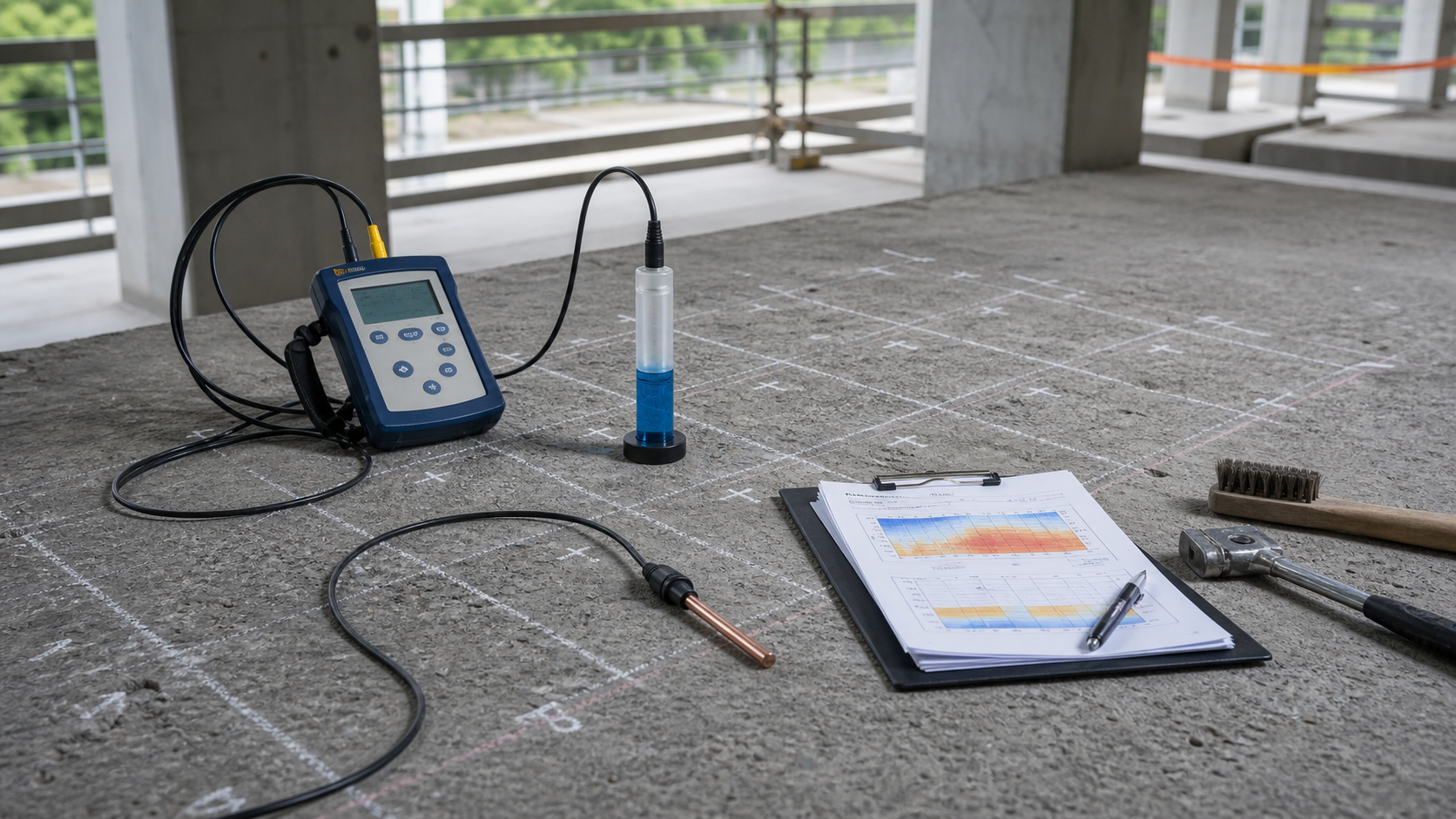
The method measures the electrical potential difference between embedded reinforcing steel and a reference electrode placed on the concrete surface. In practice, more negative potential readings normally indicate a higher probability that corrosion activity is present at the steel. The widely used reference for this type of field testing is ASTM C876, Standard Test Method for Corrosion Potentials of Uncoated Reinforcing Steel in Concrete.
The result should be treated as a corrosion-probability map, not a repair drawing by itself. Good decisions come from combining half-cell potential data with visual defects, cover depth, carbonation depth, chloride testing, moisture exposure, concrete resistivity, delamination survey results, and structural importance.
When to use it before concrete repair
Half-cell potential testing is especially useful when a structure has repeated spalling, marine or de-icing salt exposure, water leakage, rust staining, or a history of patch repairs that failed earlier than expected. It is also valuable before selecting between localized patching, broader concrete removal, corrosion inhibitor treatment, cathodic protection, protective coatings, waterproofing, or a monitoring plan.
If the main concern is chloride contamination, use this method alongside chloride profiling rather than instead of it. The article Chloride Testing Before Concrete Repair: How to Map Corrosion Risk explains how chloride data helps predict where corrosion may continue even after a patch looks complete.
A practical field workflow
1. Review the structure and mark inspection zones
Start with a visual survey. Mark cracks, spalls, rust stains, wet areas, previous patch boundaries, joints, drains, and exposed reinforcement. The grid spacing should be selected by the engineer based on the structure size, defect pattern, and required resolution. Tighter spacing is usually needed around active defects and high-exposure zones.
2. Confirm electrical continuity of reinforcement
The embedded steel network must be electrically continuous enough for readings to be meaningful. If continuity is poor, readings can become misleading. This step is often overlooked, yet it can decide whether half-cell testing is reliable for the specific structure.
3. Prepare the surface and maintain electrical contact
Concrete surface condition matters. Dry, coated, contaminated, or highly resistive surfaces may prevent stable readings. Field teams normally use proper wetting and electrode contact procedures so the measurement represents the concrete-steel system, not a poor surface connection.
4. Record readings systematically
Each reading should be tied to a location. Use a grid, drawing, photo map, or digital survey sheet. Record reference electrode type, surface condition, weather, moisture condition, cover observations, and any unusual readings. FHWA long-term bridge performance documentation also emphasizes systematic field protocols for corrosion-related measurements, including half-cell potential and resistivity data collection.
5. Convert readings into a risk map
The most useful output is not a table of numbers. It is a plan view or elevation map showing zones of higher and lower corrosion probability. This makes the results easier to coordinate with repair drawings, quantities, access planning, and budget decisions.
How to use the results in repair design
High-risk zones near visible damage may justify extending removal beyond the cracked or spalled area. High-risk zones away from visible damage may need protection, monitoring, or additional testing before they become future failures. Low-risk zones are not automatically safe forever, but they may support a more selective intervention when other evidence agrees.
For spalled areas where reinforcement is already exposed, half-cell data can help define whether the visible repair should be isolated or part of a wider corrosion-control strategy. See Concrete Spalling Repair: How to Diagnose, Patch, and Prevent Reinforcement Corrosion for a practical repair sequence.
For broader rehabilitation planning, combine half-cell potential maps with service-life objectives, exposure class, structural capacity, and access constraints. Structural Rehab can support this through structural rehabilitation services, including assessment, concrete repair strategy, strengthening advice, waterproofing, and long-term durability planning.
Limitations engineers should respect
Half-cell potential testing has limits. It does not measure corrosion rate, bar diameter loss, chloride content, concrete strength, or load capacity. Readings can be affected by moisture gradients, coatings, carbonation, oxygen availability, stray currents, electrical continuity, concrete resistivity, temperature, and cover depth. That is why a reliable repair decision should use more than one inspection method.
For code-aware repair planning, the evaluation should also fit within the broader requirements for assessment and repair of existing concrete structures. A useful reference point is ACI CODE-562: Assessment, Repair, and Rehabilitation of Existing Concrete Structures.
Recommended decision path
- Use visual inspection to locate visible distress and previous repairs.
- Use half-cell potential testing to map probable active corrosion zones.
- Use chloride testing, carbonation checks, cover survey, resistivity, and delamination testing to explain the cause.
- Define repair boundaries based on combined evidence, not only surface damage.
- Select protection measures that address the exposure source, such as waterproofing, drainage correction, coating, corrosion inhibitor, cathodic protection, or planned monitoring.
If your structure already shows warning signs such as rust staining, cracking, delamination, or spalling, review 7 Critical Signs Your Concrete Structure Needs Immediate Repair before deciding whether a detailed corrosion survey is needed.
FAQ
Is half-cell potential testing destructive?
It is generally considered a non-destructive electrochemical test, although a connection to the reinforcement is usually needed. Small local access may be required if no exposed steel or reliable connection point is available.
Can half-cell testing replace chloride testing?
No. Half-cell testing indicates corrosion probability at the time of testing. Chloride testing helps identify contamination levels and future corrosion risk. The two methods are stronger together.
Does a negative reading always mean severe damage?
No. A more negative reading suggests a higher probability of active corrosion, but it does not quantify steel section loss or structural capacity. It must be interpreted with other inspection data.
Who should interpret the results?
A qualified engineer or corrosion specialist should interpret the readings in relation to the exposure, structure type, reinforcement layout, concrete condition, and repair objective.
Need a corrosion-risk map before repair?
Structural Rehab helps owners and engineers move from visible damage to evidence-based repair decisions. For assessment, repair planning, corrosion-risk mapping, strengthening, waterproofing, or durability planning, book a structural repair consultation. You can also use the free guide and full ebook on the home page to plan inspection and maintenance more clearly.
Sources
Need a professional structural assessment?
Book a consultation with Structural Rehab to evaluate repair priorities, corrosion risks, and rehabilitation options before damage escalates.
Book Consultation