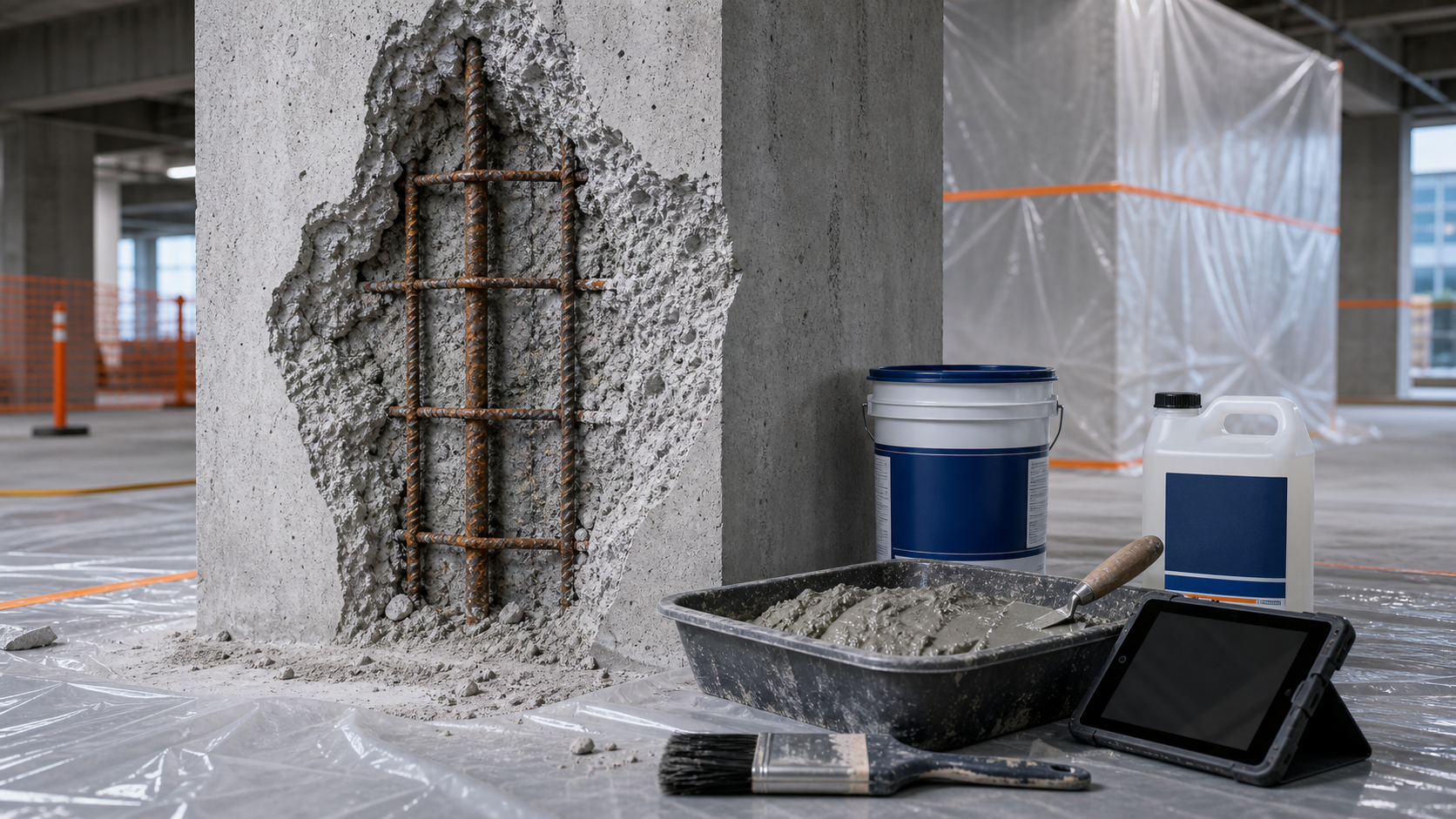
Concrete spalling repair is one of the most common structural rehabilitation needs in buildings, bridges, marine assets, parking structures, and industrial facilities. Spalling is the visible symptom: broken concrete, exposed reinforcement, rust staining, delamination, or loose cover concrete. The real problem is usually deeper, such as reinforcement corrosion, moisture movement, chloride contamination, carbonation, poor cover, impact damage, freeze-thaw distress, or previous patch failure.
A durable repair does more than refill the missing concrete. It identifies why the concrete failed, removes unsound material, treats or replaces affected reinforcement where needed, restores the section with compatible repair material, and protects the member from the same exposure returning. This guide explains the practical sequence owners and project teams should follow before starting a repair.
What Concrete Spalling Means
Spalling happens when concrete breaks away from the surface or cover zone. Small spalls may look cosmetic, but they often indicate pressure from expanding corrosion products around embedded steel reinforcement. When steel corrodes, rust occupies more volume than the original steel, creating internal tensile stress that cracks and pushes the cover concrete outward.
Visible warning signs include rust stains, map cracking, hollow sounds during hammer tapping, exposed reinforcement, damp patches, recurring patch failure, and loose concrete near joints, edges, balconies, columns, beams, slabs, or retaining structures. For a wider defect checklist, see our guide on critical signs your concrete structure needs repair.
Diagnose Before Repairing
The best repair method depends on the cause and extent of the damage. A good assessment should check the visible spall, the surrounding delaminated area, crack patterns, moisture sources, drainage, concrete cover, reinforcement condition, and exposure severity. On larger assets, testing may include cover measurement, carbonation depth, chloride sampling, half-cell potential mapping, concrete resistivity, pull-off testing, and repair mortar compatibility checks.
This diagnostic stage is especially important for structures exposed to deicing salts, marine splash zones, leaking roofs, wet basements, tanks, podiums, parking garages, and industrial chemicals. If moisture and contaminants keep reaching the reinforcement, the new patch may fail again.
Step-by-Step Concrete Spalling Repair Workflow
1. Make the area safe. Restrict access below loose concrete, check for falling hazards, and protect nearby finishes, equipment, and occupied areas. Cutting, grinding, and concrete removal can create respirable crystalline silica dust, so site teams should follow appropriate dust-control and worker-protection practices.
2. Remove unsound concrete. The repair boundary should extend beyond visibly loose material until sound concrete is reached. Saw-cut edges are commonly used to avoid feather-edge patches. The repair cavity should allow proper placement and compaction of repair material.
3. Expose and clean reinforcement. Corroded reinforcement should be exposed around its perimeter where required by the repair specification, cleaned to remove rust scale, and assessed for section loss. If bar loss is significant, a structural engineer should determine whether supplemental reinforcement, anchorage, or strengthening is required.
4. Treat corrosion and bond surfaces. Depending on the exposure and repair system, corrosion inhibitors, passivating primers, bonding agents, or galvanic protection may be used. Surface preparation should follow the repair material manufacturer’s instructions and the project specification.
5. Restore the section. Use a compatible repair mortar or concrete with suitable strength, shrinkage control, modulus, permeability, and application thickness. For vertical and overhead repairs, polymer-modified or engineered repair mortars are often used. For deeper repairs, form-and-pour or form-and-pump materials may be more appropriate.
6. Cure and protect. Poor curing can cause shrinkage cracking and weak patch performance. After curing, the repaired area may need waterproofing, breathable protective coating, joint sealant renewal, drainage correction, or cathodic protection depending on the exposure. See our overview of corrosion prevention and protective coating solutions.
Choosing the Right Repair Method
Small, shallow defects may be suitable for local patch repair if the surrounding concrete is sound and the corrosion risk is limited. Larger spalls, widespread delamination, chloride-contaminated concrete, or repeated failures need a broader rehabilitation strategy. In some cases, repair must be combined with strengthening, waterproofing, joint replacement, or drainage redesign.
If load capacity is affected, surface patching alone is not enough. Structural strengthening may involve added reinforcement, steel plates, steel jacketing, carbon fiber reinforcement, or other engineered systems. For strengthening selection, review carbon fiber reinforcement vs. steel jacketing.
Common Mistakes That Cause Patch Failure
- Patching only the visible hole while leaving delaminated concrete around it.
- Covering active corrosion without treating reinforcement or moisture sources.
- Using repair mortar that is too stiff, too weak, too impermeable, or incompatible with the parent concrete.
- Skipping saw-cut edges and proper surface preparation.
- Ignoring leaking joints, poor drainage, or waterproofing failures.
- Returning the member to service before the repair has cured properly.
Prevention: How to Stop Spalling From Returning
Long-term prevention starts with water control. Keep joints sealed, correct ponding, protect exposed surfaces, maintain drainage, repair cracks early, and apply suitable protective coatings or waterproofing where exposure demands it. Periodic inspection is far cheaper than emergency repair after delamination spreads across a slab, beam, balcony, or column line.
For asset owners, the most useful plan is a simple condition map: where spalling exists now, where corrosion risk is likely next, which areas need monitoring, and which repairs should be prioritized first. Structural Rehab can support assessment, repair design, material selection, waterproofing strategy, and long-term protection planning through our structural rehabilitation services.
When to Call a Structural Repair Specialist
Call a qualified repair team if reinforcement is exposed, cracks are widening, concrete sounds hollow, spalling is near load-bearing columns or beams, corrosion stains keep returning, or the defect is located in a wet or aggressive exposure zone. If you need project-specific guidance, you can book a structural repair consultation and share photos, drawings, inspection notes, and site constraints.
FAQ
Is concrete spalling always structural?
No. Some spalling is localized cover damage, but spalling near reinforcement, supports, slabs, beams, columns, or recurring wet areas should be investigated because it may indicate corrosion or section loss.
Can I repair spalled concrete with ordinary cement mortar?
Ordinary site-mixed mortar is often not durable enough for structural repair. Engineered repair mortars or concrete repair systems are usually selected for bond, shrinkage control, permeability, strength, and compatibility.
Why does repaired concrete spall again?
Repeat failure usually means the root cause was not addressed. Common causes include remaining delaminated concrete, active reinforcement corrosion, leaking joints, chloride contamination, poor curing, or incompatible repair material.
Should exposed reinforcement be replaced?
Not always. Light corrosion may be cleaned and treated, but significant section loss requires engineering assessment and may need supplemental bars, anchorage, or strengthening.
References and Further Reading
- OSHA guidance on respirable crystalline silica in construction
- International Concrete Repair Institute resources
- American Concrete Institute technical resources
Need a professional structural assessment?
Book a consultation with Structural Rehab to evaluate repair priorities, corrosion risks, and rehabilitation options before damage escalates.
Book Consultation