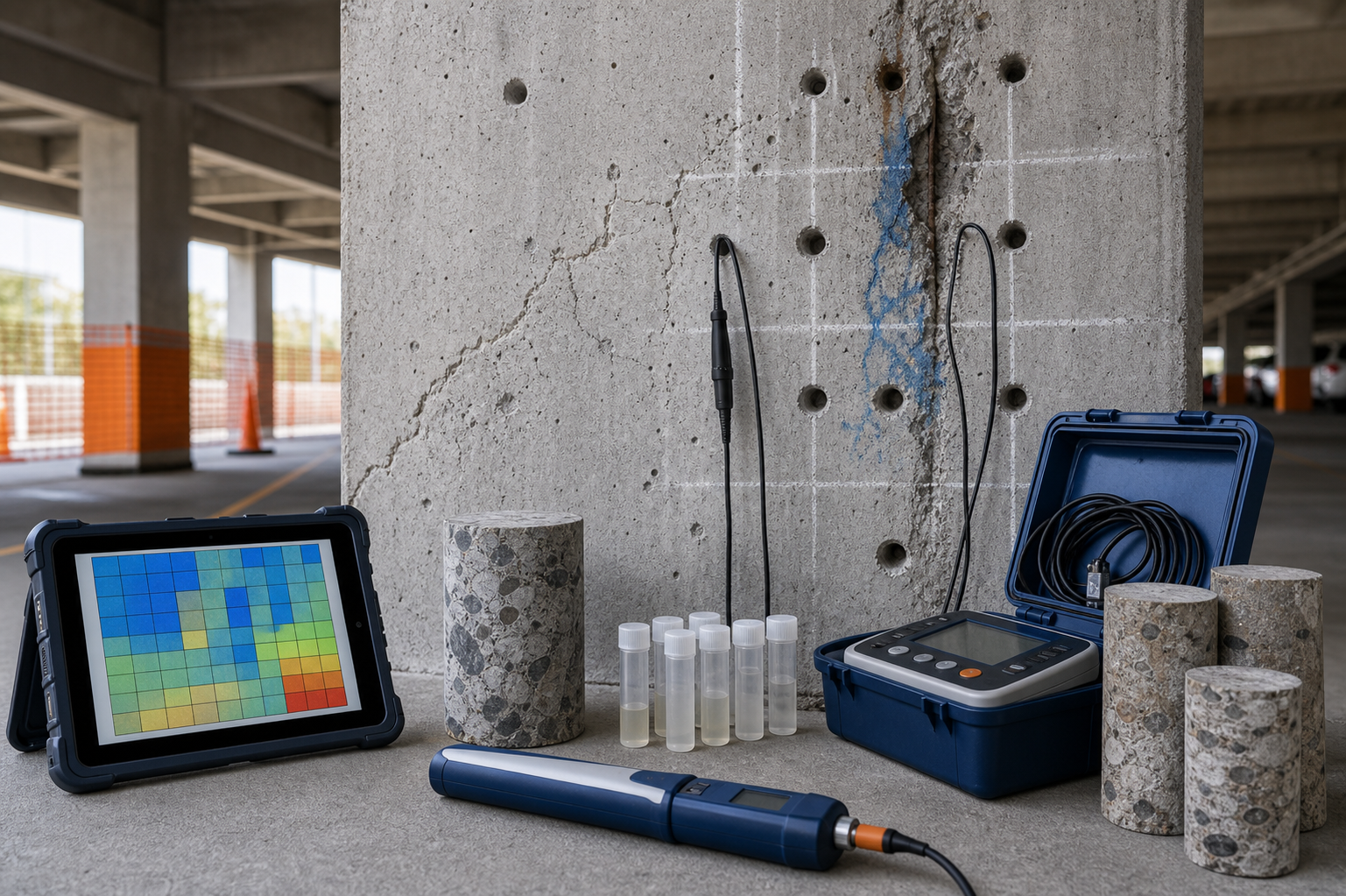
Chloride testing before concrete repair is one of the most useful ways to avoid short-lived patch repairs. When chloride contamination is left in place, a new repair mortar may look successful at handover but corrosion can continue beside the patch, causing new cracking and spalling months or years later.
This guide explains how owners, facility managers, and engineering teams can use chloride profiles, cover-depth checks, half-cell potential readings, and corrosion-risk mapping to decide where to repair, where to protect, and where to monitor.
Why chloride testing matters before repair
Chlorides from marine exposure, de-icing salts, contaminated materials, or industrial environments can break down the passive protection around reinforcing steel. Once corrosion starts, the expanding rust products create internal pressure, cracking, delamination, and spalling.
A visual survey alone can miss contaminated concrete that has not cracked yet. Chloride testing helps answer three practical questions:
- Is chloride contamination only near the surface, or has it reached reinforcement depth?
- Are defects isolated, or is the surrounding concrete already at high corrosion risk?
- Should the repair scope include patching only, protective coating, corrosion inhibitor, cathodic protection review, or wider concrete removal?
Start with a targeted condition survey
Begin with a structured survey of cracking, spalling, rust staining, delamination, leakage, exposure severity, and previous repair history. Then mark test locations so the chloride data represents both visibly damaged and apparently sound areas.
Useful survey inputs include:
- Visual defect mapping and photographs.
- Hammer sounding or chain dragging for delamination.
- Cover-depth measurements to identify shallow reinforcement.
- Carbonation depth checks where carbonation-induced corrosion is possible.
- Moisture and leakage observations, especially around joints and slabs.
Build a chloride profile, not just one test point
A single chloride result rarely tells the full story. Better repair decisions come from a chloride profile, where samples are taken at different depths from the same location. This helps show whether contamination is shallow, near reinforcement, or already deep inside the concrete section.
For practical repair planning, engineers normally compare chloride results with reinforcement depth, exposure conditions, moisture availability, and corrosion readings. The goal is not only to find damaged concrete, but to identify sound-looking concrete that may soon become active.
Use half-cell potential as a risk-map tool
Half-cell potential testing is commonly used to assess the likelihood of active reinforcement corrosion in concrete. ASTM C876 provides a standardized test method for half-cell potentials of uncoated reinforcing steel in concrete.
The strongest use of half-cell data is mapping. A grid of readings can reveal corrosion-risk zones across a slab, beam, column, wall, balcony, or parking structure. These maps help distinguish isolated patch repairs from broader protection needs.
Combine chloride data with cover depth
Cover depth is critical because chloride concentration near reinforcement is more important than chloride at the surface. Shallow cover can turn a moderate chloride exposure into a high-risk repair zone, while deeper cover may provide more time before corrosion activity becomes severe.
When chloride profile results, cover-depth readings, and half-cell mapping point to the same risk area, the repair scope becomes much easier to defend technically and commercially.
How corrosion-risk mapping changes repair decisions
Good mapping can prevent both under-repair and over-repair. Depending on the results, the recommended action may include:
- Localized patch repair where contamination and corrosion risk are isolated.
- Extended concrete removal where chloride levels are high around the visible defect.
- Protective coatings or waterproofing to reduce future moisture and chloride ingress.
- Corrosion inhibitor treatment when appropriate for the exposure and project objective.
- Specialist review for cathodic protection where corrosion is widespread or recurring.
- Monitoring where risk is present but intervention can be scheduled later.
Common mistakes to avoid
- Repairing only the visible spall. Corrosion often extends beyond the broken concrete.
- Ignoring adjacent chloride-contaminated concrete. This can create new corrosion cells around the patch.
- Skipping moisture-control strategy. Chlorides are more damaging when moisture and oxygen support corrosion.
- Using test data without a map. Isolated numbers are less useful than a risk plan.
- Choosing materials before diagnosis. Repair mortar, bonding systems, coatings, and inhibitors should follow the assessment.
Recommended workflow for owners
- Document visible defects and exposure conditions.
- Perform delamination, cover-depth, and moisture checks.
- Collect chloride samples at planned depths and locations.
- Run half-cell potential mapping where reinforcement corrosion is suspected.
- Overlay results into a repair-risk map.
- Select the repair and protection strategy based on risk zones.
- Record baseline data for future maintenance inspections.
Internal resources
For related guidance, see Concrete Spalling Repair, 7 Critical Signs Your Concrete Structure Needs Immediate Repair, Steel Structure Protection and Corrosion Prevention, and Structural Rehab services.
Useful references
- American Concrete Institute: repair and rehabilitation topic resources
- American Concrete Institute: corrosion topic resources
- American Cement Association: corrosion of embedded materials
- Whole Building Design Guide: corrosion prevention and control
- Sika concrete repair systems and protection resources
FAQ
Is chloride testing needed for every concrete repair?
Not every minor repair needs a full chloride investigation, but it is strongly worth considering for marine structures, parking decks, bridges, balconies, industrial floors, water-exposed elements, and recurring spalls.
Can half-cell potential testing replace chloride testing?
No. Half-cell readings indicate corrosion likelihood, while chloride testing helps explain contamination depth and future risk. They work best together.
Does a good repair mortar stop chloride corrosion by itself?
Repair mortar helps restore section and cover, but the surrounding concrete condition, moisture exposure, chloride level, and protection system determine long-term durability.
What is the best time to test?
Test before finalizing the repair scope. Testing after repair often confirms only that the opportunity for better diagnosis was missed.
Need a repair-risk map?
Structural Rehab can help assess chloride exposure, corrosion activity, repair extent, waterproofing needs, and long-term protection options for concrete and steel structures. Book a consultation or download the concrete and steel structures repair guide from the home page.
Need a professional structural assessment?
Book a consultation with Structural Rehab to evaluate repair priorities, corrosion risks, and rehabilitation options before damage escalates.
Book Consultation