Concrete crack repair is changing, but “innovative” does not automatically mean ready for structural use. Electrodeposition, bacteria-based self-healing, encapsulated agents, and geopolymer repair materials can reduce permeability or close small cracks under suitable conditions. They do not remove the need to identify why the concrete cracked, whether the crack is moving, and whether capacity has been affected.
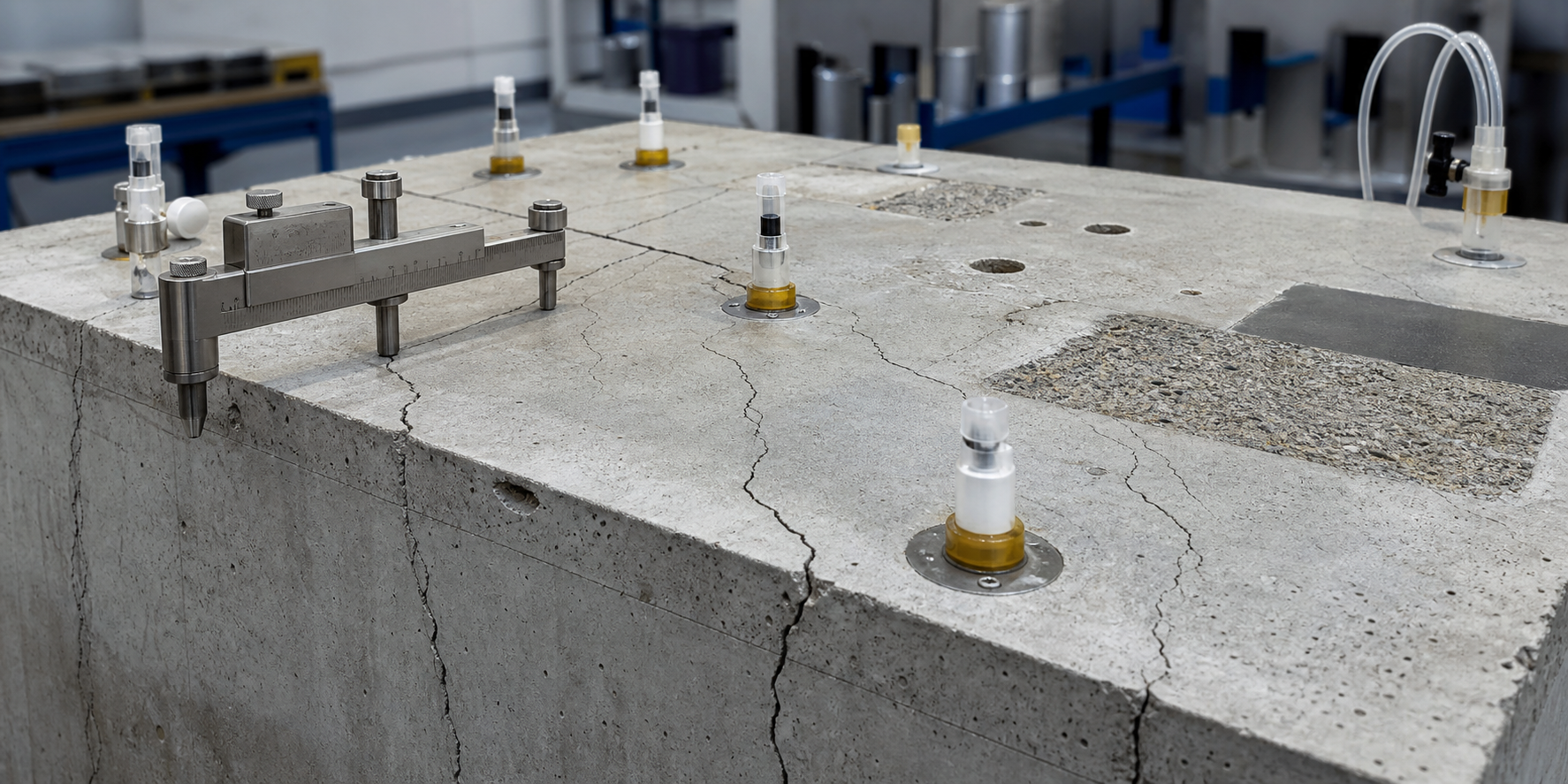
This guide separates methods available for normal repair work from technologies that still need project-specific trials and specialist review.
Diagnose the crack before choosing a material
A crack is evidence, not a diagnosis. Record its width, depth, pattern, orientation, moisture condition, age, and movement. Then relate it to loading, restraint, shrinkage, settlement, thermal effects, reinforcement corrosion, alkali-silica reaction, or other deterioration.
Cracks crossing a primary load path, widening cracks, displaced concrete, active leakage, and cracks associated with corrosion or impact require engineering assessment. Review the surrounding concrete as well: spalling and reinforcement corrosion may indicate that sealing the visible line alone will not produce a durable repair.
Established concrete crack repair methods
Epoxy injection
Low-viscosity epoxy can bond clean, dry, dormant cracks and may restore continuity when the repair is designed and executed correctly. It is generally unsuitable for actively moving cracks or uncontrolled water flow. Injection pressure, port spacing, crack cleanliness, temperature, and confirmation of fill all matter.
Polyurethane injection
Hydrophilic or hydrophobic polyurethane grouts are commonly used to control leakage. They can react or expand in the presence of water, but product behavior varies. A water-stopping injection should not be represented as structural bonding unless the selected system and design support that claim.
Routing, sealing, stitching, and section repair
Routing and flexible sealing can suit nonstructural moving cracks. Stitching or added reinforcement may be designed where forces must cross a crack. When cracked concrete is unsound or reinforcement is corroding, removal and compatible section repair may be required. Surface preparation should be specified and verified; see our guide to concrete surface profile before repair.
Electrodeposition: promising, but specialized
Electrodeposition uses an electric field and an electrolyte to encourage mineral deposits in and around cracks. Laboratory studies have reported crack closure and reduced water transport under selected electrical, solution, crack-width, and exposure conditions. Pulse-current research has also examined whether changing the electrical regime improves deposition.
The mechanism is attractive for wet or marine concrete because the treatment can form deposits without conventional resin injection. However, performance depends on the electrolyte, current density, duration, reinforcement condition, crack geometry, and deposit stability. Published experiments do not establish a universal field procedure for occupied buildings, bridges, tanks, or marine structures.
Before field use, require representative trials, electrical and chemical safety controls, reinforcement-potential monitoring, verification of crack penetration, permeability testing, and a plan for durability after treatment. Electrodeposition should not conceal an active structural crack or substitute for corrosion assessment. Where corrosion is suspected, combine visual mapping with methods such as half-cell potential testing and concrete resistivity testing.
Self-healing concrete: several different technologies
Autogenous healing
Concrete can naturally seal some fine cracks when moisture supports continued hydration and calcium-carbonate precipitation. This may reduce water flow, but the degree of healing depends strongly on crack width, age, moisture cycles, and available reactive material. Visual closure is not proof that tensile capacity has been restored.
Bacteria-based mineral precipitation
Bio-based systems use protected spores or other microorganisms with nutrients to promote mineral precipitation after cracking and water entry. Experimental studies have demonstrated mineral formation and improved sealing in controlled specimens. Practical constraints include survival in the alkaline cement matrix, nutrient delivery, activation, crack size, temperature, repeatability, and long-term verification.
Capsules, vascular networks, and superabsorbent polymers
Other systems store a healing agent in capsules or channels, or use polymers that swell and retain water. These approaches can help seal small cracks or support further hydration. Their use must account for mixing damage, trigger reliability, compatibility, finite healing-agent volume, and any effect on fresh and hardened concrete properties.
Self-healing technologies are most credible when specified during new construction with tested mix designs. They are not interchangeable with post-construction injection into an existing distressed member.
Where geopolymer repair materials fit
Alkali-activated or geopolymer repair mortars can be formulated for patching, overlays, or crack-related rehabilitation. Potential advantages depend on the binder and curing regime rather than the label alone. Bond, shrinkage, modulus, thermal compatibility, permeability, chemical resistance, installation temperature, and worker exposure must be evaluated for the actual product.
A geopolymer mortar does not “heal” a structural crack merely because it has a different binder. For bonded repairs, verify substrate strength and adhesion with a project-specific quality plan. Pull-off adhesion testing can help confirm whether the prepared substrate and installed system achieve the specified bond.
How to select a repair approach
| Condition | Typical starting point | Key limitation |
|---|---|---|
| Dormant, dry structural crack | Engineered epoxy injection | Needs clean crack and verified fill |
| Active water-bearing crack | Water-control diagnosis and compatible polyurethane or joint solution | Stopping water may not restore strength |
| Moving nonstructural crack | Flexible routed seal or movement joint | Rigid fillers may crack again |
| Crack with spalling or corroded reinforcement | Corrosion assessment and section repair | Line sealing alone leaves the cause active |
| Fine cracks in new concrete design | Tested self-healing system may be considered | Performance is system- and exposure-specific |
| Special wet or marine trial | Electrodeposition may merit a controlled pilot | No universal field repair procedure |
Quality-control plan for any crack repair
- Map and monitor crack widths before intervention.
- Confirm whether cracks are dormant, cyclic, or progressively widening.
- Identify moisture, chloride, carbonation, corrosion, and load-related causes.
- Define the repair objective: water tightness, durability, appearance, or structural force transfer.
- Prepare a trial area or mock-up for unfamiliar systems.
- Specify temperature, moisture, mixing, injection pressure, curing, and access controls.
- Verify fill or seal continuity using suitable inspection methods.
- Record materials, batch data, locations, photographs, and acceptance results.
- Monitor repaired cracks and adjacent concrete after return to service.
Limitations owners should understand
Crack closure is not the same as structural recovery. A treatment may reduce leakage while providing little tensile transfer, or it may bond a dormant crack without preventing a new crack nearby. Laboratory results often use controlled crack widths, curing, and exposure that are difficult to reproduce in the field.
Do not specify an emerging method solely from a headline percentage or a photograph. Require evidence for the same substrate, exposure, crack range, loading, and service objective. If chlorides are part of the deterioration mechanism, use a defined sampling plan such as the approach described in chloride testing before concrete repair.
Sources and further reading
- U.S. Army Corps of Engineers: Evaluation and Repair of Concrete Structures
- Cement and Concrete Research: Crack closure of reinforced concrete by electrodeposition technique
- Construction and Building Materials: Repair of concrete crack by pulse electrodeposition
- FraMCoS: Self-healing of cracked concrete—a bacterial approach
- Cement and Concrete Research: Mechanical quantification of bacteria-based self-healing concrete
FAQ
Can self-healing concrete repair a structural crack?
It may seal fine cracks under defined conditions, particularly when engineered into new concrete. Do not assume it restores structural force transfer. A structural engineer should assess capacity and specify any required strengthening or bonding.
Is electrodeposition available for normal building repairs?
It remains a specialized method with substantial research evidence but limited standardized field practice. Use it only with expert design, trials, safety controls, and measurable acceptance criteria.
Should a leaking crack be injected with epoxy?
Not automatically. Active water can interfere with many epoxies. Diagnose the water path and movement, then select a compatible water-control or structural repair system.
How can a repaired crack be verified?
Verification may include injection records, consumption checks, cores where justified, nondestructive assessment, water testing, adhesion testing, and follow-up crack monitoring. The method should match the repair objective.
Are geopolymer mortars always more durable?
No. Performance depends on the specific formulation, substrate, curing, exposure, and workmanship. Require product data and project-relevant testing rather than relying on the material category.
Need a crack repair strategy?
Structural Rehab can review crack maps, test results, moisture and corrosion evidence, and proposed repair materials before work begins. Book a consultation to define the repair objective, suitable methods, quality-control tests, and monitoring plan for your structure.
Need a professional structural assessment?
Book a consultation with Structural Rehab to evaluate repair priorities, corrosion risks, and rehabilitation options before damage escalates.
Book Consultation