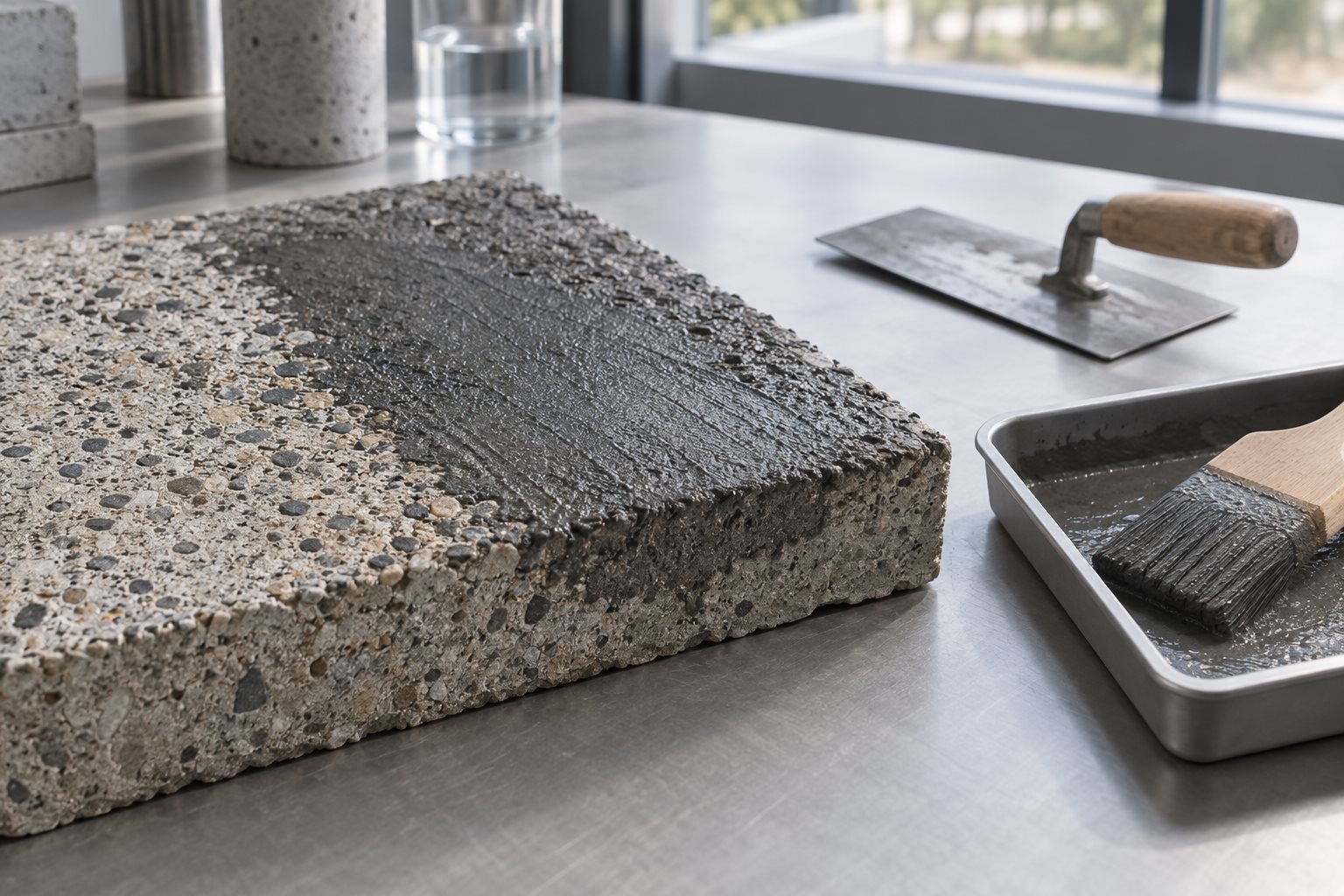
A concrete repair bonding agent creates another operation that must be coordinated with mortar placement. Selecting a familiar primer is not enough: the approved system must identify the substrate condition, application method and interval in which the repair can cover it. An otherwise well-prepared cavity can become a disputed repair when nobody can establish when its bonding layer was applied.
This guide focuses on bonding-agent selection and open-time QA/QC for concrete patch repairs. It offers a practical inspection workflow for engineers, contractors and owners. The checklist is an editorial planning aid, not a replacement for the repair design, specification or current regional product instructions.
Decide whether a separate bonding agent belongs in the repair
Start with the complete approved repair system. Identify the concrete substrate, repair mortar, orientation, exposure and placement method before deciding whether a proprietary adhesive is required. Do not add a primer simply because another project used one, or omit one because the substrate looks rough. A change in the interface treatment is a change to the installation procedure and needs an agreed technical basis.
The public description of ACI PRC-548.11-24 identifies evaluation of hardened concrete, adhesive selection and application as connected subjects. Its scope concerns epoxy and latex adhesives. That description supports treating selection and execution together; it does not establish that every cementitious repair needs a separate adhesive.
A useful distinction is between a scrub coat made from the repair mortar and a separately supplied proprietary bonding product. Under its intermediate-spall procedure, TxDOT describes a mortar scrub coat worked into the conditioned substrate, followed by repair while that layer remains wet. The same procedure requires engineer approval before substituting a proprietary epoxy layer for its specified SSD approach. These are requirements of that procedure, not universal permission to interchange products.
Separate the three timing questions
1. How long can the mixed bonding material be used?
Pot life concerns the mixed material before or during application, under the conditions stated by its supplier. Record the event that starts the clock, the batch identification and the applicable limit. A container that still appears workable does not by itself establish compliance. Do not extend use by adding solvent, water or another ingredient unless the approved instructions explicitly require it.
2. When can repair material cover the applied layer?
The placement window concerns the bonding material after application to the substrate. Depending on the system, the instruction may require a wet layer, a particular tack condition or a stated maximum interval. These terms cannot be converted into one universal number. The primer clock and the mortar clock are separate records. A fresh mortar batch does not restart the window of a previously applied bonding layer.
3. What other waiting periods apply?
A product may serve more than one purpose, with different instructions for each. As an example, the currently available US Sika Armatec-110 EpoCem data sheet, dated March 2020, separates reinforcement coating from concrete bonding-primer application. It provides temperature-dependent waiting limits and additional wet-on-wet limitations for certain mortar applications. Its reinforcement coating sequence must not be copied as the concrete interface sequence. Confirm the current locally supplied system with the manufacturer; this example is not a product recommendation or a transferable site time limit.
Prepare one approved interface instruction
Before production, assemble the relevant specification clauses and supplier documents into a short instruction covering the actual combination of materials. Resolve conflicting requirements before a crew has mixed a batch. Record document revisions and the person responsible for approving any clarification. Avoid a method statement that merely says “apply bonding agent according to manufacturer” while leaving the actual product unidentified.
- Identify the repair material and whether the interface uses its own scrub coat, a named primer or another approved procedure.
- State the required substrate preparation and moisture condition, including how it will be verified.
- Record mixing proportions, permitted batch sizes, application tools and coverage or thickness controls from the approved documents.
- Separate pot life, placement window and any other waiting period, with their temperature or application restrictions.
- Assign the person who releases each placement zone and the person who can stop work.
- Include the approved response to contamination, rain, delay or an expired window.
Keep substrate acceptance as its own hold point. A bonding layer does not authorize covering unsound concrete, residue or an unaccepted profile. Use the project preparation requirements alongside the principles in concrete surface profile before repair. For cementitious systems requiring conditioning, the companion guide to SSD substrate moisture addresses the moisture release rather than adhesive selection.
Use placement zones that the crew can finish
Divide the repair into identifiable areas that connect application records with actual mortar coverage. The appropriate zone size depends on access, reinforcement congestion, placement rate and the permitted sequence. Demonstrate the proposed operation in a representative trial rather than assuming the theoretical coverage rate will match work around obstructions.
For each zone, record bonding-layer application start and finish, observed conditions, mortar placement start and finish, and any interruption. Where the specified window is measured from application, a single finish time for the whole area can conceal the age of the earliest coated section. The record should let the inspector establish the interval at the portion being covered, not just the average duration of the operation.
Plan the sequence backwards from achievable mortar placement. Check access, batching equipment, material supply and curing arrangements before releasing the bonding operation. If formwork will hide the surface, decide how coverage and timing will be witnessed before forms prevent inspection. Do not coat inaccessible areas speculatively while waiting for the next operation to become ready.
Inspect the applied layer before it disappears
Use the approved application criteria to check continuity, coverage and the required condition. Record missed areas or accumulations and obtain correction while the interface remains accessible. A photograph can document location and appearance, but cannot certify chemistry, elapsed time or compliance with a supplier’s tack criterion. Use only a supplier-approved assessment method with the required chemical-handling precautions.
Check that weather protection and nearby work have not introduced contamination. Keep separate records for the exposed bonding layer and the mixed material remaining in its container. A compliant batch may have been applied to an unsuitable surface, and an acceptable-looking surface may have been coated using material outside its permitted use period. Both questions need answers before coverage.
What to do when the window is missed
Hold the affected zone before placing more repair material. Identify where the interruption began, preserve the batch and timing records, and obtain a written disposition using the approved system instructions. Do not improvise by misting the layer, adding another coat or mechanically roughening it without a confirmed recovery procedure. Those actions create a different interface whose suitability has not been established.
If mortar has already covered a questionable area, mark its location and raise a nonconformance record. The engineer should determine the investigation and disposition with supplier input where needed. Removal, testing or acceptance cannot be selected responsibly from elapsed time alone; the actual materials, exposure, application records and structural role matter. Keep the affected work traceable until that decision is closed.
For example, if equipment failure stops placement halfway through a primed cavity, separate the covered and uncovered portions in the record. Do not report the entire cavity as having been placed at the first start time. On restart, assess the remaining interface against its own application history. This simple location-based distinction makes a later technical review much more useful.
Verify the repair without overclaiming the evidence
Where specified, plan bond testing before work begins, including locations, ages, acceptance criteria and reinstatement of test areas. ASTM C1583/C1583M-25 covers direct-tension testing for relevant substrate, repair and adhesive evaluations. The observed result depends on the failure mechanism; report the failure location rather than calling every result an interface bond strength. The public significance section also cautions that averaging requires the same failure mode.
Combine testing with installation records and the engineer’s assessment. One passing test does not reconstruct undocumented timing across an entire repair. Conversely, an unsatisfactory result needs investigation of the complete system rather than automatic blame of the bonding agent. Preparation, substrate strength, placement and curing records provide context for interpreting the evidence.
Frequently asked questions
Is epoxy always better than a mortar scrub coat?
No universal ranking is appropriate. Use the system selected for the repair and its approved conditions. A product substitution needs a compatibility and installation review, including whether the proposed crew can execute its placement window.
Can a dried primer receive another coat?
Only when the approved recovery instructions allow it for the actual condition. Identify contamination and the elapsed interval, then obtain the required disposition. An additional coat should not be treated as an automatic reset.
Can I use the published pot life as the open time?
No. They answer different questions. Establish which event starts each interval, the applicable conditions and the required state of the applied layer when mortar reaches it.
Does this guide establish structural capacity?
No. Bonding-agent QA/QC does not replace repair design, assessment of the original deterioration, reinforcement detailing or loading decisions. Specialist applications such as prestressed members and submerged repairs require their own engineered procedures.
For a project-specific review, book a Structural Rehab consultation. Provide the proposed repair system, current product documents, interface method statement, repair locations and any timing or test records so the discussion can address the actual decision.
Need a professional structural assessment?
Book a consultation with Structural Rehab to evaluate repair priorities, corrosion risks, and rehabilitation options before damage escalates.
Book Consultation