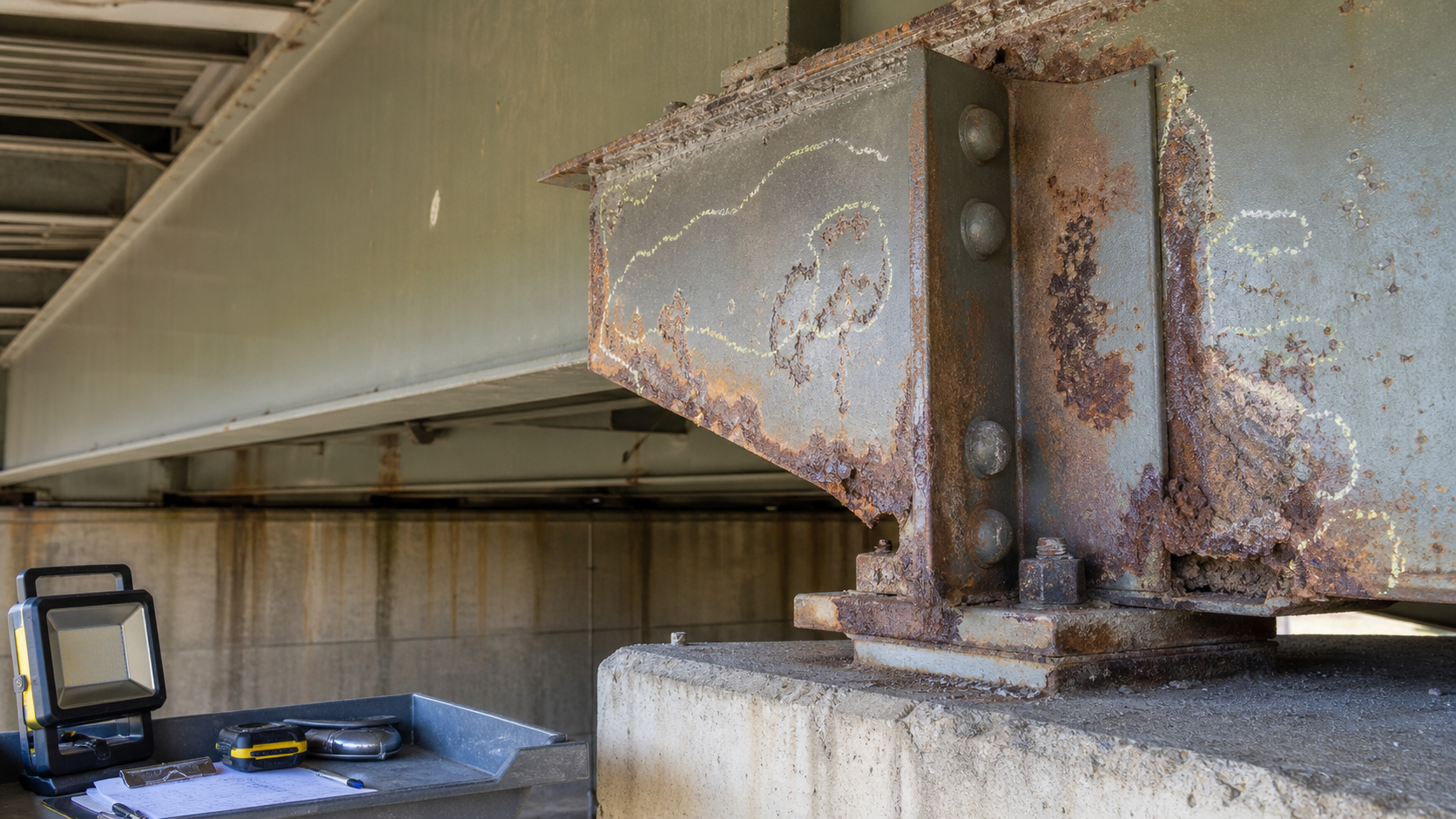
Steel girder end repair is one of the highest-priority bridge rehabilitation decisions because the damage usually sits where water, deicing salts, leaking deck joints, bearings, web plates, stiffeners, diaphragms, and abutment geometry all meet. A small-looking corrosion pocket can reduce web thickness, weaken a bearing stiffener, lock up movement, or create a local buckling risk right where reactions enter the substructure.
This guide explains how engineers and owners should approach corroded steel bridge girder ends: what to inspect, how to choose between plating, bearing-zone reconstruction, UHPC encasement, FRP support systems, coating renewal, and replacement, and where each option can fail if the root cause is not corrected.
Why Girder Ends Deteriorate Faster Than the Rest of the Span
Girder ends live in a severe microclimate. Expansion joints and approach slabs often concentrate leakage at the abutment. Chloride-bearing water can run down the end diaphragm, collect around the bearing, and stay trapped behind debris. Because airflow is limited, the steel may remain wet long after the visible bridge deck looks dry.
FHWA bridge inspection and inventory programs treat steel section loss, cracking, bearing condition, and deterioration of primary members as core inspection concerns. The National Bridge Inspection Standards and National Bridge Inventory do not prescribe a single repair detail, but they do reinforce the same engineering principle: condition findings must be translated into a load path, inspection interval, and repair decision.
Common damage mechanisms at steel girder ends
- Web section loss: corrosion thins the web near the bearing, reducing shear and bearing-zone capacity.
- Bearing stiffener deterioration: stiffeners, weld toes, and connection plates corrode where water sits at the sole plate or masonry plate.
- Frozen or misaligned bearings: corrosion debris and failed movement systems can introduce unintended restraint.
- Deck-joint leakage: water and chlorides repeatedly wash the same end zone.
- Local buckling risk: a thin web panel near the support may no longer behave like the original design section.
- Coating breakdown: coating loss near edges, bolts, crevices, and pack rust accelerates corrosion cells.
For broader steel deterioration modes outside the end zone, see our guide to steel structure repair for cracks, corrosion, weld defects, and fatigue.
Assessment Comes Before Any Repair Detail
A girder-end repair should start with measured condition data, not a favorite detail. The goal is to decide whether the bridge can remain in service during repair, whether temporary shoring or load posting is needed, and which member components must be restored for strength, stiffness, durability, and inspectability.
Minimum field data to collect
- Ultrasonic thickness readings across the web, flange, stiffeners, connection plates, and bearing seat zone.
- Photos and corrosion maps that separate surface rust, pack rust, pitting, holes, and laminar section loss.
- Bearing condition, movement capacity, anchor bolt condition, and sole plate contact.
- Deck joint leakage path, drainage condition, debris accumulation, and abutment moisture sources.
- Web out-of-flatness, bearing stiffener plumbness, and evidence of local buckling or distortion.
- Fatigue-sensitive details, cracked welds, and secondary member restraint near the end diaphragm.
Dry film thickness testing is also useful when a coating system is being renewed after structural repair. For the QA side of coating work, see dry film thickness testing for steel coatings and our overview of steel structure protection and corrosion prevention.
Repair Option 1: Bolted or Welded Steel Plating
Steel plating is often the most direct way to restore lost section in the web, flange, or stiffener. The design may use bolted cover plates, welded inserts, new bearing stiffeners, diaphragm repairs, or a combination of plates and angles that bypass the deteriorated region.
Where plating works well
Plating is strongest when the remaining steel can be cleaned, measured, and connected without relying on badly pitted material. It is also useful when inspectors need future visual access and when the bridge owner prefers conventional steel fabrication, familiar inspection requirements, and predictable load-transfer behavior.
Where plating can fail
Plating is not a cure for active leakage. If the deck joint, drainage path, bearing seat, or debris trap remains unchanged, a new plate can hide moisture and create new crevice corrosion. Bolted repairs also need careful detailing around faying surfaces, hole quality, edge distances, pack rust removal, and coating restoration.
Repair Option 2: Bearing-Zone Reconstruction
When damage is concentrated at the support, the better repair may be local reconstruction rather than simple cover plating. That can include jacking the girder under a controlled plan, replacing bearings, cleaning or rebuilding the bearing seat, adding or replacing stiffeners, restoring web material, and reestablishing a clear movement path.
This option is more disruptive, but it addresses the structural reaction path directly. It is often the right conversation when corrosion has affected the sole plate, bearing stiffener, anchor bolts, or end diaphragm connections.
Repair Option 3: UHPC or Cementitious Encasement
Ultra-high-performance concrete has become an important bridge preservation material, especially for joint closure, link slabs, overlays, and repairs where high durability and bond are needed. FHWA’s UHPC state-of-the-art report for the bridge community describes UHPC as a fiber-reinforced cementitious material with high mechanical and durability performance compared with conventional concrete.
For steel girder ends, UHPC or another engineered cementitious encasement may be considered when the objective is to protect a deteriorated end zone, improve bearing-area load distribution, or create a durable closure around repaired steel. It must be designed as a structural system, not poured as cosmetic armor.
Important limitations
- The remaining steel still needs inspection, section-loss measurement, cleaning, and structural evaluation.
- Moisture trapped against steel can continue corrosion if detailing and surface preparation are poor.
- Future inspection access may be reduced unless the design includes a monitoring and maintenance plan.
- Interface bond, shrinkage, thermal movement, bearing movement, and drainage must be checked.
UHPC encasement can be attractive, but it is not automatically better than steel repair. It is best evaluated where durability, constructability, access, and load-transfer benefits clearly outweigh inspection-access concerns.
Repair Option 4: FRP or Hybrid Strengthening
Fiber-reinforced polymer systems can sometimes supplement a steel repair, especially where access is tight or added dead load must be minimized. In girder-end repair, FRP is usually a specialist option rather than the first answer, because bond reliability, fire exposure, impact risk, surface preparation, fatigue behavior, and inspection access are critical.
Hybrid repairs can combine steel plates with FRP or localized composite reinforcement. The engineer must define exactly what the FRP is carrying, what happens if the bond degrades, and how the system will be inspected over time.
Repair Option 5: Replacement of the End Zone or Member
Sometimes the honest answer is replacement. If section loss is severe, access is poor, fatigue cracks are present, bearings are frozen, and repeated patching would leave the owner with an uninspectable detail, replacing the girder end, span, bearing assembly, or even a larger bridge component may be more reliable than another localized repair.
The NTSB Fern Hollow Bridge investigation page is a reminder that bridge decisions are system decisions. The lesson for routine girder-end repair is not to overstate any single case; it is to connect inspection findings, owner action, load effects, deterioration mechanisms, and follow-through.
Decision Framework for Steel Girder End Repair
A practical selection process should answer these questions before the repair is detailed:
- Is the bridge safe to keep open during repair? Check reactions, remaining section, bearing behavior, redundancy, and temporary works.
- What caused the deterioration? Fix leakage, drainage, debris traps, coating failure, and bearing movement problems.
- What load path must be restored? Define shear, bearing, stiffener, web-buckling, flange, and diaphragm demands.
- Can the repaired area be inspected later? Avoid details that hide active corrosion without a monitoring plan.
- What is the expected service environment? Deicing salts, marine exposure, humidity, and access constraints change the best repair.
- How will workmanship be verified? Plan steel prep, weld or bolt inspection, coating QA, geometry checks, and final documentation.
Construction Quality Checks That Matter
Girder-end repairs fail when construction treats corrosion removal, alignment, and coating as secondary tasks. Field teams should verify surface preparation, measured remaining thickness, bolt installation, weld acceptance, bearing fit-up, temporary jacking sequence, cure conditions for cementitious materials, and coating thickness before the bridge is returned to normal service.
Advanced repair methods such as laser cladding for steel structure repair may be relevant for specialized steel restoration, but bridge girder ends usually need a conservative owner-approved repair plan with clear inspection and maintenance access.
When to Call a Structural Repair Specialist
Call a qualified structural engineer or bridge repair specialist when the girder end has holes, measurable section loss, bearing distress, distorted stiffeners, cracks, locked bearings, recurring leakage, or coating failure around primary members. The earlier the assessment happens, the more likely the owner can choose a planned repair instead of an emergency closure.
Need a repair strategy for a corroded steel girder end? Structural Rehab can review inspection photos, repair history, and available drawings, then help define a practical assessment and rehabilitation path. Start with the consultation booking page.
FAQ
What is the best repair for a corroded steel bridge girder end?
There is no universal best repair. The right choice depends on measured section loss, bearing condition, remaining load path, access, traffic staging, coating condition, leakage sources, and future inspection needs.
Can UHPC repair a steel girder end?
UHPC can be part of a girder-end rehabilitation strategy when it is engineered for load transfer, durability, bond, movement, and inspection limitations. It should not be used to simply cover corrosion without assessing and preparing the steel.
Should a bridge stay open during girder-end repair?
That decision belongs to the engineer and bridge owner. It depends on remaining capacity, redundancy, traffic loads, temporary works, jacking plans, and whether the repair affects bearings or primary load-carrying members.
How do you prevent repaired girder ends from corroding again?
Stop the water source, restore drainage, clean debris traps, renew coatings, detail repairs to avoid crevices, verify coating thickness, and include the end zone in future inspection plans.
Is steel plating better than FRP for girder-end repair?
Steel plating is often more direct for restoring lost steel section at a bearing zone. FRP may help in selected hybrid repairs, but it needs careful checks for bond, fire, impact, fatigue, surface preparation, and inspectability.
Sources
- FHWA: National Bridge Inspection Standards
- FHWA: National Bridge Inventory
- FHWA: Steel Bridge Design Handbook
- FHWA: Ultra-High Performance Concrete, A State-of-the-Art Report for the Bridge Community
- NTSB: Fern Hollow Bridge investigation page
Need a professional structural assessment?
Book a consultation with Structural Rehab to evaluate repair priorities, corrosion risks, and rehabilitation options before damage escalates.
Book Consultation