Laser cladding can be a useful steel repair method when the problem is local section loss, surface wear, or corrosion damage that can be restored with a controlled metallurgical overlay. It is not a shortcut around structural engineering, welding procedure qualification, temporary works, fire safety, or inspection.
For building, bridge, marine, and industrial steel, the practical question is not “Is laser cladding advanced?” The better question is: does this repair need precise deposited metal with limited heat input, and can the owner prove the repaired member is fit for service after the work?
What laser cladding actually does
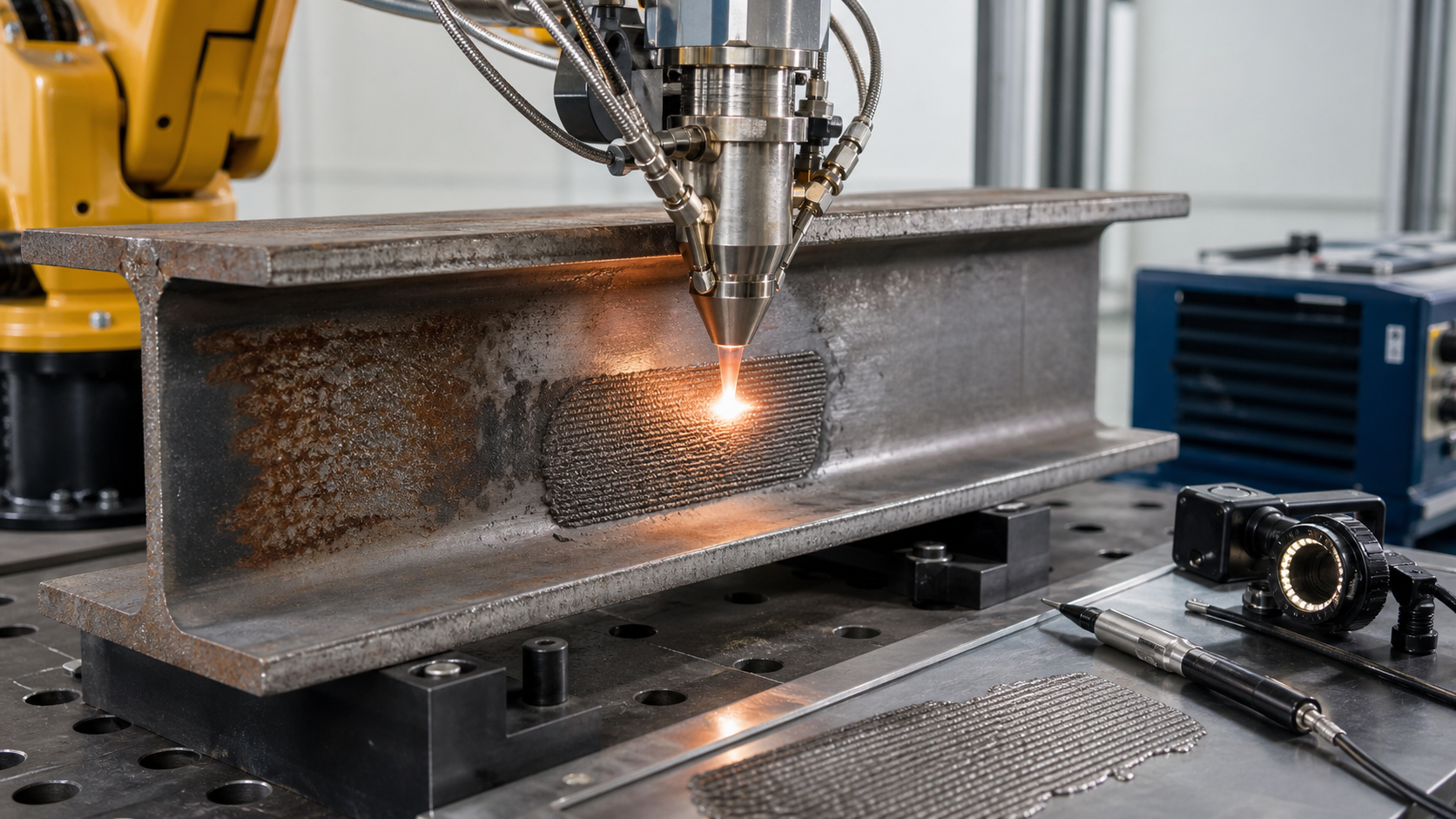
Laser cladding, also called laser metal deposition in many manufacturing contexts, uses a concentrated laser heat source to create a small molten pool on the base steel while powder or wire feedstock is added. TWI describes the result as a metallurgically bonded layer, with short heat exposure and rapid cooling compared with broader thermal processes. ASTM ISO/ASTM 52900 also provides the broader additive manufacturing vocabulary used when deposition processes build geometry by adding material.
For structural repair, that means laser cladding is closer to a controlled weld overlay than to paint, filler, or thermal spray. The deposited material becomes part of the steel surface, so the repair must be assessed for compatibility, dilution, hardness, heat-affected zone behavior, residual stress, distortion, and inspectability.
Where laser cladding may fit in steel structure repair
Laser cladding is most credible where damage is local and access is controlled. It may be considered for:
- Localized corrosion pits or shallow section loss after the cause of corrosion is removed.
- Wear-damaged bearing, guide, rail, or sliding contact surfaces on industrial steel components.
- Restoring dimensions on non-fracture-critical details after machining and inspection.
- Applying corrosion- or wear-resistant alloys to exposed steel surfaces when coating alone is not enough.
- Shop repair trials before committing to field deployment on a live asset.
It is usually a poor first choice for long cracks, unstable members, lamellar tearing, active fatigue cracking, gross corrosion over large areas, unknown steel grades, inaccessible details, or members that cannot tolerate local heating. In those cases, conventional strengthening, plate replacement, bolted repair, welded repair, CFRP strengthening, or replacement may be more defensible.
The live-load question: proceed carefully
The phrase “repair under live load” should be handled with care. A member that remains in service during any thermal repair still experiences stress, vibration, restraint, and safety risk. Laser cladding’s localized heat input can make it attractive for some in-situ repairs, but it does not automatically make live-load repair acceptable.
Before considering any in-service laser cladding work, the engineer should confirm:
- The member has adequate remaining capacity during preparation, heating, deposition, cooling, and inspection.
- The damaged region is not fracture-critical or fatigue-critical without a specific fracture mechanics review.
- Temporary shoring, unloading, isolation, or traffic/load restriction has been evaluated.
- Thermal effects, residual stress, distortion, and metallurgical changes are included in the repair procedure.
- The site has laser hazard controls, fire watch, fume control, exclusion zones, and trained operators.
For many structures, the responsible answer will be partial unloading, temporary support, or shop repair rather than true live-load repair.
Engineering checks before specifying laser cladding
1. Identify the steel and the damage mechanism
Start with drawings, mill certificates if available, field hardness checks, chemical analysis where needed, and NDT. Laser cladding should not hide an active deterioration mechanism. If chloride exposure, trapped moisture, coating failure, galvanic action, fatigue, or poor drainage caused the defect, the repair must address that cause.
2. Quantify section loss and load demand
Map the defect depth, length, width, remaining thickness, and location relative to flanges, webs, welds, bolt holes, stiffeners, connections, and bearing points. Compare the repaired and unrepaired section to governing load combinations and service requirements. For general steel repair planning, see Structural Rehab’s guide to steel structure repair for cracks, corrosion, weld defects, and fatigue.
3. Qualify the procedure before field work
Treat the cladding procedure like a special welding process that needs a written repair method, trial coupons, inspection acceptance criteria, operator qualification, and records. Variables should include base metal, feedstock, laser power, travel speed, overlap, preheat if used, interpass temperature, shielding gas, powder feed rate, bead geometry, number of layers, machining allowance, and post-repair finishing.
4. Control heat input and residual stress
One reason laser cladding is attractive is the narrow thermal zone, but heat is still heat. A thin web, restrained connection, fatigue detail, or high-strength steel may be sensitive to local hardness, hydrogen, cracking, distortion, or residual stress. Do not assume a small bead is structurally harmless.
5. Plan inspection after deposition
Inspection should be selected for the defect type and consequence of failure. Visual testing alone is rarely enough for structural repair. Consider dimensional checks, surface profile checks, dye penetrant or magnetic particle testing, ultrasonic testing where geometry allows, hardness testing, coating inspection, and follow-up monitoring.
How laser cladding compares with common alternatives
Laser cladding should be selected because it solves a specific repair problem, not because it sounds modern.
| Repair option | Best fit | Main limitation |
|---|---|---|
| Laser cladding | Local wear, corrosion pits, precision build-up, alloy surface upgrade | Needs specialist equipment, procedure qualification, and metallurgical control |
| Weld build-up or welded plates | Heavier section restoration and conventional structural repairs | Higher heat input, distortion risk, access limits, and code qualification needs |
| Bolted cover plates | Strengthening where drilling and fit-up are practical | Connection detailing, slip, corrosion traps, and fatigue detail concerns |
| CFRP strengthening | Low-weight strengthening where temperature and surface prep are controlled | Fire, UV, bond, inspection, and long-term exposure limits |
| Protective coating only | Sound steel needing corrosion prevention | Does not restore lost steel section |
If corrosion protection is the main problem, start with surface preparation and coating QA. Structural Rehab has practical guides on steel structure protection and coating systems and dry film thickness testing for steel coatings.
Safety and site controls
Industrial laser work introduces beam and non-beam hazards. OSHA notes that laser exposure can damage eyes and skin, and laser work also brings fume, fire, electrical, reflection, and access-control hazards. A field repair plan should include a laser safety officer or competent responsible person, controlled area boundaries, eye protection matched to the laser wavelength, fire protection, fume extraction, shielding, lockout where needed, and exclusion of untrained personnel.
Recommended specification language
A laser cladding repair specification should be short on marketing claims and strong on verification. Include:
- Repair objective: restore section, improve wear resistance, or provide corrosion-resistant overlay.
- Design basis: measured section loss, loads, remaining capacity, and acceptance criteria.
- Base metal identification and compatibility requirements.
- Feedstock alloy and evidence for compatibility with the steel and exposure.
- Procedure qualification test coupon requirements.
- Maximum heat input or process variables to be controlled.
- Machining, grinding, and profile requirements after deposition.
- NDT, hardness, dimensional tolerance, and coating QA requirements.
- Temporary support, unloading, fire protection, and laser safety controls.
- As-built records, photos, inspection reports, and monitoring requirements.
Limitations owners should understand
Laser cladding is not a universal repair method. It may be unavailable locally, costly for small projects, difficult on rough field geometry, and hard to qualify for fracture-critical structural members. The deposited layer may need machining or grinding, and the surrounding protective coating still needs proper reinstatement. If the original defect came from poor drainage or aggressive exposure, the repair can fail again unless the exposure is corrected.
For reinforced concrete assets that include embedded steel corrosion issues, the repair logic is different. Owners should review concrete-specific diagnosis guides such as chloride testing before concrete repair and half-cell potential testing before concrete repair.
Practical decision checklist
Laser cladding deserves serious consideration when the answer is “yes” to most of these questions:
- Is the defect local, measurable, and stable after cleaning?
- Can the steel grade and damage mechanism be identified?
- Can the structure remain safe during preparation and deposition?
- Can the contractor qualify the exact procedure on representative steel?
- Can the repair be inspected after deposition?
- Will coating, drainage, or exposure controls prevent recurrence?
- Is laser cladding better than bolting, welding, CFRP, coating, or replacement for this specific detail?
Sources and standards to review
- TWI: What is laser cladding technology?
- ASTM ISO/ASTM 52900-21: Additive manufacturing – fundamentals and vocabulary
- OSHA: Laser hazards overview
- American Welding Society: welding standards and publications
- AISC: current structural steel standards, including AISC 360
FAQ
Is laser cladding the same as welding?
It is a laser-based deposition process that creates a metallurgical bond to the base metal, so structural engineers should treat it with the same seriousness as a specialized weld overlay. It needs procedure control, material compatibility checks, and inspection.
Can laser cladding restore lost steel section?
It can build up local metal loss when the defect is suitable and the procedure is qualified. It should not be used to cover active cracking, unstable corrosion, or unknown damage without engineering assessment.
Can it be used while the structure remains in service?
Sometimes only after a project-specific engineering and safety review. In-service work does not remove the need for temporary support, load restrictions, heat-effect checks, laser safety controls, and post-repair inspection.
Does laser cladding replace protective coatings?
No. It may restore or upgrade local metal, but the surrounding steel still needs surface preparation, compatible coating, DFT verification, and exposure control.
What is the biggest risk of specifying laser cladding too early?
The biggest risk is choosing a process before diagnosing the structure. If the cause is fatigue, overload, poor detailing, trapped moisture, or widespread section loss, another repair method may be safer and more economical.
Need help evaluating a steel repair option?
Structural Rehab can review inspection findings, section loss maps, coating failures, and repair proposals before work is committed. Book a consultation to compare laser cladding with conventional steel repair, strengthening, protection, or replacement options for your structure.
Need a professional structural assessment?
Book a consultation with Structural Rehab to evaluate repair priorities, corrosion risks, and rehabilitation options before damage escalates.
Book Consultation