Cathodic protection for reinforced concrete is a corrosion-control strategy used when patch repair, coatings, or sealers alone may not be enough to manage active steel corrosion. It is most often discussed for chloride-contaminated bridge decks, marine structures, parking garages, balconies, podium slabs, industrial structures, and other concrete assets where reinforcement corrosion continues beyond the visibly damaged area.
The basic idea is electrochemical: shift the reinforcing steel toward a protected condition by supplying protective current from an anode system. In practice, the decision is more complex. The structure must be assessed, the reinforcement must be electrically continuous enough for the system, concrete resistivity and moisture matter, anodes must be detailed, and the owner must accept monitoring and maintenance. Cathodic protection should be treated as a corrosion-control system, not as a decorative add-on to a patch repair.
Why Patch Repair Alone Can Fail
Conventional concrete repair removes unsound concrete, cleans or replaces steel, restores the section, and protects the surface. That approach works well when the problem is local and the cause can be controlled. It becomes less reliable when chlorides, carbonation, moisture, or stray electrical conditions extend beyond the visible spall. In chloride-contaminated concrete, patching one area can leave adjacent reinforcement in concrete that still supports corrosion activity.
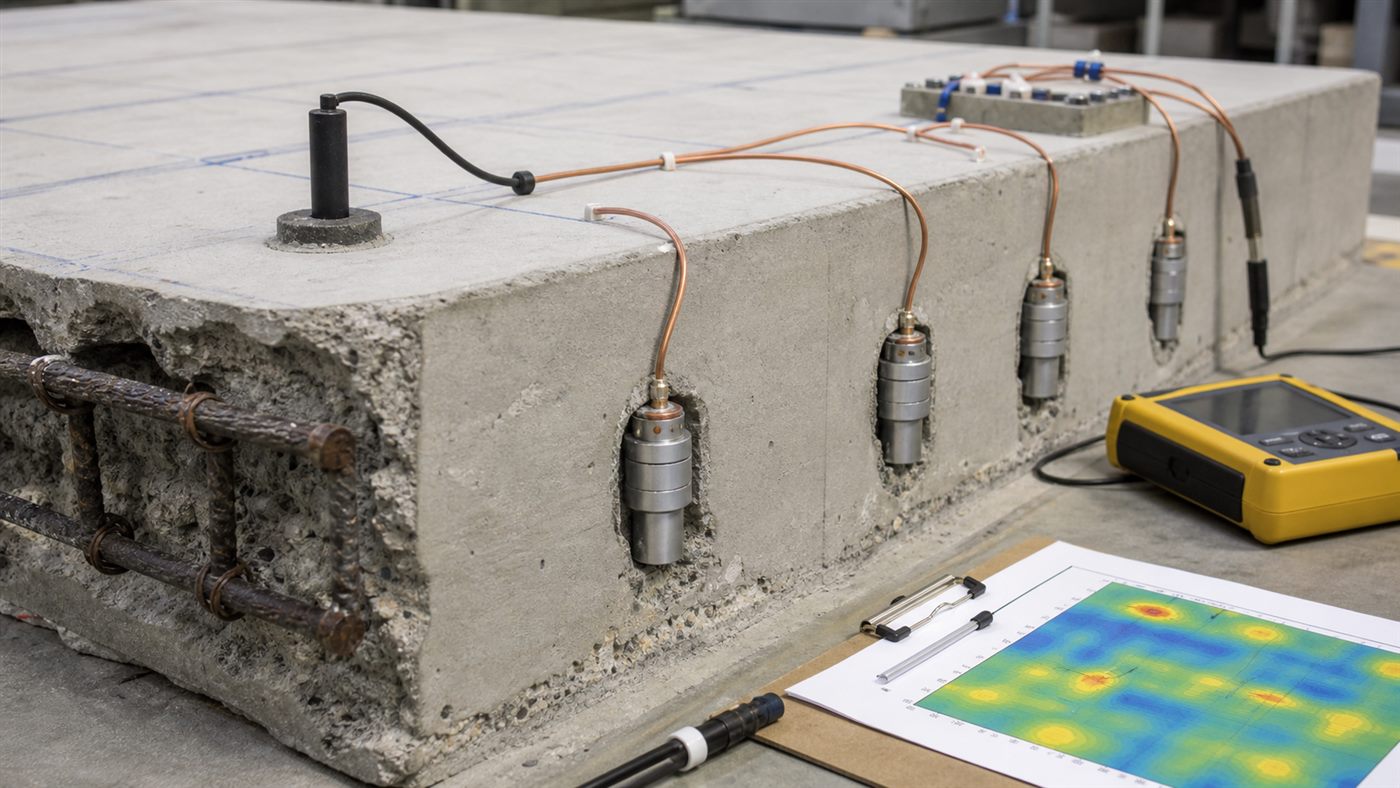
This is why diagnosis matters before selecting a repair. Chloride testing, half-cell potential mapping, resistivity testing, delamination survey, cover measurement, and crack mapping help determine whether corrosion is local or systemic. Structural Rehab has separate guides on chloride testing before concrete repair, half-cell potential testing, and concrete resistivity testing.
How Cathodic Protection Works in Concrete
Cathodic protection uses anodes and electrical continuity to reduce the tendency of reinforcing steel to corrode. In reinforced concrete, the concrete pore solution acts as the electrolyte. The protective current flows from the anode through the concrete to the embedded steel. The design must account for current distribution, concrete resistivity, steel continuity, anode spacing, exposure, moisture, and monitoring points.
ISO 12696 is the international standard for cathodic protection of steel in concrete. It provides a formal reference for principles, design, installation, commissioning, monitoring, and maintenance. Owners do not need to become corrosion engineers, but they should understand that a cathodic protection project is a system design, not a product purchase.
Galvanic vs Impressed Current Systems
Most owner decisions begin with two broad categories: galvanic cathodic protection and impressed current cathodic protection. Both can be useful, but they behave differently.
Galvanic cathodic protection
Galvanic systems use sacrificial anodes that are more electrochemically active than the reinforcing steel. They do not require an external power supply. Common uses include embedded discrete anodes around patch repairs, distributed galvanic anode systems, and localized corrosion mitigation where current demand is modest and simplicity is valuable.
The advantages are simpler installation, no rectifier, and lower operational complexity. The limitations are finite anode life, lower driving voltage, sensitivity to concrete resistivity, and the need to confirm that current output is enough for the exposure and repair objective.
Impressed current cathodic protection
Impressed current systems use durable anodes connected to a controlled DC power source. They can deliver higher and adjustable current, making them suitable for larger or more severe corrosion environments. They also require more design, commissioning, monitoring, power supply protection, and maintenance.
The advantages are control and capacity. The limitations are complexity, need for specialist design, risk of overprotection if poorly controlled, electrical maintenance, and more intensive documentation.
When Cathodic Protection Should Be Considered
Cathodic protection becomes worth studying when corrosion is active or likely to continue after ordinary repair. It is especially relevant where chloride levels are high, concrete cover is limited, moisture exposure is persistent, replacement is impractical, or the owner needs to preserve a large asset without repeated patch cycles.
- Parking garages exposed to deicing salts and recurring slab corrosion.
- Marine piles, piers, seawalls, and splash-zone concrete.
- Bridge decks, substructure elements, and joint leakage zones.
- Balconies and facade elements where corrosion extends beyond visible spalls.
- Industrial structures exposed to salts, moisture, or chemical contamination.
- Historic or critical assets where replacement would be highly disruptive.
For a broader overview of corrosion-driven repair, see reinforced concrete structural repair for corrosion damage.
Assessment Before Design
A cathodic protection design should not start from an anode layout. It should start from condition data. The engineer needs to understand reinforcement layout, continuity, cover, chloride profile, concrete resistivity, moisture exposure, cracks, delamination, prior repairs, structural capacity, and whether the concrete can support anode installation.
Minimum checks to discuss
- Concrete delamination and spall survey to define removal areas.
- Chloride testing or carbonation assessment to define corrosion environment.
- Half-cell potential mapping and resistivity testing to support corrosion-risk interpretation.
- Reinforcement continuity testing so protective current can reach the intended steel.
- Cover survey to avoid damaging bars during drilling or saw cutting.
- Structural review where section loss, cracking, or load changes are present.
Quality Control During Installation
Installation quality determines whether a cathodic protection system performs. Galvanic anodes must be positioned, connected, and embedded correctly. Impressed current anodes need proper spacing, electrical isolation where required, cabling, junction boxes, reference electrodes, and power control. Concrete repairs around anodes must be compatible and conductive enough for the design.
Commissioning should verify electrical continuity, anode connections, reference electrode function, initial current output, and protection criteria. The owner should receive as-built drawings, circuit records, test locations, operating settings, and a monitoring plan. Without this documentation, future maintenance becomes guesswork.
Limitations and Risks
Cathodic protection is powerful, but it is not universal. It does not replace structural strengthening where steel section loss has already reduced capacity. It does not fix major cracks, settlement, poor drainage, leaking joints, or unsound concrete by itself. It also may not be economical for small isolated defects where conventional repair and moisture control are enough.
Prestressed concrete needs special caution because inappropriate protection levels can create durability risks for high-strength prestressing steel. Any prestressed, post-tensioned, or safety-critical member should be reviewed by specialists before electrochemical repair is selected.
Owner Decision Framework
- Confirm the corrosion mechanism. Use testing to separate chloride corrosion, carbonation, leakage, cracking, and local defects.
- Define the service objective. Decide whether the goal is local patch durability, broad corrosion control, or service-life extension for the whole asset.
- Compare alternatives. Consider patch repair, coatings, waterproofing, galvanic anodes, impressed current cathodic protection, strengthening, and replacement.
- Check maintainability. Cathodic protection needs monitoring access and records.
- Use life-cycle thinking. FHWA’s life-cycle cost principles are relevant because the lowest first-cost repair may not control long-term corrosion risk.
How Structural Rehab Can Help
Structural Rehab can help owners decide whether cathodic protection belongs in a concrete repair strategy. We can review inspection findings, identify missing corrosion tests, compare repair options, and help define a practical scope for specialist design. Start with the consultation booking page.
FAQ
Does cathodic protection repair damaged concrete?
No. Unsound concrete still needs removal and repair. Cathodic protection controls reinforcement corrosion; it does not restore lost concrete section or fix structural cracking by itself.
Is galvanic cathodic protection enough for every structure?
No. Galvanic systems can be effective for selected applications, but severe or widespread corrosion may require impressed current systems or a different rehabilitation strategy.
How long does a cathodic protection system last?
Service life depends on system type, anode capacity, current demand, exposure, installation quality, and maintenance. It should be designed and monitored for the owner’s required service interval.
Can cathodic protection be used on prestressed concrete?
It requires specialist review. Prestressed and post-tensioned systems are sensitive to durability and electrochemical risks, so protection levels and repair methods must be carefully controlled.
Sources
- ISO 12696: Cathodic protection of steel in concrete
- ACI CODE-562-25: Assessment, Repair, and Rehabilitation of Existing Concrete Structures
- FHWA: National Bridge Inspection Standards
- FHWA: Life-Cycle Cost Analysis Primer
Need a professional structural assessment?
Book a consultation with Structural Rehab to evaluate repair priorities, corrosion risks, and rehabilitation options before damage escalates.
Book Consultation