
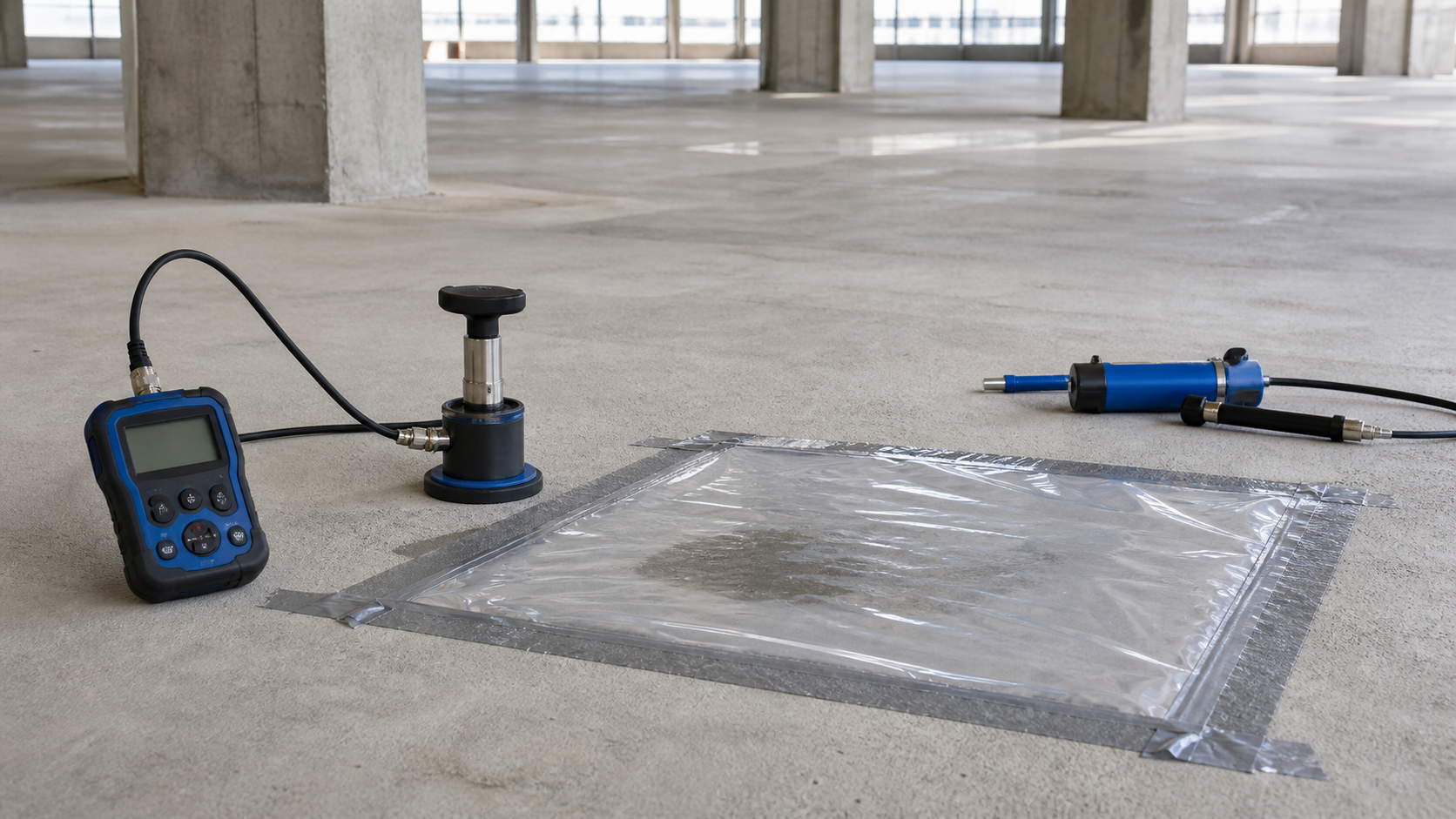
Protective coatings can reduce water, chloride, and chemical exposure, but only when the concrete substrate and the selected system are compatible. Moisture moving through concrete can interfere with adhesion, cure, or long-term service. The practical question is not simply whether concrete is “dry.” It is whether the measured condition, exposure, drainage, and vapor drive are acceptable for the specified coating at the time of application.
A defensible moisture-testing plan links every reading to a location, test method, environmental condition, and product-specific acceptance criterion. It also recognizes that a plastic-sheet indication, an electronic meter reading, and an in-situ relative-humidity result do not measure the same thing. This guide explains how owners, engineers, inspectors, and applicators can use those tools without turning one reading into a false universal pass or fail.
Why moisture matters before a concrete coating
Concrete contains interconnected pores and may receive moisture from curing, rain, washing, leaks, groundwater, or vapor transmission. A surface can appear dry while moisture remains below it. Conversely, temporary condensation can wet an otherwise acceptable substrate. Film-forming coatings may blister, lose adhesion, discolor, or cure irregularly when moisture or vapor pressure exceeds the system’s tolerance.
ASTM D4263-24 states that capillary moisture can be detrimental to coating systems that cannot tolerate moisture at or within the surface boundary. The standard’s plastic-sheet method is designed to indicate moisture before coating concrete. The key word is indicate: it is a qualitative field check, not a measurement of moisture content or a guarantee of coating performance.
Moisture is only one substrate condition. Soundness, contamination, laitance, profile, cracks, temperature, and previous treatments also matter. Coordinate moisture testing with the broader concrete surface-profile specification and with the system-selection process described in our concrete surface-protection guide.
Start with the moisture source and exposure
Before choosing a test, walk the structure and document how water could enter or leave. Look for active leaks, failed joints, blocked drains, cracks, wall-to-slab transitions, wet soil contact, recently placed repairs, washdown areas, and HVAC changes. Ask whether the element can dry from one face or two. An elevated slab exposed on both sides behaves differently from a slab-on-ground with no effective vapor retarder.
Do not use a coating to conceal an uncontrolled leak or hydrostatic condition. Repair drainage and water-entry defects first where practicable. If moisture will continue to move through the concrete, the designer must select a system specifically intended for that exposure or reconsider whether a film-forming barrier is appropriate.
Record the environment
Record air temperature, concrete surface temperature, relative humidity, recent weather, ventilation, and whether the building is operating under expected service conditions. Condensation risk depends on the relationship between surface temperature and dew point. A substrate may pass a moisture check and still be unsuitable for coating if its temperature is too close to the dew point or outside the manufacturer’s application range.
Choose the test for the decision
Plastic-sheet indication: ASTM D4263
The plastic-sheet practice is useful for finding visible condensation or darkening under a sealed area. Use the current standard’s prescribed materials, sheet size, sealing, duration, and observation procedure. Place tests in representative and suspect areas, not only where access is easiest. Protect them from disturbance and record photographs before removal.
A positive indication is a warning that requires investigation. A negative result only means the test did not indicate capillary moisture at that location during that test period. It does not quantify internal relative humidity, emission rate, or future vapor drive, and it should not override a coating manufacturer’s required quantitative method.
Electronic moisture meters
Handheld meters can rapidly compare many locations and help map relative differences. Their readings can be affected by instrument design, depth of response, concrete composition, reinforcement, salts, temperature, surface profile, and calibration. Treat a meter as a screening or mapping tool unless the project specification and coating manufacturer explicitly recognize the device and procedure for acceptance.
Establish a repeatable grid, keep the instrument orientation consistent, note reinforcement and embedded services, and confirm anomalous zones using an appropriate direct or standardized method. A number displayed as a “percentage” should never be assumed to equal gravimetric moisture content unless the instrument and calibration establish that relationship for the concrete being tested.
Relative-humidity and vapor-emission methods
For floor systems, project requirements may call for in-situ relative humidity under ASTM F2170 or moisture vapor emission testing under ASTM F1869. These methods answer different questions. F2170 measures relative humidity in prepared holes at a prescribed depth; F1869 evaluates moisture vapor emitted from a defined surface area during the test period. Neither should be substituted casually for the other.
The ICRI concrete slab moisture-testing program emphasizes the distinction between qualitative and quantitative tests, test preparation, calibration, and potential influences. Use trained personnel, current procedures, calibrated equipment, and the exact method required by the specification. Structural walls, soffits, tanks, and exterior decks may need a project-specific approach rather than a floor-covering test imported without engineering judgment.
Build a representative test plan
Divide the work into exposure zones: perimeter and interior areas, high and low elevations, repaired and unrepaired concrete, wet-service and dry-service areas, and regions over soil or enclosed spaces. Include visible damp spots and apparently dry controls. The plan should state the number and distribution of tests, timing relative to surface preparation, conditioning requirements, retest rules, and who can accept the results.
Surface preparation can expose wetter concrete or change drying. Cleaning can also introduce water. Therefore, specify whether tests occur before preparation, after preparation, or both. Final acceptance should represent the actual prepared substrate as closely as the method permits, after required cleaning and conditioning but before primer or coating placement.
Use product-specific acceptance criteria
There is no universal moisture limit for every concrete coating. Obtain the current technical data sheet and written manufacturer guidance for the exact primer and coating build, substrate type, test method, and exposure. Record the document revision. A limit stated for one instrument or method cannot automatically be converted to another.
If results exceed the limit, do not simply wait an arbitrary number of days. Identify whether the cause is residual construction moisture, active leakage, vapor transmission, wash water, or condensation. Correct the source where possible, restore specified environmental conditions, allow drying, and retest at the same locations plus representative adjacent points. A moisture-mitigation primer is a designed system choice, not a generic shortcut.
QA/QC hold points before coating
The coating should not begin until the responsible party signs the substrate-release hold point. At minimum, verify:
- active leaks, drainage defects, and uncontrolled water sources have been addressed;
- the approved coating system and its current moisture limits are documented;
- test methods, locations, frequencies, and conditioning match the specification;
- equipment identification, calibration status, and operator competence are recorded;
- air temperature, surface temperature, relative humidity, and dew-point margin are acceptable;
- surface soundness, cleanliness, profile, and previous treatments have been checked;
- all nonconforming results have an approved disposition and successful retest; and
- a representative trial area has confirmed application, appearance, and adhesion requirements.
Keep a location plan, raw readings, photographs, instrument information, weather records, and acceptance signatures in the closeout package. After cure, verify adhesion where specified; our guide to pull-off adhesion testing explains the need to document failure mode as well as peak value. For larger scopes, a mockup or trial panel can expose preparation and application problems before production work.
Limitations owners should understand
Moisture varies with time and location. A test is a snapshot under recorded conditions, not a prediction of every future season. Small test areas may miss localized paths. Surface meters can be influenced by materials and geometry. Plastic sheets are qualitative. In-situ tests require correct hole preparation, equilibration, sensor handling, and environmental conditioning. Vapor-emission tests characterize the tested surface and period, not the entire slab depth.
Testing also cannot prove that a coating is chemically compatible, resistant to service exposure, or capable of bridging movement. Review cracks and movement separately using a concrete crack-monitoring plan. Where a structural defect, corrosion mechanism, or active water pressure is suspected, obtain an engineering assessment before selecting the protection system.
Frequently asked questions
Is the plastic-sheet test enough to approve a concrete coating?
Only when the project specification and coating manufacturer accept it for that exact system and exposure. ASTM D4263 indicates capillary moisture; it does not quantify internal humidity or vapor emission.
Can a handheld meter give a concrete moisture percentage?
Some instruments display a percentage or scale, but the meaning depends on the device and calibration. Use meters for comparative mapping unless a recognized procedure establishes quantitative acceptance for the project.
Should testing occur before or after surface preparation?
Planning tests can occur before preparation, but final acceptance should represent the prepared, cleaned, and conditioned substrate. The specification should define timing because preparation and wet cleaning can change results.
What should happen after a failed moisture test?
Identify and correct the moisture source where possible, re-establish specified environmental conditions, allow appropriate drying, and retest. If moisture will remain, the engineer and manufacturer should evaluate a compatible mitigation or alternative protection system.
Does a passing moisture result guarantee coating performance?
No. Performance also depends on sound concrete, surface profile, cleanliness, material compatibility, ambient conditions, mixing, application thickness, curing, details, and service exposure.
Turn readings into a defensible coating decision
Structural Rehab can help owners develop substrate investigations, test plans, coating specifications, hold points, and repair scopes that connect field evidence to service conditions. Book a structural rehabilitation consultation to review a moisture-related coating problem or upcoming protection project. You can also use our structural repair resources to prepare better questions for the designer, testing agency, and coating manufacturer.
Sources and further reading
- ASTM D4263-24, Standard Practice for Indicating Moisture in Concrete by the Plastic Sheet Method
- ASTM F2170-19a, Relative Humidity in Concrete Floor Slabs Using In Situ Probes
- ASTM F1869-23, Moisture Vapor Emission Rate of Concrete Subfloor Using Anhydrous Calcium Chloride
- ICRI Concrete Slab Moisture Testing education overview
- Bureau of Reclamation, Moisture Content Requirements for Effective Concrete Repairs
Need a professional structural assessment?
Book a consultation with Structural Rehab to evaluate repair priorities, corrosion risks, and rehabilitation options before damage escalates.
Book Consultation