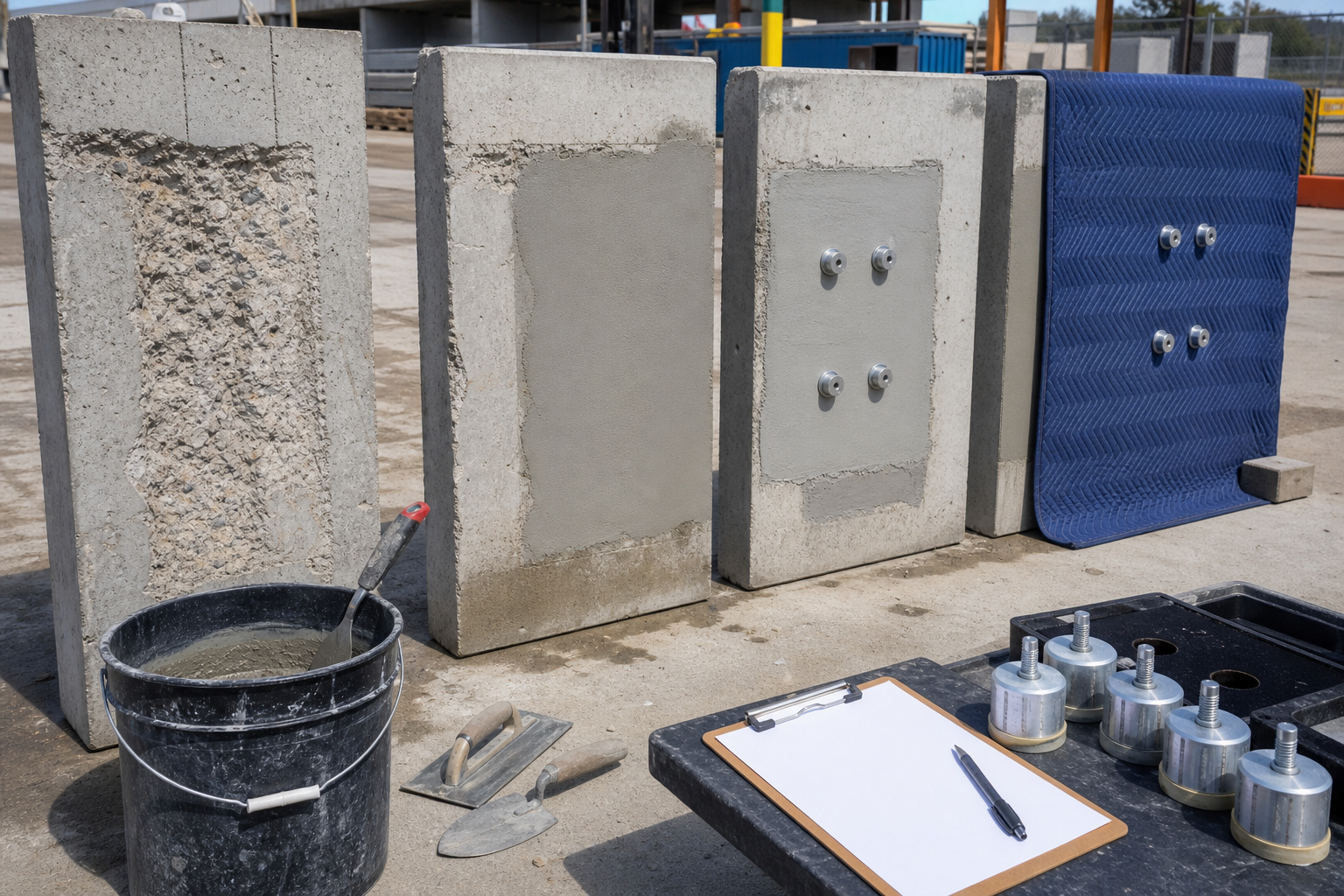
Concrete repair failures often start before production work begins. The specification may call for a repair mortar, a surface profile, a curing period, or a bond test, but the first real test of the system happens when the crew, substrate, access, weather, equipment, material, and inspection process meet on site. That is why a repair mockup is a controlled rehearsal for production risk, not a decorative sample.
Mockups and trial panels are especially useful for repetitive patch repairs, overhead repairs, shotcrete, architectural concrete, traffic-bearing overlays, cathodic protection interfaces, repair coatings, and projects where access or weather can change placement quality. Used well, they reduce rework, clarify acceptance criteria, and expose weak assumptions before the owner pays for full-scale failure.
What a Concrete Repair Mockup Should Prove
A good mockup proves more than appearance. It should show that the specified removal method reaches sound concrete without damaging reinforcement, the surface preparation can achieve the required profile, the repair material can be mixed and placed within its working time, the crew can consolidate or finish the material, curing can be maintained, and inspection criteria are practical. If bond testing or pull-off testing is required, the mockup should confirm how the test will be performed and how failure modes will be interpreted.
ACI SPEC-563-25 is described by ACI as a reference specification for repair and rehabilitation work involving structural concrete, including sections for removal, substrate preparation, materials, placing, curing, formwork, joints, embedded items, mockups, and finishing. That scope reflects how repair quality depends on the full process, not one product. ICRI’s technical resources similarly cover evaluation, surface preparation, materials selection, application, strengthening, waterproofing, and protection.
When a Trial Panel Is Worth the Time
Trial panels are valuable when the repair has a high consequence of failure, high repetition, uncertain substrate, strict appearance requirements, difficult access, overhead placement, unusual thickness, tight schedule, or new crew/material combination. They are also useful when the owner is choosing between repair materials or surface preparation methods. A small trial can prevent a large dispute about bond, color, cracking, finish, or curing.
For surface preparation, the mockup should match the actual substrate as closely as possible. A trial on new, clean concrete may not represent a chloride-contaminated, carbonated, oil-stained, fire-damaged, or microcracked member. If the real work includes soffits, vertical faces, corners, congested reinforcement, or limited headroom, the mockup should include those conditions. Structural Rehab’s guide to concrete surface profile before repair explains why profile, cleanliness, and soundness must be verified together.
Define Acceptance Before the Mockup Starts
The mockup should not become an open-ended experiment. The specification should define what will be judged and who has authority to accept it. Typical criteria include removal limits, substrate soundness, surface profile, cleanliness, reinforcement cleaning, moisture condition, form leakage, mixing sequence, application thickness, consolidation, finish, curing method, early shrinkage cracking, color range, bond test values, failure modes, and repair dimensions.
ASTM C1583/C1583M covers pull-off testing for near-surface tensile strength of concrete and bond or tensile strength of repair and overlay materials. FHWA’s tensile bond tester resource explains that pull-off testing can help determine the need for surface preparation, identify relative differences in surface strength, and evaluate preparation adequacy. The test result must be read with the failure mode. A high number with adhesive failure may not prove substrate bond; a lower number with cohesive substrate failure may tell a different story. Structural Rehab’s pull-off adhesion testing guide discusses these interpretation issues.
Use the Same People and Equipment Planned for Production
A mockup has limited value if it is built by a specialist crew with equipment that will not be used during production. The point is to validate the actual process. Use the planned removal tools, surface preparation equipment, mixers, pumps, nozzles, forms, curing materials, inspection tools, and crew roles. If the work will be performed at night or under traffic restrictions, consider whether the trial should include the same constraints.
For shotcrete, the trial should verify nozzle access, rebound control, encapsulation of reinforcement, finish, curing, and thickness control. For formed repairs, it should verify form tightness, venting, head pressure, consolidation, and stripping time. For overhead hand-applied repairs, it should verify build thickness, sag resistance, finishing, and curing. Structural Rehab’s shotcrete structural concrete repair article covers additional QA/QC points for sprayed repairs.
Record the Mockup Like a Test, Not a Photo Opportunity
The project record should include location, substrate condition, removal method, surface profile reference, cleaning method, reinforcement condition, ambient conditions, substrate moisture condition, material batch numbers, mix water or component ratios, mixing time, placement time, lift thickness, curing method, test locations, test results, photographs, and acceptance decisions. If a mockup fails, record what changed before the next attempt. That history helps prevent production crews from repeating the same failure.
The accepted mockup can become the benchmark for production workmanship. However, it should not replace inspection. Production areas still need hold points, random checks, and repair maps because substrate conditions vary across a structure.
Common Mockup Mistakes
The first mistake is building the mockup too late. If the trial is performed after materials are purchased, access is fixed, and schedule float is gone, it becomes a formality. The second mistake is testing only appearance when the real risk is bond, curing, or corrosion. The third mistake is using unrealistic substrate. The fourth mistake is accepting a mockup without defining what changes require a new trial. A different material, surface preparation method, crew, thickness, temperature range, or orientation can invalidate the original result.
Material selection also matters. If the mockup shows shrinkage cracking, weak bond, poor finish, or difficult placement, do not force the material into production just because it was specified. Revisit the selection criteria: modulus, shrinkage, permeability, thickness range, working time, curing demand, and compatibility with the existing concrete. See Structural Rehab’s concrete repair material selection guide for a broader checklist.
A Simple Mockup Checklist
- Confirm the mockup represents the actual substrate, orientation, access, and exposure.
- Define acceptance criteria before work starts.
- Use the production crew, tools, materials, and inspection methods.
- Include surface preparation, cleaning, moisture condition, placement, finishing, and curing.
- Test bond or surface tensile strength where the project risk justifies it.
- Record results and turn accepted work into a production benchmark.
FAQ
Is a mockup needed for every concrete repair?
No. Very small, low-risk repairs may not justify one. Mockups are most useful when repairs are repetitive, structural, overhead, appearance-sensitive, or exposed to aggressive service conditions.
Can the accepted mockup remain in the finished work?
Sometimes, if it is located in the work area, meets all requirements, and is approved by the design professional and owner. Otherwise, it should be removed or kept as a separate benchmark.
What should happen if the mockup fails?
Stop and identify the cause. Change only the relevant variable, such as surface preparation, moisture conditioning, material, placement method, curing, or crew technique, then repeat the trial before production.
Sources
- ACI SPEC-563-25 abstract and scope
- ICRI technical publications
- ICRI surface preparation webinar based on Guideline 310.2R
- ASTM C1583/C1583M pull-off test method
- FHWA tensile bond tester resource
Need help turning a repair specification into field-ready acceptance criteria? Book a Structural Rehab consultation to review mockup requirements, test methods, and production QA/QC before mobilization.
Need a professional structural assessment?
Book a consultation with Structural Rehab to evaluate repair priorities, corrosion risks, and rehabilitation options before damage escalates.
Book Consultation