What shotcrete can do in structural repair
Shotcrete structural concrete repair uses pneumatically placed mortar or concrete to rebuild damaged members, encase reinforcement, restore cover, and create new protective or load-carrying sections. It is common on bridge substructures, retaining walls, parking structures, tunnels, tanks, marine structures, and overhead concrete where conventional form-and-pour repairs are difficult. It can be wet-mix or dry-mix, reinforced or unreinforced, and applied in layers to match the repair geometry.
Shotcrete succeeds when the repair is treated as engineered concrete placement, not as sprayed patching. The method gives excellent access to complex shapes, but it also exposes the project to workmanship risk. Nozzle angle, air pressure, rebound control, surface moisture, reinforcement congestion, layer thickness, and curing all influence the final quality. A repair that looks sound from the outside can still contain voids, poor encapsulation, or weak bond if the work is rushed.
For owners, the practical question is not whether shotcrete is modern or efficient. The question is whether it is the right placement method for the defect, exposure, geometry, and inspection requirements. A good specification makes that decision before the crew mobilizes.
Where shotcrete is a strong fit
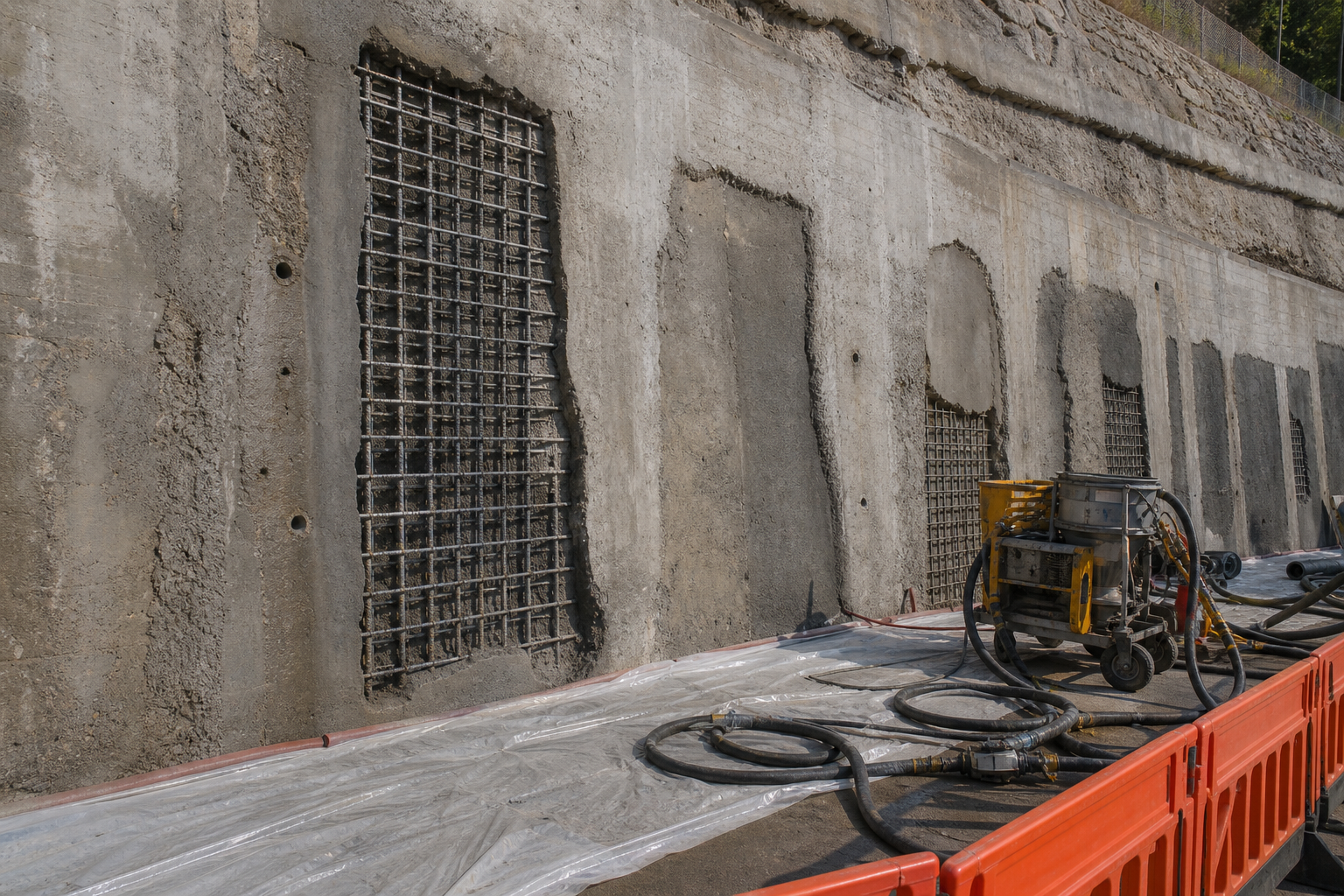
Shotcrete is often well suited for vertical and overhead repairs, irregular surfaces, large delaminated zones, beam and column section restoration, retaining wall rehabilitation, tunnel linings, and areas where forming would be slow or expensive. It can also be useful when access permits continuous placement and the crew can maintain a clean nozzle orientation.
It is not automatically the best option for every patch. Small isolated spalls may be better repaired with hand-applied repair mortar. Deep congested repairs may require form-and-pump placement if nozzle access cannot encapsulate bars. Thin cosmetic resurfacing should not be sold as structural repair. The selected method must match the design objective, not only the contractor’s equipment.
Start with removal limits and substrate condition
Durable shotcrete repair begins before any material is sprayed. The engineer should define removal limits based on sounding, delamination mapping, cracking, corrosion, contamination, and structural demand. Our guide to concrete delamination surveys explains why visible distress rarely captures the full repair area. If loose or contaminated concrete remains behind the repair, the new shotcrete may bond to a weak layer rather than to competent substrate.
The substrate should have a rough, clean, sound profile with no laitance, dust, oil, unsound concrete, or loose corrosion products. The needed roughness depends on design and material, but the principle is simple: the new material needs mechanical interlock and a clean surface. Our article on concrete surface profile before repair covers how to specify that condition instead of using vague language such as roughen as required.
Reinforcement treatment and section rebuilding
Exposed reinforcement must be evaluated before placement. The team should verify bar section loss, continuity, splice condition, anchorage, clear spacing, and cover. Light rust staining is different from meaningful cross-section loss. If bars have lost capacity, the design may require supplemental reinforcement, lap splices, mechanical couplers, or a different strengthening approach. Shotcrete can encase reinforcement, but it cannot restore steel that is no longer there.
Congested reinforcement is a special risk. Shotcrete must flow around and behind bars without leaving shadows or voids. Nozzle operators need access and correct angle, and inspectors need to watch for rebound trapped behind reinforcement. Where bars are too close to the substrate or to each other, the design may need local adjustment or alternative placement.
Material selection
Shotcrete mixtures should be selected for the exposure, thickness, structural role, and installation method. Requirements may include compressive strength, bond, shrinkage control, permeability, freeze-thaw durability, sulfate resistance, chloride limits, fiber reinforcement, accelerator compatibility, and pumpability. For structural repair, the material should be compatible with the existing concrete’s stiffness and movement. A very high-strength repair material is not automatically better if it increases shrinkage stress or creates a stiffness mismatch.
Owners should ask for preconstruction submittals that include mix design, product data, aggregate grading, admixtures, accelerator use, batch controls, curing method, and previous qualification records. For wet-mix work, delivery time and slump control matter. For dry-mix work, water control at the nozzle and operator skill are critical.
Nozzle technique and mockups
The nozzle operator is central to quality. Proper angle and distance reduce rebound and help compact the material. Layer thickness must be controlled so material does not sag, trap voids, or overheat. Rebound should be removed, not reused in the repair. Corners, bar intersections, overhead areas, and edges need special attention.
A mockup or test panel is often worth the cost, especially for structural repairs, overhead work, unusual materials, or high-visibility projects. Panels can be cored, tested, and inspected before production. They also align expectations between the engineer, contractor, nozzle operator, and owner. If the mockup reveals voiding or poor finish, it is better to correct technique before the structure becomes the test specimen.
QA/QC hold points owners should require
Shotcrete repair needs written hold points. Do not wait until the end to discover missing preparation records. At a minimum, require inspection after concrete removal, after reinforcement cleaning and supplemental bar placement, after substrate cleaning and moisture conditioning, during placement, after finishing, during curing, and before acceptance. Photographs should show repair limits, bar condition, surface profile, reinforcement details, and curing protection.
Testing may include compressive strength panels or cores, bond testing, depth checks, cover verification, sounding after cure, and selective coring where voids are suspected. For bonded structural repairs, pull-off adhesion testing can help confirm that the system is not only strong in itself but connected to the existing concrete. Acceptance criteria should be defined before work starts.
Curing is not optional
Shotcrete has a high surface area during placement and can dry quickly. Poor curing increases shrinkage cracking, reduces hydration, and weakens durability. The curing plan should match the material and exposure: wet curing, curing compounds, evaporation control, wind protection, temperature controls, or insulated blankets may be required. Freshly sprayed repairs should also be protected from vibration, impact, rain, freezing, direct sun, and rapid drying.
Owners often see the crew leave after the surface is finished and assume the repair is complete. In reality, early curing may decide whether the repair performs for years or cracks within weeks.
Common failure modes
The most common shotcrete repair problems are poor bond, voids behind reinforcement, rebound inclusion, plastic shrinkage cracking, inadequate cover, cold joints between layers, weak curing, and mismatched material properties. Many are preventable with preconstruction planning and inspection. Some are hard to detect after the surface is finished, which is why continuous observation and records matter.
Another failure mode is treating shotcrete as a cosmetic cover over unresolved corrosion. If chloride contamination, leakage, or carbonation remains active, new material may only hide the next corrosion cycle. Our guide to concrete spalling repair explains why patching must be paired with corrosion diagnosis and moisture control.
Owner checklist for bid documents
- Define repair objectives: cover restoration, section restoration, strengthening, protection, or a combination.
- Require removal to sound concrete and engineer approval before placement.
- Specify reinforcement cleaning, replacement, supplemental bars, and cover requirements.
- Require qualified nozzle operators and a preconstruction mockup when risk is meaningful.
- State testing, acceptance criteria, curing method, and documentation requirements.
- Prohibit rebound reuse and require removal of trapped rebound and loose overspray.
Sources and standards to review
- ACI PRC-506-22: Guide to Shotcrete
- USACE EM 1110-2-2002: Evaluation and Repair of Concrete Structures
- ACI CODE-562-25: Assessment, Repair, and Rehabilitation of Existing Concrete Structures
FAQ
Is shotcrete as strong as cast-in-place concrete?
It can meet structural strength requirements when properly designed, placed, compacted, cured, and tested. The main risk is not the concept; it is inconsistent execution.
Can shotcrete be used overhead?
Yes, overhead placement is one of its common advantages. It requires qualified nozzle operators, controlled layer thickness, rebound management, and careful inspection.
Does shotcrete stop reinforcement corrosion?
Not by itself. It restores cover and can improve protection, but active corrosion drivers such as chloride, carbonation, and leakage may require additional mitigation.
Should every shotcrete project include test panels?
Not every small repair needs a full mockup, but structural, overhead, unusual, or high-risk work should use panels or equivalent prequalification to confirm technique and material performance.
Need help specifying a shotcrete repair?
Structural Rehab can help define removal limits, QA/QC hold points, and acceptance criteria before bidding or construction. Review our structural rehabilitation services or book a consultation for a project-specific repair plan.
Need a professional structural assessment?
Book a consultation with Structural Rehab to evaluate repair priorities, corrosion risks, and rehabilitation options before damage escalates.
Book Consultation