
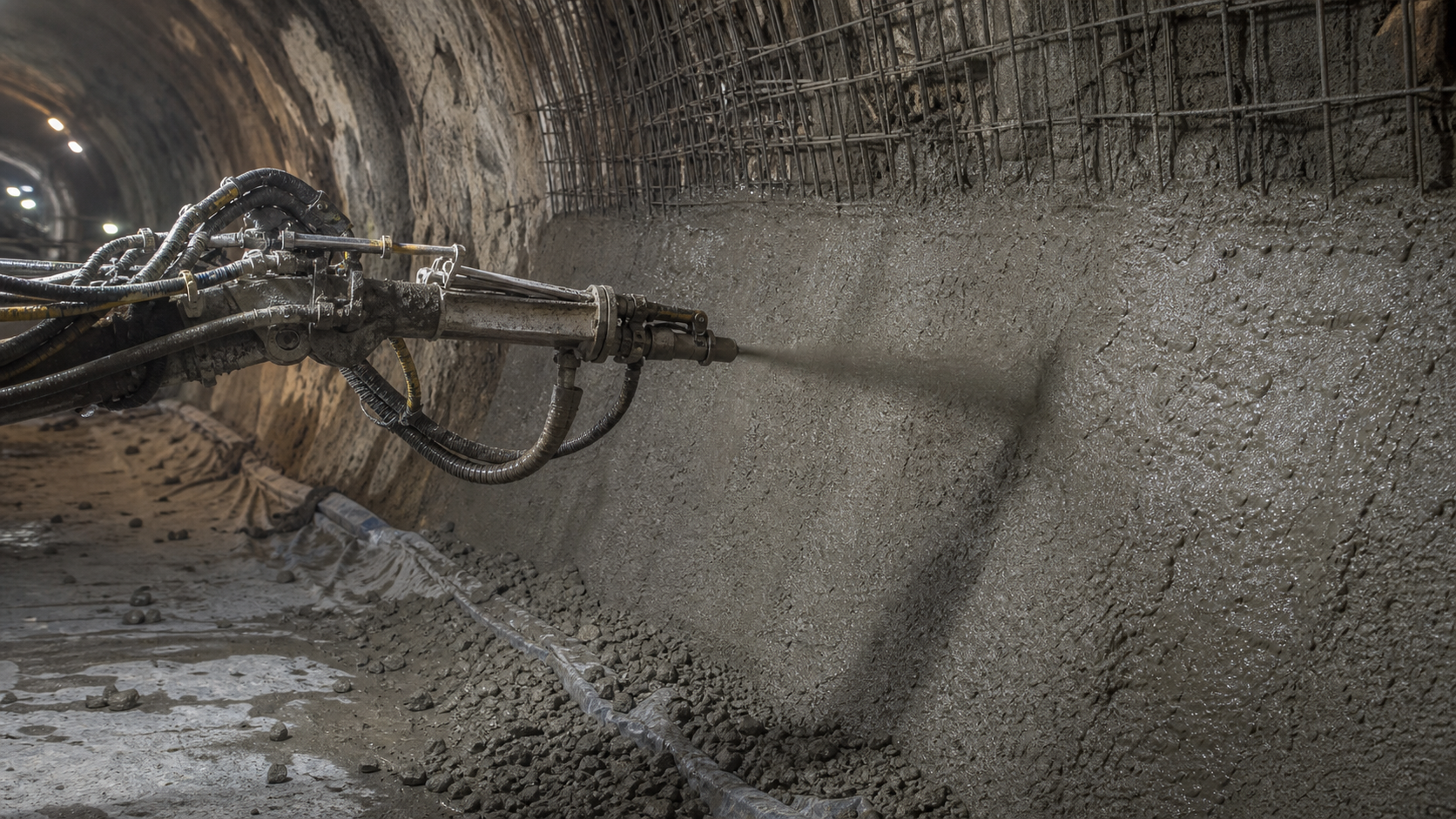
Shotcrete has transformed the construction and mining industries by providing a rapid, flexible, and cost-effective method of applying concrete to vertical and overhead surfaces. Its ability to conform to complex shapes without conventional formwork makes it valuable for tunnel linings, swimming pools, slope stabilization, and structural repairs. However, although its benefits are widely recognized, the limitations of shotcrete are often underestimated.
Beneath this high-velocity application process lies a series of technical challenges that can compromise durability, increase project costs, and create safety risks. Engineers, contractors, and project owners should understand these disadvantages when deciding whether shotcrete is the right solution—or a potential liability. For the companion design and construction perspective, see our guide to shotcrete structural concrete repair.
1. The density dilemma and permeability concerns
One significant technical challenge is the risk of variable consolidation compared with conventionally cast concrete. High-velocity impact and layered placement can trap air or create poorly consolidated zones when materials, equipment, or nozzle technique are not properly controlled. High-quality application can produce dense shotcrete, but inadequate application may result in higher void content.
Concrete develops its intended performance only when the material is properly proportioned, placed, and consolidated. Because shotcrete is consolidated mainly by impact rather than internal vibration, quality depends heavily on spray velocity, nozzle distance and angle, mixture consistency, reinforcement congestion, and the skill of the nozzle operator.
Reduced density can increase permeability. A porous shotcrete layer provides easier pathways for water and aggressive chemicals, including chlorides and sulfates, to penetrate. This can accelerate reinforcement corrosion and shorten the service life of the structure, potentially requiring early repairs or additional corrosion-protection measures.
2. Material rebound and financial waste
Both wet-mix and dry-mix shotcrete processes produce some rebound: aggregate and cementitious material that bounces away from the receiving surface before becoming embedded in the layer. The amount of rebound can vary considerably according to operator skill, equipment, mixture proportions, nozzle technique, reinforcement congestion, and surface geometry.
Rebound is not merely an aesthetic nuisance. It represents material that must be collected, removed, and disposed of, while fresh material is needed to achieve the required volume. Rebound composition may also differ from the original mixture because larger aggregate particles tend to rebound more readily. As a result, the composition of the in-place shotcrete may differ from the supplied mixture if the process is poorly controlled.
Rebound must never be incorporated into the work. Allowing loose rebound to remain in corners, behind reinforcement, or between layers can create weak, porous zones that undermine bond and durability.
3. The human factor: a high-skill process
Shotcrete is not a “set it and forget it” technology. Manual application is a demanding physical and technical task that requires a highly experienced nozzle operator. The operator must control nozzle distance, angle, movement, material flow, and air pressure while responding to changing geometry and field conditions. Maintaining accuracy throughout this process can be difficult.
An inexperienced operator may create shadowing, where areas behind reinforcement do not receive direct impact, or sagging, where fresh material falls away under its own weight. The learning curve is steep, and skilled labor may not always be available. Relying on unqualified personnel can lead to delamination, poor consolidation, excessive rebound, and costly remedial work, eliminating the schedule advantages that shotcrete initially promised.
Qualification panels and representative shotcrete mockups or trial panels help verify the crew, equipment, mixture, reinforcing arrangement, finish, and inspection procedure before production work begins.
4. Geometric challenges on complex surfaces
Shotcrete is often praised for its ability to follow complex geometries, but maintaining a uniform layer thickness on irregular surfaces can be difficult. Even with robotic equipment, achieving consistent thickness over rough rock formations, curved surfaces, corners, or reinforcement-dense areas requires careful control and frequent verification.
Inconsistent thickness can create thin areas that do not satisfy structural, durability, or fire-resistance requirements. Excessively thick areas waste material, add weight, and may increase shrinkage or sagging risks. Where reinforcing steel is present, maintaining the required concrete cover for corrosion and fire protection becomes particularly challenging.
Guide wires, depth pins, screeds, survey controls, cores, and other approved measurement methods may be required to verify the finished geometry. Reinforcement position should also be confirmed before spraying; our guide to exposed reinforcement assessment and QA/QC explains why bar condition and clearance matter.
5. The hydraulic challenge: controlling running water
Shotcrete can be effective on properly prepared dry or damp substrates, but active flowing water creates a serious placement problem. The spray stream cannot reliably create sound concrete through uncontrolled water flow. Water can dilute or wash away cement paste and create channels or voids behind the hardened layer.
If the shotcrete has not developed sufficient early strength, hydrostatic pressure may displace it from the substrate. This can create voids between the substrate and shotcrete, uneven hydration, weak bond, and a lining that leaks rather than seals.
In tunnels, retaining structures, and water-retaining facilities, drainage, diversion, sealing, or pre-grouting may be required before shotcrete application. The water source and pressure must be assessed rather than concealed behind a new layer.
6. Temperature sensitivity and curing challenges
Cement hydration and moisture retention are sensitive to ambient conditions. In extreme heat, rapid evaporation can contribute to plastic shrinkage cracking and prevent the shotcrete from developing its intended properties. High temperatures can also accelerate setting and reduce the time available for placement and finishing.
In freezing conditions, fresh shotcrete can be damaged if its internal water freezes before adequate strength develops. Cold weather also slows hydration, delays strength gain, and may extend the construction schedule. Accelerating admixtures can support early setting in some applications, but dosage and compatibility must be controlled because they may affect long-term performance.
Temperature control does not replace curing. The repair team should implement an approved curing and protection plan immediately after finishing and protect the work from rapid drying, freezing, rain, vibration, and premature loading.
7. Air voids and structural performance
Shotcrete can be vulnerable to entrapped air voids, particularly around congested reinforcement, corners, and poorly accessible areas. Air-entraining admixtures add another layer of complexity. Although a controlled air-void system may be required for freeze-thaw resistance, pumping and spraying can alter that system, making the in-place result harder to predict.
Entrapped voids reduce the effective cross-section, increase permeability, and may become crack-initiation points. Measuring the in-place air content of shotcrete can also be difficult, so specifications must clearly distinguish between tests performed on the supplied mixture and verification of the hardened material.
Visual inspection alone cannot confirm internal consolidation. Cores, sounding, petrographic examination, strength testing, and other specified acceptance methods may be needed in critical work.
8. The bonding bottleneck: delamination risks
One of the most important structural limitations is the risk of inadequate bond between the substrate and new shotcrete, especially in overhead applications. On ceilings and slab soffits, the fresh material must remain stable while developing adhesion and strength against gravity.
If the substrate is unsound, contaminated, overly smooth, improperly conditioned, or poorly cleaned, the weight of the fresh shotcrete may overcome the developing bond. Incorrect spray pressure or nozzle orientation can make the problem worse. The result may be delamination, where the new layer separates from the existing substrate and produces a hollow response during sounding. Overhead delamination can become a serious falling-material hazard.
Removal boundaries, surface roughness, cleanliness, moisture condition, and pre-placement acceptance should be treated as hold points. The required texture should be defined using an appropriate concrete surface profile, not by vague terms such as “roughened.”
9. Health, safety, and environmental hazards
Pneumatic shotcrete application can generate significant dust, particularly during the dry-mix process. That dust may contain respirable crystalline silica, which can cause silicosis and other serious respiratory diseases. Exposure risks are especially important in confined spaces such as tunnels, shafts, and enclosed repair areas.
Ventilation, wet methods, restricted access, exposure monitoring, suitable respiratory protection, housekeeping, and trained supervision are essential controls. The high alkalinity of wet cementitious material can also cause severe skin and eye injuries. Appropriate personal protective equipment, washing facilities, and emergency procedures add cost and logistical complexity but are necessary parts of the work.
Rebound, overspray, wastewater, packaging, and cleaning residues must also be contained and disposed of properly. Environmental controls should be included in the method statement rather than treated as an afterthought.
Conclusion: mitigating the risks
Shotcrete is not a universal solution. Its disadvantages—including rebound waste, variable consolidation, thickness uncertainty, bond failure, water sensitivity, curing challenges, and health hazards—require careful engineering and construction oversight.
Projects can reduce these risks by investing in:
- Robotic application: Reducing operator exposure and improving consistency in nozzle movement, distance, and angle where geometry and access permit.
- Water control and substrate preparation: Stabilizing, draining, sealing, or grouting the substrate as required before application.
- Qualified personnel and mockups: Verifying the nozzle operator, crew, mixture, equipment, and reinforcement details under representative conditions.
- Stringent testing: Using cores and other specified methods to verify thickness, consolidation, strength, and bond rather than relying only on visual inspection.
- Documented hold points: Releasing the substrate, reinforcement, environmental conditions, placement, curing, and completed work through defined QA/QC records.
When repair engineers address these limitations proactively, shotcrete remains a powerful construction and rehabilitation tool. When they are overlooked, however, a fast placement method can become a fast route to defects, delays, and premature failure. If you are evaluating shotcrete for an existing structure, book a Structural Rehab consultation to review the substrate, access, water conditions, reinforcement, acceptance testing, and alternative repair methods.
Need a professional structural assessment?
Book a consultation with Structural Rehab to evaluate repair priorities, corrosion risks, and rehabilitation options before damage escalates.
Book Consultation