A repair weld can satisfy a visual check and still carry avoidable risk if the steel was too cold before a pass or too hot when the next pass began. Structural steel repair weld preheat and interpass temperature QA/QC is the field discipline of turning the approved welding procedure specification (WPS) into measured, traceable controls. It is especially important when repair work involves restrained members, thicker material, older bridge steel, difficult access, or an engineered fatigue- or fracture-sensitive detail.
This is not a substitute for a repair design, a qualified WPS, a welding engineer, or the governing contract documents. It is a practical framework for owners, engineers, contractors, and inspectors who need to decide what must be checked, recorded, and released before welding continues.
Why preheat and interpass controls belong in a repair hold point
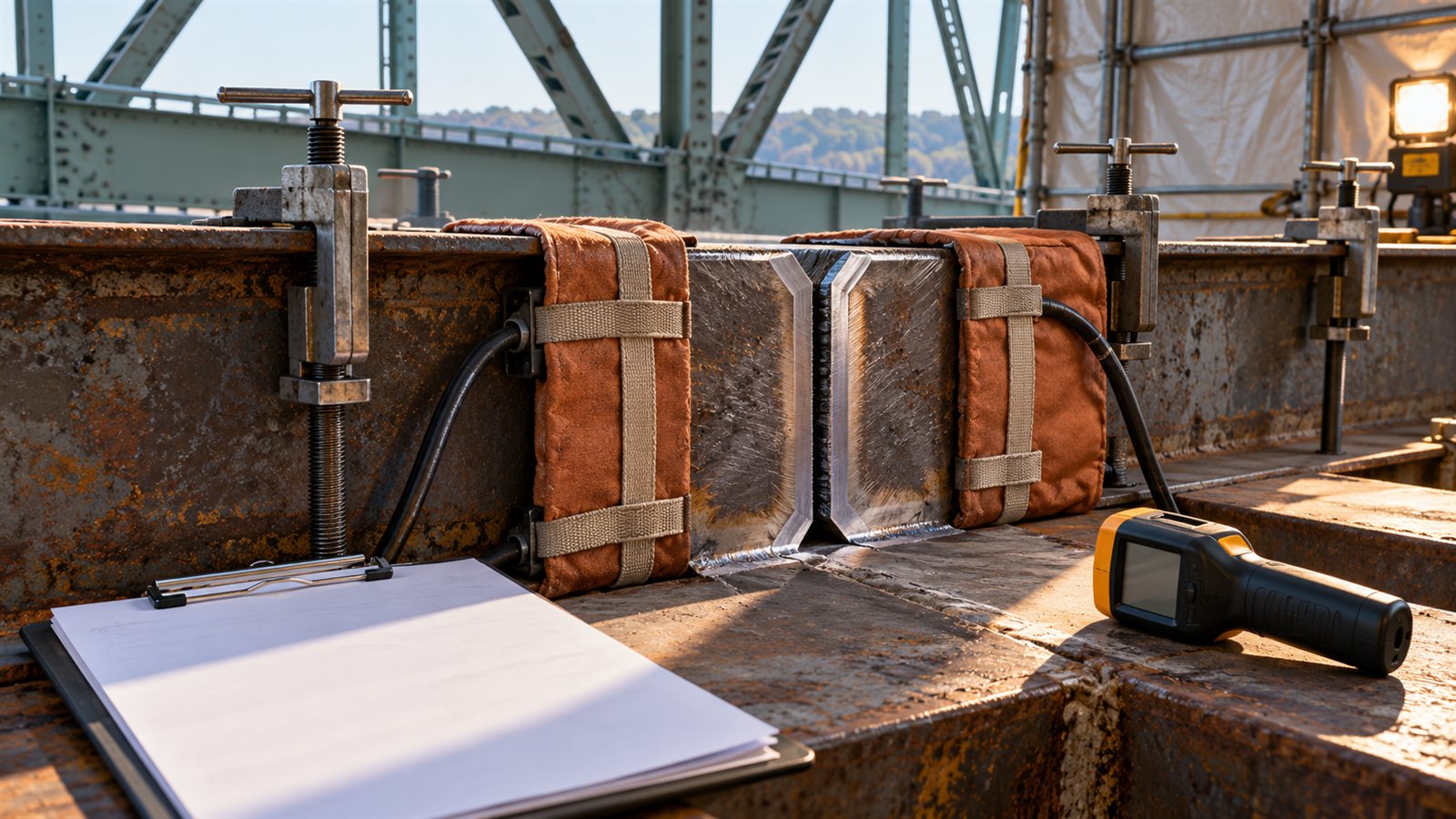
Preheat is the temperature of the base metal immediately before the arc reaches the work. Interpass temperature is the temperature of the weld and nearby base metal between passes. The applicable WPS sets the permitted range and method; it is not safe to substitute a generic temperature or a crew habit. The FHWA Bridge Welding Reference Manual explains that these controls help prevent cracking and support required mechanical properties. It also notes that the minimum preheat applies before every pass, not only at the beginning of a weld.
In repair work, the issue is rarely just heat. Existing steel may have variable thickness, coating residues that require an approved removal plan, water exposure, restraint from the remaining structure, and limited access for heating or measurement. The engineer must first decide whether welding is appropriate and define the repair sequence. The field team then needs a clear, repeatable way to show that the released conditions actually matched the approved plan.
A temperature reading is useful only when it is tied to the right joint, the right location, the right time, and the governing WPS.
Start with the approved repair package
Before heat is applied, assemble the documents that govern the work: repair drawings, member and material identification, WPS, procedure qualification support where required, consumable requirements, welder qualifications, inspection and test plan, and any owner restrictions on sequence, traffic, fire protection, or access. Resolve contradictions before the joint is released. A field inspector should not select a preheat value from memory, infer it from plate appearance, or amend a WPS at the work face.
Connect this review to the broader repair plan. Our guide to welded steel connection repair explains why assessment and engineering decisions must precede execution. For repair joints affected by corrosion or layered material, also document the condition work using the approach in structural steel pack rust repair. The record should identify the exact joint and repair stage, rather than merely saying “preheat checked.”
Build a defensible preheat verification workflow
1. Confirm the joint is ready to heat
Verify that the prepared joint, fit-up release, backing or run-off details where applicable, access, and surface condition match the approved repair details. Moisture, snow, visible contamination, or an unapproved coating-removal condition should be resolved before welding. The prior fit-up record remains important: it establishes the joint condition that the WPS is being applied to, not merely a convenient location for a temperature check.
2. Identify the specified measurement method and location
Use the temperature method accepted by the WPS and project requirements. Confirm instrument condition and any required calibration or verification. Record where the reading is taken, because a heated area can be uneven. For bridge work, the FHWA manual describes heating the steel so the required preheat is present within the specified zone surrounding the arc, including through thickness where the governing requirements call for it. A convenient reading on a nearby flange is not evidence that the weld location is ready.
3. Measure immediately before welding begins or resumes
Record the actual temperature against the WPS minimum and maximum limits, the joint identifier, pass or weld segment, date and time, device or method, operator, and inspector acceptance where required. On a long repair, a moving heat source may be appropriate only when the required condition exists where the arc will next encounter the steel. Do not treat one early reading as a blanket release for an entire shift.
4. Control interruptions
Wind, rain, a power interruption, a long pause, or a change in welding sequence can invalidate an earlier release. Define what triggers re-measurement in the inspection and test plan. If the steel falls below the WPS minimum, stop and re-establish the required condition before the next pass. If the repair condition no longer matches the assumed sequence, escalate to the responsible engineer rather than improvising.
Manage interpass temperature without creating a paperwork ritual
Interpass control has both a lower and upper boundary. The same minimum preheat condition applies before each pass. A WPS may also set a maximum interpass temperature; when the measured temperature exceeds it, welding must wait until the joint cools within the approved limit. The FHWA manual cautions that excessive interpass temperature can lead to overly slow cooling and unfavorable grain-size or toughness outcomes, with some steels more sensitive than others.
A useful field log separates observation from disposition. It should show the WPS limit, the reading, the pass or segment, and the action taken. “Hot” is not an acceptance criterion. Likewise, a cooling period with no recorded recheck is not evidence that the upper limit was met. If the team changes heating equipment, weld sequence, consumable handling, or the repair detail, pause for review because the basis for the approved WPS application may have changed.
Set practical QA/QC hold points
Hold points should be short enough to be used and specific enough to protect the joint. A typical plan can include:
- Document release: approved repair detail, WPS, personnel qualifications, consumable controls, and joint identification are available.
- Fit-up and surface release: joint preparation and access are accepted before heating and welding.
- Initial preheat release: the required temperature is measured at the required location immediately before the first pass.
- Interruption/restart release: required conditions are rechecked after a defined delay, weather event, sequence change, or loss of heat control.
- Interpass release: each relevant reading is within WPS limits before the next pass.
- Post-weld inspection release: the planned visual and nondestructive examination is completed, documented, and dispositioned by authorized personnel.
For the final release, coordinate the inspection method with the repair specification. See our explainers on magnetic-particle testing of structural steel welds and ultrasonic weld testing for the different questions those methods can address. They do not replace a qualified inspection plan or establish acceptance criteria on their own.
Plan for delayed cracking and sensitive repairs
Preheat records do not prove that a repair is defect-free. They document one necessary control. FHWA’s technical advisory on QA/QC inspections on welded-steel fracture-critical members discusses delayed cracking and the need for scheduled QA after QC. For sensitive bridge components, the repair engineer should define the examination method, timing, acceptance criteria, and escalation path. Inspection findings are evidence for an engineered disposition, not permission for a field repair outside the approved scope.
Where the work changes a connection or creates a new bolted interface, coordinate the records with direct-tension-indicator inspection for repair bolts. After acceptance, protect repaired surfaces under the documented coating system; our steel coating QA/QC guide covers the handoff from repair completion to corrosion protection.
Common failure modes to prevent
- Copying a temperature from a generic rule instead of the approved WPS.
- Measuring a remote or already cooled area rather than the imminent weld location.
- Recording only the first preheat reading and ignoring restarts or later passes.
- Using an unverified device, unclear unit, or unlabeled joint reference.
- Continuing after weather, access, fit-up, or sequence changes without an authorized review.
- Confusing a temperature log with acceptance of the completed weld.
Limitations and owner decisions
Temperature control does not determine whether welding is safe for a specific member, whether an existing crack can be welded, or whether traffic can remain over a repair. Those are engineering and project-governance decisions. Historic material, fracture-critical members, restrained details, active fatigue cracking, or uncertain material properties deserve early involvement from the responsible engineer and specialists. Require the contractor to submit traceable records, but do not turn an inspector into the designer of the repair.
For a complex repair, Structural Rehab can help owners organize condition evidence, repair-scope questions, QA/QC hold points, and close-out records for discussion with the project’s licensed design professional. Our ebook and consultation resources are educational planning aids, not a replacement for site-specific engineering.
FAQ
Is preheat required only before the first pass?
No. The governing WPS controls, and the minimum preheat requirement generally applies before each pass. The project plan should identify when the field team must measure again.
Can an infrared thermometer be used for weld preheat?
Only if the project and WPS permit the method and its use is appropriate for the surface condition and measurement location. Follow the approved procedure, keep the device traceable where required, and record the method used.
What should happen when interpass temperature is too high?
Stop welding and allow the joint to cool within the WPS limit before resuming. Record the condition and recheck; do not invent a faster cooling method unless it is authorized by the governing procedure.
Does a compliant temperature log mean the weld is accepted?
No. It documents heat-control compliance. Visual examination, required NDE, acceptance criteria, and the engineer’s disposition remain separate controls.
A preheat and interpass record is most valuable when it makes a decision auditable: the approved procedure, the actual joint condition, the measurement, and the release to proceed all stay connected.
Need a professional structural assessment?
Book a consultation with Structural Rehab to evaluate repair priorities, corrosion risks, and rehabilitation options before damage escalates.
Book Consultation