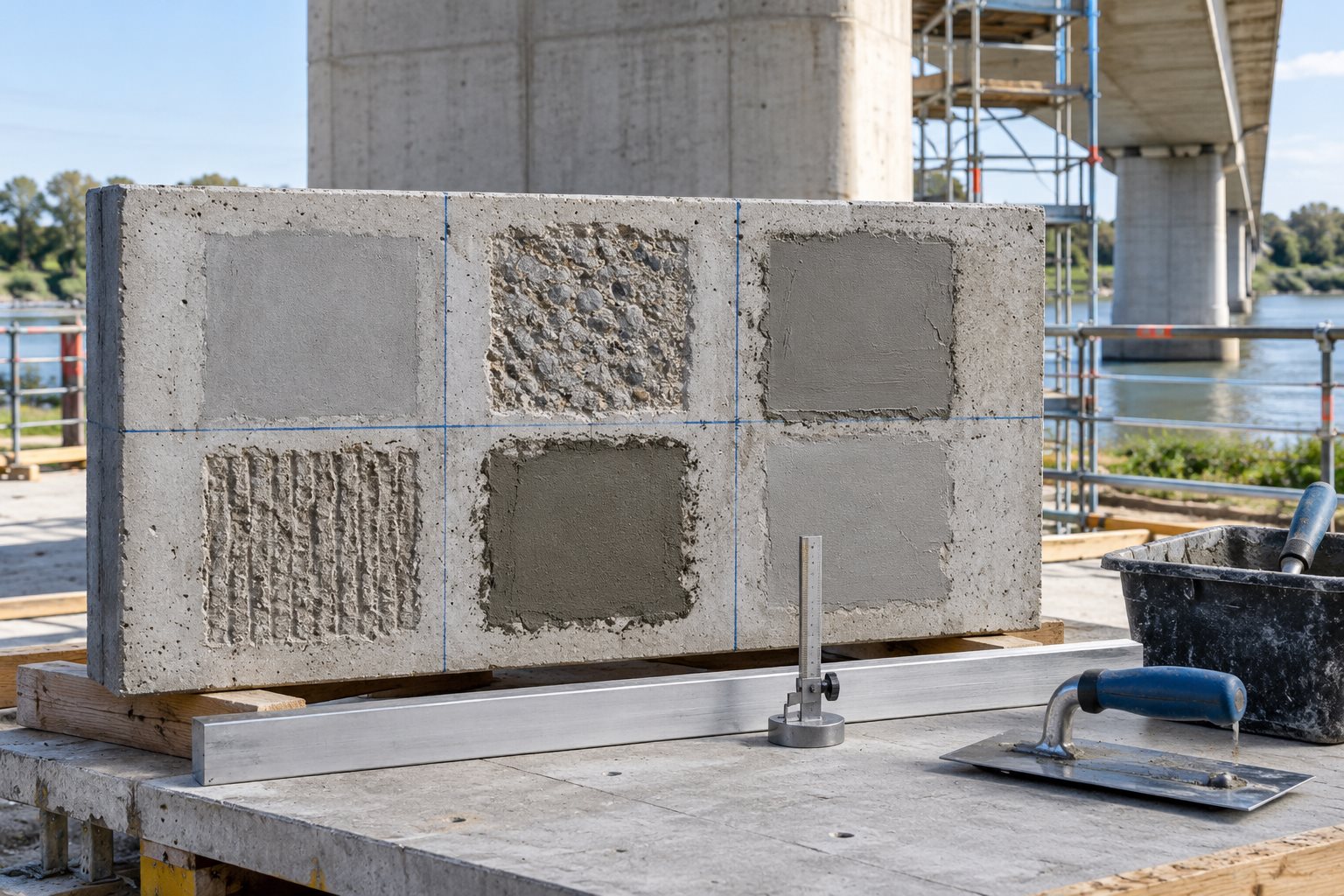
A concrete repair mockup panel is a controlled preconstruction trial that lets the project team prove a proposed repair sequence before it is repeated on the structure. It is not a decorative sample. When it is planned around the actual substrate, repair material, access, surface preparation, placement method, curing, and inspection criteria, it exposes practical conflicts early—when they can still be corrected without turning production work into an experiment.
Mockups are especially valuable for structural patches, overhead work, formed repairs, congested reinforcement, new-to-the-project materials, and repairs where appearance or durability matters. They help the owner, engineer, contractor, material supplier, and inspector agree on what evidence is needed before production begins. A successful panel does not automatically approve every future repair area; it establishes a repeatable method and a baseline for field acceptance.
Start with a decision, not a sample
Before building a panel, write down the decision it must support. The question might be whether the selected material can be consolidated around exposed reinforcement, whether the specified surface condition can be achieved, whether a formed placement is leak-tight, or whether the curing sequence is feasible in the actual work environment. Tie each question to an acceptance criterion and a person authorized to accept or reject the trial.
ACI’s repair-code resources describe repair as an assessment, design, and implementation process rather than a material-only choice. That is a useful mindset for mockups: the panel should test the installed system, including the substrate and workmanship variables that affect it. A product data sheet may demonstrate a material property under laboratory conditions, but it cannot by itself prove that a field crew can reproduce the specified repair on a particular structure.
A mockup is a production rehearsal with recorded evidence, not a substitute for an engineered repair design. The engineer of record still determines repair limits, reinforcement disposition, loading restrictions, and final acceptance criteria.
Design the panel to resemble the work
Use a representative substrate whenever practical. A purpose-built panel can be appropriate, but it should include relevant features: the anticipated repair depth, vertical or overhead orientation, edges, reinforcement congestion, form tie locations, and exposure condition. If production work includes a change of plane, a narrow cavity, or a large formed pour, include that condition rather than testing only an easy flat patch.
Identify the same approved repair material, batch size, mixing equipment, water-control method, placement tools, forms, consolidation method, and curing materials planned for the work. If the project permits more than one material or method, build a separate panel for each meaningful combination. Do not quietly substitute a convenient mortar, small mixer, or different form system and then call the outcome representative.
TxDOT’s concrete repair manual emphasizes removing unsound material without damaging sound concrete, providing clean sound substrate, allowing adequate clearance around exposed reinforcement, and ensuring repair material can flow and consolidate in tight places. Those are exactly the conditions a good trial should make visible. For the surface-preparation record, use our concrete repair surface-profile QA/QC guide alongside the project specification.
Set hold points before the work starts
A short inspection and test plan prevents a mockup from becoming a photo opportunity with no usable conclusion. Typical hold points are listed below; the project documents should refine them to the repair system and risk.
- Substrate release: document removal limits, soundness, edge geometry, cleanliness, reinforcement condition, and required surface moisture condition.
- Material release: record product identity, storage condition, batch or lot traceability, mixing time, water addition if permitted, ambient and substrate conditions, and working-time limits.
- Placement release: confirm form tightness, vents or fill path where relevant, access, lift sequence, consolidation method, and protection of adjacent sound concrete.
- Curing release: identify the curing method, start time, protection from drying or temperature extremes, and any form-removal constraint.
- Acceptance review: compare the panel with specified visual, dimensional, bond, soundness, or strength criteria and document the disposition.
Keep the records attached to the panel identification and the project area it represents. A daily record should show what was released, who observed it, what changed, and whether the same method can move to production. Our concrete repair daily-log guide explains how to connect field observations to traceable QA/QC evidence.
Run the trial as the crew will work
Prepare, clean, and verify the substrate
Follow the approved removal and preparation method, including edge treatment, roughening, cleaning, and moisture conditioning. FHWA notes that successful partial-depth repairs depend heavily on complete removal of unsound concrete, clean substrate, controlled placement, and prompt curing. The exact pavement details on that page are not universal building-repair criteria, but the construction principle transfers: a repair trial should reveal whether the proposed preparation leaves a sound, clean, compatible interface.
Record the actual condition rather than merely checking a box. If the specification calls for a concrete surface profile, compare it using the project’s accepted method. If reinforcement is exposed, record clearance and any engineer-directed treatment. Do not use a mockup to authorize changes to bar cover, anchors, or repair boundaries; route those changes through the project’s approved engineering process.
Mix and place within the approved limits
Use the same crew roles, timing, and equipment intended for production. Note the time each batch is mixed and placed, the quantity used, observed workability, lift thickness, consolidation approach, and finishing steps. If the repair is formed, observe leaks, trapped air, venting performance, and pressure effects. A mockup that only succeeds with extra workers, an extended working time, or off-spec water addition has identified a production problem, not a qualified procedure.
Where the selected material requires substrate saturation, bonding agent, primer, or temperature control, demonstrate it exactly as specified. The TxDOT manual, for example, treats clean substrate, moisture condition, consolidation, and curing as connected field controls. The project specification and manufacturer instructions govern the particular system; when they conflict, stop and obtain the designated technical disposition rather than improvising.
Cure and inspect at the correct time
Start curing promptly and document the method, duration, protection, and any deviations. Inspect only after the applicable curing or test age. Visual review can identify cracking, leakage paths, voids, discoloration, edge failure, or unfinished areas; sounding can be a useful screening observation where the project procedure allows it. For a controlled discussion of that limitation, see post-repair sounding for concrete patches.
Where the contract requires bond testing, strength specimens, trial cores, or other measurements, state the sampling location, age, test method, laboratory, and acceptance rule in advance. Do not reverse-engineer a passing criterion after the result is known. A panel can also establish the appearance standard for exposed work, but appearance alone should not override structural or durability requirements.
Convert lessons into a production release
Close the mockup with a brief written disposition: accepted as demonstrated, accepted with listed revisions, or rejected. If accepted with revisions, update the work plan, hold-point checklist, crew briefing, and material instructions before production starts. If a recurring issue was seen—such as inadequate clearance, a form leak, poor finishability, or an impractical curing method—correct it on another trial or obtain the engineer’s direction. Do not assume that a successful small panel validates a larger pour, a different orientation, or a different weather exposure.
Production records should reference the accepted panel and confirm that the approved variables remain in place. A shift in material lot, mixing equipment, crew, substrate condition, repair geometry, or weather protection may require re-evaluation. This is where a mockup earns its value: it gives the team a documented baseline instead of relying on memory or verbal agreement.
Common failure modes
- Testing an easy condition: a flat, shallow panel does not qualify an overhead or congested repair.
- Leaving acceptance undefined: photos without criteria cannot show whether the method is ready.
- Changing several variables at once: when the panel fails, the team cannot identify the cause.
- Skipping cure documentation: repair performance can be affected long after a good-looking placement.
- Treating the mockup as design approval: engineering changes require the project’s formal review path.
Limitations and engineering judgment
This is general guidance, not a repair specification or construction safety plan. A mockup cannot establish the capacity of an existing member, the adequacy of shoring, corrosion condition, compatibility of every material, or the suitability of a repair design. The engineer of record should set the panel scope, testing, acceptance criteria, and any required requalification. Stop for project-specific direction when work reveals unexpected deterioration, prestressing, instability, restricted access, or conditions that depart from the repair design.
FAQ
Does every concrete repair need a mockup panel?
No. The project team should decide based on repair risk, novelty, geometry, exposure, contract requirements, and the consequences of poor installation. A documented preconstruction trial is particularly useful when workmanship variables are difficult to control.
Can a manufacturer’s sample board replace a project mockup?
Usually not. It may show a product’s intended use, but a project mockup should represent the project substrate, repair geometry, crew, equipment, and curing controls.
What should happen if the mockup fails?
Document the observation, identify the variables that need correction, and obtain the appropriate engineering or manufacturer-supported direction. Repeat the trial when needed; do not carry an unqualified method into production.
Use the trial to make production predictable
A concrete repair mockup panel gives the team a practical way to test workmanship before it affects the structure. Structural Rehab can help owners develop repair assessment scopes, preconstruction hold points, and evidence-based QA/QC plans for existing concrete structures. This article is general information and does not replace a project-specific structural assessment, repair design, or safety plan.
Sources
- ACI 562 Repair Code resources
- TxDOT Concrete Repair Manual: Major Spall Repair and Concrete Replacement
- FHWA: Partial-Depth Concrete Repair Construction
Need a professional structural assessment?
Book a consultation with Structural Rehab to evaluate repair priorities, corrosion risks, and rehabilitation options before damage escalates.
Book Consultation