
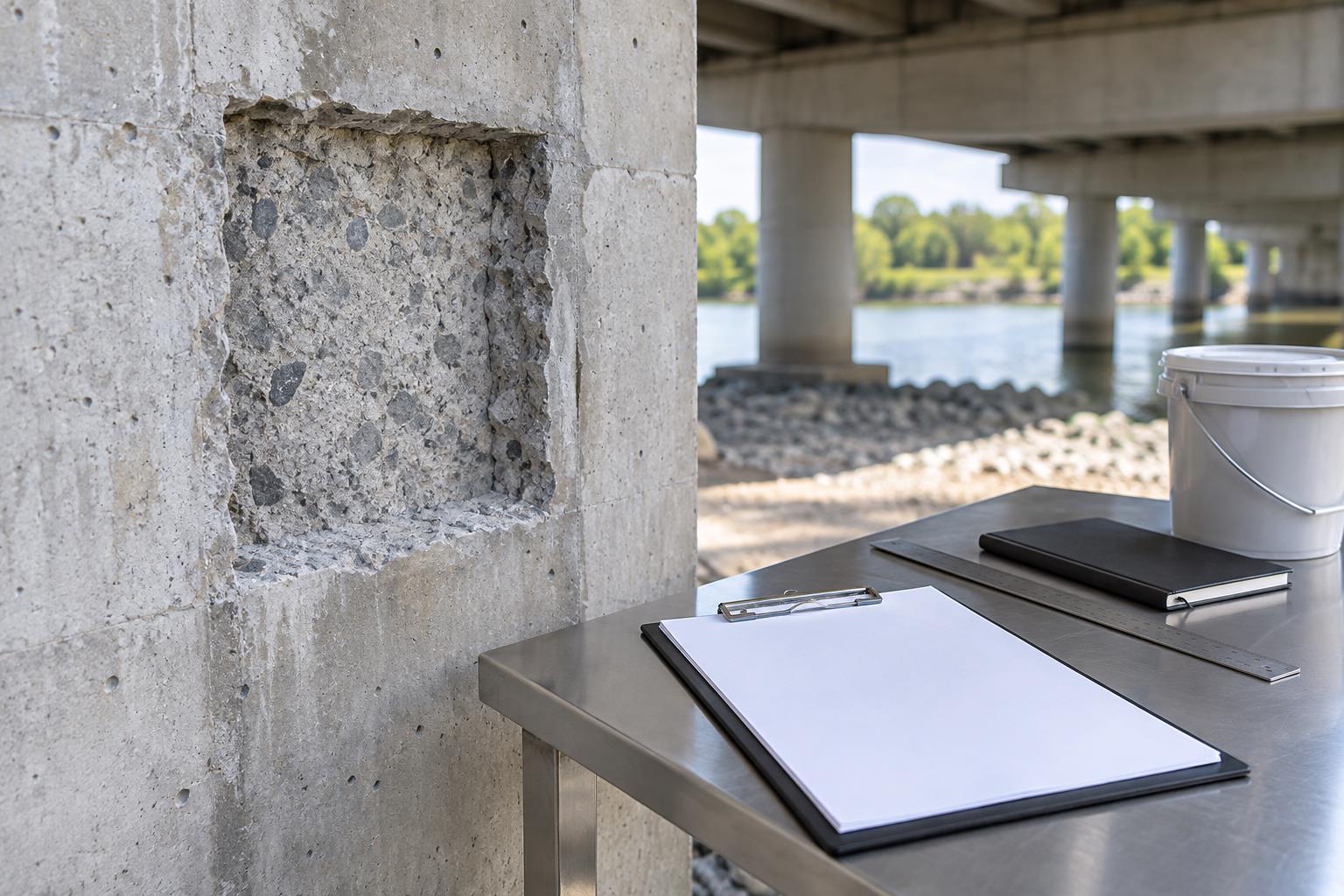
A concrete repair daily log is the record that connects what was approved on paper to what happened at the repair location. It should make it possible to answer practical questions later: which area was released, what material and batch were used, what conditions were observed, what hold points were cleared, and what changed when the work did not proceed as planned.
This is not a call for duplicative paperwork. It is a field-control workflow for structural concrete repairs, where a small missing fact can make a later bond, curing, or material investigation needlessly difficult. The project specification, repair design, and manufacturer instructions remain controlling. A daily log documents work; it does not replace inspection, testing, engineering judgment, or formal acceptance.
Start with the decision the log must support
Before issuing a template, define the decisions that the record needs to support. A useful log can show that the crew worked only in released repair areas, placed the specified product under acceptable conditions, followed the approved procedure, and reported deviations promptly. A poor log merely repeats a weather forecast and a headcount.
ACI’s guide for jobsite QA/QC of cementitious packaged materials includes a daily log within its quality-control framework, alongside delivery, storage, batching, testing, and curing. That is a helpful organizing principle: the record should connect controls rather than isolate them. It does not prescribe a universal one-page form for every repair type.
Use the repair plan to decide the fields. A bridge-deck patch, a vertical column repair, and a post-installed strengthening system do not have identical risks or hold points. Start with the planned sequence, then add only fields that demonstrate compliance or make a future disposition possible.
Identify the repair location precisely
Every entry should tie the day’s work to a durable location reference: member identification, gridline or station, elevation, face, cavity number, drawing reference, or a controlled repair map. Describe the work boundary enough that a reviewer can distinguish adjacent repairs. “North wall patching” is usually weaker than a marked plan location with the individual repair references listed.
Location control matters before material reaches the workface. The site’s pre-placement inspection guidance explains why substrate and release conditions need a hold point before placement. Put the release time, responsible role, and exception reference in the daily record rather than assuming a later signature reconstructs the sequence.
Photographs can help, but they need context. Link photos to the repair identifier, date, and stage—such as after removal, before placement, or after initial cure protection—without treating a photograph as proof of every hidden condition. Follow the project’s privacy, safety, and document-control requirements when taking and storing images.
Record environmental conditions that affect the work
Record the measured site conditions required by the approved repair procedure, the location and time of the reading, and the instrument or method where that information is relevant. Do not turn a single air-temperature reading into a conclusion about substrate temperature, wind exposure, or material temperature. Those are different conditions and may require different checks.
Use the same condition record to show the action taken. If sun, wind, rain, or temperature required a change in work timing, protection, curing, or area release, state the decision and its authority. The site’s hot-weather concrete repair QA/QC guide and cold-weather repair guidance are useful related reading, but neither substitutes for the product-specific limits and the approved project procedure.
A condition record should be factual. Write “substrate reading taken at 09:10; placement deferred pending shade and recheck” rather than “conditions acceptable” when the basis was not documented. A transparent note is more useful to the owner and to the repair team than a generic assurance statement.
Link the approved material to each batch
For packaged repair materials, the log should identify the approved product, its lot or batch information when required, mix water or component proportions, mixing time, and the repair area receiving the material. Keep this record connected to receiving and release controls; a batch sheet cannot prove that a material was eligible if its lot was held or its package condition was unresolved.
TxDOT’s intermediate spall-repair material guidance calls for retaining manufacturer lot tags with packaged date and shelf life for inspection before use. Its details apply to that agency’s work, not automatically to every project, but they demonstrate why material identity belongs in the record chain. For large replacement work, record the concrete batch ticket or equivalent production record as specified.
Coordinate this entry with the jobsite mixing QA/QC process. The daily log does not need to copy every mixer observation if a controlled batch record exists; it should point to it and note which repair locations received each batch. This prevents a stack of disconnected forms from becoming the project record.
Capture hold points, tests, and deviations
List the planned hold points that were reached that day, who released them, and the applicable reference. Examples may include completion of unsound-concrete removal, reinforcement review, substrate preparation, material release, trial placement, or curing-protection installation. The actual list must come from the approved repair procedure; do not invent a hold point just to fill a template.
Record tests with their actual status: sampled, performed, pending, accepted, rejected, or awaiting engineering review. Include the test reference, location, specimen or report identifier, and any result available at the time. Never record a future result as passed simply because the specimen was taken. A daily log should clearly distinguish a completed observation from a later acceptance decision.
When work deviates from the plan, document the observation, immediate containment, affected repair identifiers, notification, and disposition reference. A deviation is not necessarily a failure; a hidden or undocumented deviation is harder to evaluate. Do not quietly adjust water, rework a set material, expand a repair boundary, or substitute a product without the authority required by the contract and repair design.
A daily log is strongest when it records the decision point, the evidence, and the repair area together. This enables the engineer or owner to trace a concern without assuming that every event on a shift applied to every repair.
Use a practical daily-log structure
A concise template can be organized into the following sections. Adapt it to the project rather than treating it as a universal specification.
- Administrative: project, date, shift, contractor, inspector, approved repair procedure revision, and work area.
- Location and scope: member or map references, planned work, actual work completed, and changes to the day’s sequence.
- Conditions: required readings, time, location, method, and any protections or work restrictions.
- Materials and batches: approved product, lot or ticket reference, components, mix record reference, and repair-area linkage.
- Hold points and verification: released stages, observations, test identifiers, photographs, and outstanding results.
- Exceptions and close-out: deviations, notifications, corrective actions, incomplete work, curing/protection status, and next-shift constraints.
Assign a preparer and a reviewer appropriate to the contract. The reviewer should not be asked to certify facts that were not observed. Electronic forms may improve searchability and photo links, but they still need controlled edits, date/time information, and a way to preserve the original entry when a correction is made.
Do not confuse records with acceptance
Good records make acceptance decisions auditable; they do not make them automatic. TxDOT’s QA/QC guidance distinguishes contractor quality control from owner quality assurance and describes the need to confirm material suitability, sound substrate, and repair performance. The allocation of authority on a specific project must come from its contract documents.
Likewise, a completed log cannot prove long-term durability. Bond testing, strength verification, curing, monitoring, and other acceptance activities have their own methods and timing. The log should link to those records and flag what remains open at the end of the shift.
Close each day without losing open items
Before the shift closes, reconcile the repair areas entered, material issued, batches placed, tests initiated, and photographs or maps referenced. State the status of repair areas left exposed, partially placed, or under curing protection. Identify who owns the next action and what condition must be met before work resumes.
For recurring repair programs, periodically review the logs for patterns: repeated weather delays, recurring material holds, unplanned boundary changes, or missing location references. The review is an opportunity to improve the repair procedure or training; it should not be used to erase inconvenient facts from the original record.
Frequently asked questions
Is a daily log required for every concrete repair?
Requirements depend on the contract, repair design, product instructions, and owner controls. Even when a formal daily report is not mandated, a proportionate record can help establish what work was performed and what evidence supports it.
Can one log cover several repair areas?
Yes, if each area can still be identified and linked to its material batches, observations, and exceptions. Split the entry when a single summary would make those links ambiguous.
Should a log include test results that are still pending?
Include the test or sample identifier and show that the result is pending. Record the eventual disposition in the controlled test or acceptance record rather than predicting it in the daily log.
Can a photo replace a written location reference?
No. A photo can support a record, but it needs a clear repair identifier, date, and stage. A controlled map or drawing reference makes the evidence easier to retrieve and review.
Plan repair records that answer the owner’s questions
If your team needs a clearer evidence trail for a concrete repair program, request a Structural Rehab consultation. Bring the repair procedure, proposed daily form, and a sample repair map so the discussion can focus on the decisions, inspections, and records the project actually needs.
Need a professional structural assessment?
Book a consultation with Structural Rehab to evaluate repair priorities, corrosion risks, and rehabilitation options before damage escalates.
Book Consultation