Cold-weather concrete repair needs a protection plan that follows the installed repair through the night, not just a favorable temperature at mixing. A warm batch can contact a cold member, lose heat at thin edges, and develop strength more slowly than the construction schedule assumes. Owners should ask for evidence that the substrate, repair material, and protection system remained within their approved limits until each release decision was authorized.
This guide addresses cementitious repairs to concrete buildings, bridges, and similar structures. It focuses on temperature control and acceptance during cold exposure. It does not provide a universal minimum placement temperature, heating duration, or permission to load a repaired member.
When does a repair need a cold-weather plan?
ACI 306R-16 identifies cold-weather conditions when air temperature falls, or is expected to fall, below 40°F (4°C) during the protection period. That is a planning trigger, not an application limit for every repair mortar. The approved product and project specification may require warmer conditions. ACI also distinguishes protection from early freezing, strength development for support removal, and control of rapid cooling. See the ACI guide preview for its scope and principles.
For an individual repair, review the forecast across placement, curing, and planned uncovering. Include weekends and unattended hours. A daytime appointment on the program does not describe the exposure of a thin patch at dawn. Resolve conflicting project and manufacturer requirements before issuing the work permit; the crew should not have to choose between incompatible instructions at the mixer.
Specify separate limits for separate decisions
Build the cold-weather submittal around a short decision register. For each item, name the applicable requirement, measurement method, responsible person, and action when the requirement is not met. The following is a suggested project-management format, not a replacement specification:
- Material storage: approved storage range, condition of bags or components, and release from the storage area.
- Placement: permitted substrate and mixed-material temperatures, surface condition, and available protection.
- Protection: monitored locations, permitted temperature range, inspection frequency, and response arrangements.
- Uncovering: required evidence and the approved sequence for reducing thermal protection.
- Loading: the engineer’s separate criteria for forms, shores, traffic, or other construction loads.
Use the concrete repair material selection guide to assess compatibility before proposing a faster product. A change intended to accelerate winter work still needs review for the structural repair function, geometry, exposure, and installation method.
Check the existing concrete before accepting the placement window
ICRI’s discussion of cold-weather concrete repair practices emphasizes material-specific instructions, preparation of cold substrates, and the need to manage protection as conditions change. Existing concrete and forms need attention alongside the delivered material. Thin repairs should not be assumed to produce or retain the heat of a large concrete placement.
Use a marked inspection sketch to identify exposed corners, sheltered faces, deep recesses, and boundaries next to unheated concrete. Record where each reading was taken. A single measurement near a heat source is a poor description of a repair area with different exposures. Confirm that ice and frost are absent and that the prepared surface meets the approved moisture and cleanliness requirements.
Recheck after an interruption. Opening an enclosure, completing a wash, or waiting for a delayed delivery can change the conditions that were previously accepted. Attach the cold-weather measurements to the normal pre-placement inspection hold point, with a named person authorized to release the work.
Measure fresh material and the protected repair separately
ASTM C1064/C1064M-23 covers temperature measurement of freshly mixed hydraulic-cement concrete. Its published significance statement makes an important distinction: a result describes the temperature at the time of testing and may not represent a later temperature. A compliant fresh-concrete result therefore does not establish the overnight temperature of the installed repair.
For packaged products, confirm the applicable measurement procedure in the approved instructions. Log the material identity, batch, time, location, instrument, and result so a later reviewer can connect each placement to its evidence. Keep fresh-material readings distinct from substrate, enclosure-air, and embedded-sensor records. Similar-looking numbers from different locations answer different questions.
For continuous monitoring, the engineer should select representative sensor positions and any critical cold locations. Include a sensor-location drawing in the file and check that channel names correspond to those positions. Before placement, demonstrate that the logger records correctly, that alarms reach the assigned person, and that records can be exported after a power or communications interruption.
Arrange overnight protection before mixing begins
A cold-weather repair is not ready for placement until its overnight protection has an owner. This is a practical management rule: name the person who checks conditions, receives alarms, accesses the enclosure, and calls for engineering disposition. Assign a backup for a missed call or shift change.
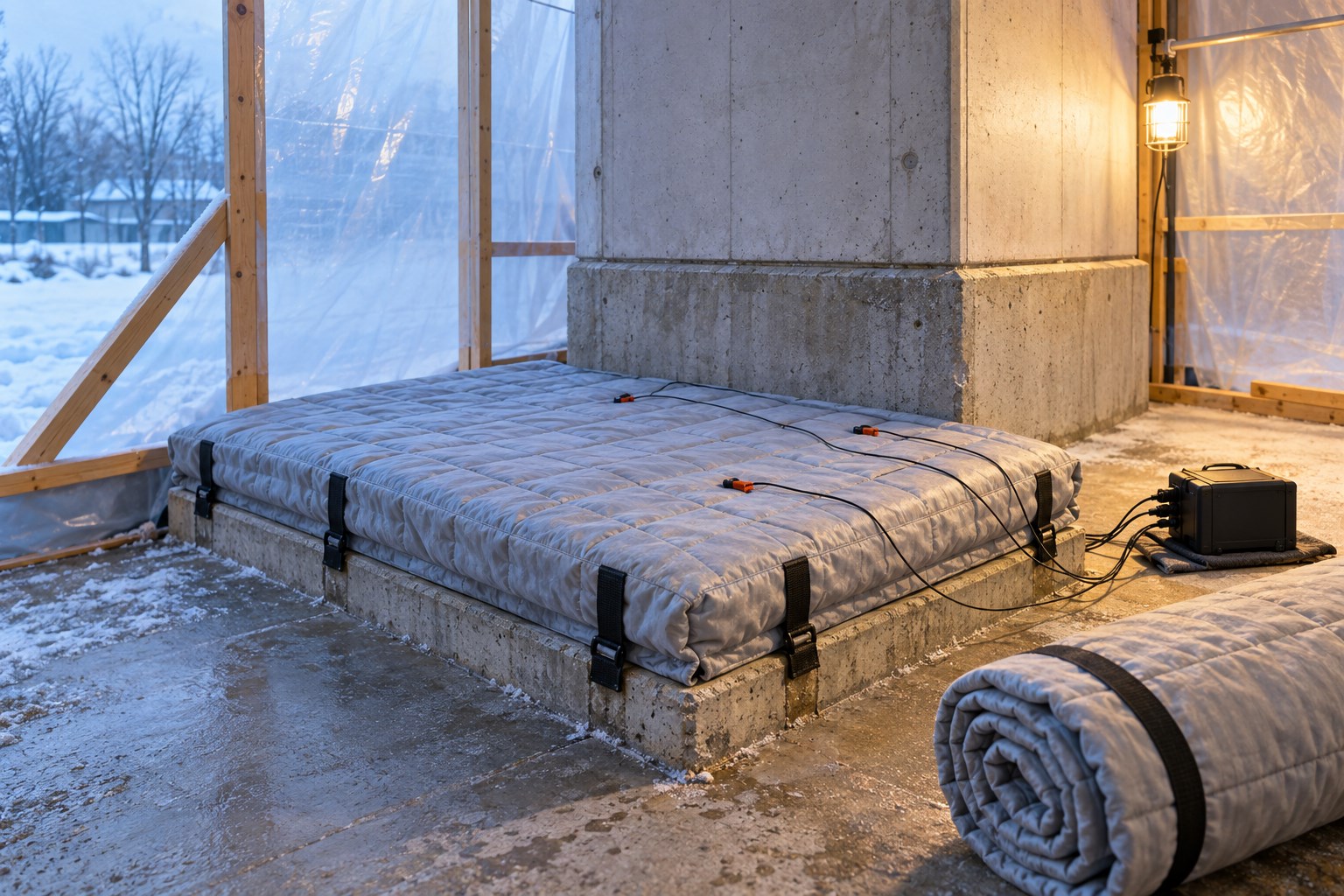
Run a readiness check of the proposed enclosure, insulation, power supply, and monitoring arrangement before the repair starts. Review access for inspection without repeatedly exposing the whole patch. Identify spare materials and the response to a torn covering or failed heat supply. Set project-specific alert levels early enough for a useful response, rather than relying only on notification after a limit has already been crossed.
If temporary heaters are used, integrate their installation into the site safety plan. The US OSHA temporary-heating requirements address ventilation, stability, and combustible clearances. Applicable local rules and equipment instructions also govern. Thermal protection must not create an unsafe enclosure or compromise access and escape.
Keep moisture control in the same plan
Cold weather does not remove curing obligations. ICRI notes that a repair surface can dry before full set in cold conditions. Select a moisture-retention method that suits the material and freezing exposure, and resolve any conflict over added curing water before work starts. Follow the approved curing and protection procedure; insulation alone should not be assumed to satisfy every curing requirement.
Do not improvise an antifreeze mixture
FHWA’s cold-weather concreting technical brief describes engineered cold-weather admixture systems and field demonstrations. These involve designed mixtures, testing, and specified implementation. The report is not approval to add an accelerator or other chemical to a proprietary repair product on site.
Request written review from the material supplier and responsible engineer before changing a mixture, product, or component temperature procedure. Record the approved revision in the submittal and briefing. If the proposed system cannot be supported by relevant data for the intended use, revise the work window or protection arrangement instead of treating a marketing description as qualification.
Respond to a temperature excursion with traceable evidence
The following response workflow is an editorial planning aid for inclusion in a project-specific method statement. Stop dependent activities, secure the area, and stabilize conditions using the approved contingency procedure. Preserve the original logger file, note the affected repair boundaries, and record when the event was discovered and what corrective action followed.
Send the engineer the actual temperature history, material records, photographs, sensor positions, and known gaps in monitoring. Separate a confirmed low reading from a disconnected sensor or uncertain location. Do not silently delete anomalous results. The disposition may call for continued protection, investigation, testing, or removal; simply warming the repair does not establish that any damage has been reversed.
Release protection and structural loads in stages
ASTM C1074 describes a maturity method that uses a laboratory-established relationship for the concrete mixture and its measured temperature history. It can support decisions about ending cold-weather protection, but requires conditions that permit hydration and supplementary indications of potential field strength. Use the dedicated repair maturity testing guide when planning that evidence.
Write separate release entries for reducing protection, removing support, and applying load. Each entry should identify the evidence reviewed, restrictions that remain, authorizing person, and time. An early-strength value intended to address initial freezing is not automatically the design strength, proof of bond, or the capacity needed for a construction load. Continue the specified checks during the approved cooldown sequence.
Close the record while the work is still identifiable
The ICRI post-placement inspection checklist includes weather measures, curing, strength testing, and protection observations. A useful project handover should connect these records to individual repairs rather than leave them as unlabelled files. Retain the accepted procedure, batch records, temperature data, inspection notes, nonconformance decisions, and signed releases together.
Limitations
This is educational guidance for planning and review. The responsible engineer must define requirements for the actual structure, loads, repair material, exposure, and jurisdiction. Polymer and resin systems may have different temperature and curing constraints. This article does not authorize structural removal, shoring changes, heating methods, or acceptance of a potentially frozen repair.
Frequently asked questions
Can concrete repair proceed when the air is above freezing?
Possibly, but that reading alone is insufficient. Check the substrate, product application range, overnight forecast, and ability to maintain the approved protection conditions.
Does a hard surface mean protection can end?
No. Surface feel is not the specified release evidence. Obtain the required records, test results, and authorization for that particular decision.
Are insulated blankets always sufficient?
No. Their suitability depends on the repair and exposure. Use an approved arrangement and verify its performance through the specified measurements.
What if an overnight temperature record is missing?
Record the gap and refer it for disposition. Do not fill it with estimated compliant readings or use it to authorize release without review.
Plan the repair through the next cold night
To discuss a concrete rehabilitation project, book a Structural Rehab consultation. Bring the repair drawings, material submittal, exposure forecast, and proposed protection and inspection records so the discussion can focus on the decisions that need resolving before placement.
Need a professional structural assessment?
Book a consultation with Structural Rehab to evaluate repair priorities, corrosion risks, and rehabilitation options before damage escalates.
Book Consultation