
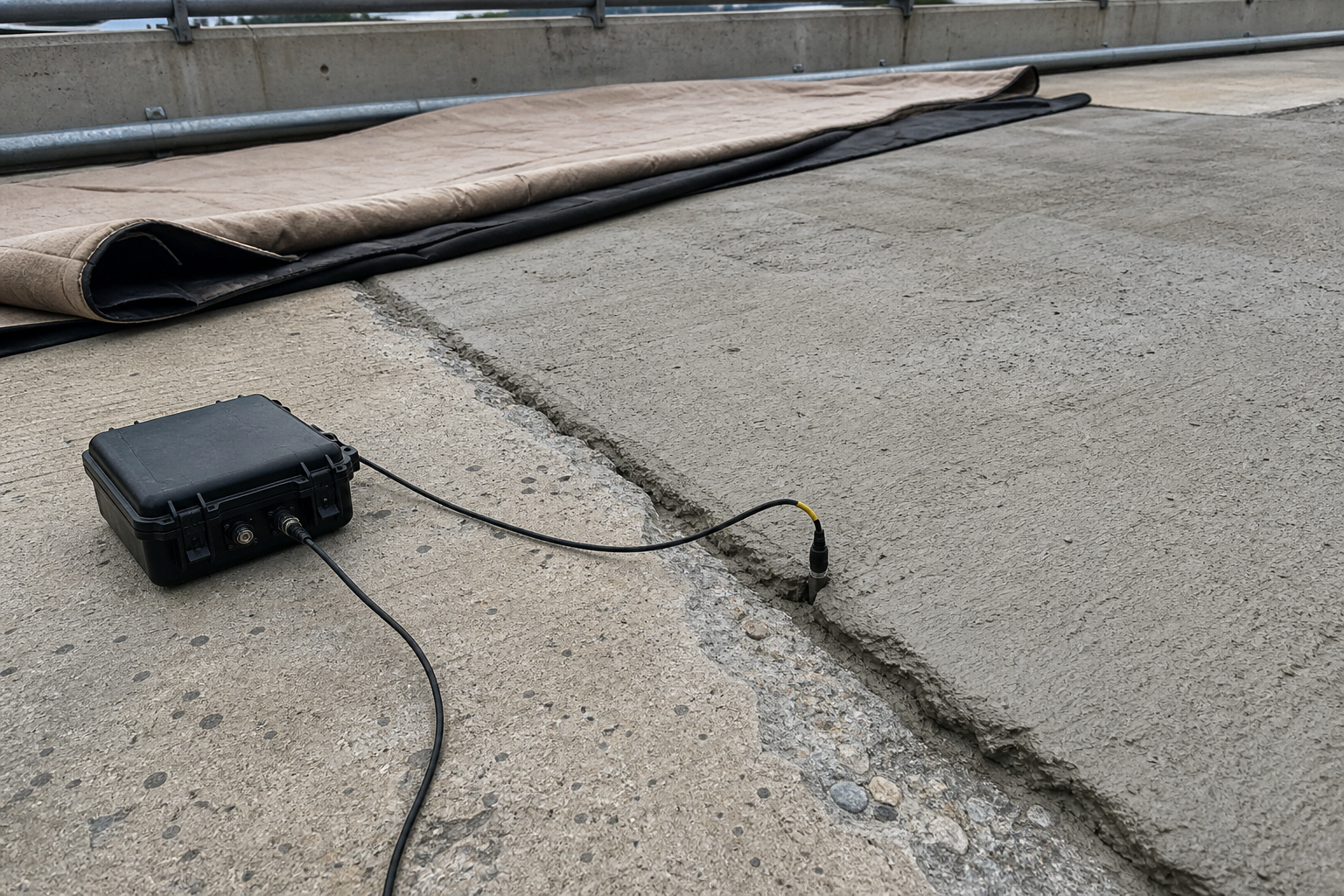
Concrete repair schedules often hinge on one deceptively difficult question: when has the new material developed enough strength for the next load or construction step? A clock alone cannot answer it because repair temperature changes with weather, member thickness, substrate temperature, insulation, and cement hydration. Concrete maturity testing combines measured temperature history with a mixture-specific strength relationship to estimate early-age in-place strength.
Used correctly, maturity can support decisions about reopening a repaired deck, removing forms or temporary support, ending cold-weather protection, or allowing follow-on work. It is not a universal strength meter, a durability test, or permission to ignore curing and verification specimens.
What concrete maturity testing actually estimates
The maturity method rests on a practical principle: for a given concrete mixture, early strength development relates to the combined effects of time and temperature. Sensors record the repair concrete’s temperature. A selected maturity function converts those readings into a maturity index, and a laboratory-developed strength-maturity curve translates the index into estimated strength.
ASTM C1074 describes temperature-time factor and equivalent-age approaches. Both require a strength-maturity relationship for the concrete mixture being placed. ACI’s maturity explanation likewise emphasizes that the relationship is empirical and mixture-specific.
This distinction matters on rehabilitation work. Maturity does not directly test the repaired member. It estimates strength from thermal history using a prior correlation. The acceptance plan must therefore define what estimated strength means, what independent checks are required, and who can release the hold point.
Where maturity adds value in concrete repair
- Traffic reopening: full- or partial-depth pavement and bridge-deck repairs can be released against an engineer-approved strength threshold rather than a generic elapsed time.
- Form and support decisions: temperature histories help assess when a repair can carry the loads introduced by form removal, reshoring changes, or subsequent construction.
- Protection decisions: maturity can inform when thermal blankets or cold-weather measures may be changed, provided specified temperature and curing requirements are also satisfied.
- Construction sequencing: anchors, coatings, lifting, stressing, or adjacent work may have separate substrate-strength and product requirements that maturity can help document.
FHWA guidance on full-depth concrete repairs favors strength-based traffic-opening decisions and identifies maturity as a useful field method. Its maturity technical brief also describes applications such as opening to traffic, stripping forms, and ending special concreting practices. These are project decisions, not universal maturity values: the engineer must establish the required strength for the actual load case.
Build the calibration before the repair
Lock down the mixture identity
The calibration specimens must represent the field repair mixture. Record cementitious materials, water-cementitious ratio, admixtures, aggregate sources and grading, batch proportions, and any fibers. Rapid-hardening packaged repair materials require the same discipline. A curve developed for an ordinary concrete mix should not be borrowed for a proprietary repair mortar or another product formulation.
Define which changes invalidate or require verification of the relationship. Material-source changes, admixture dosage shifts, water additions, and substantial batch-temperature differences can alter strength development. This control belongs alongside the broader concrete repair material selection process.
Develop the relationship across useful ages
Instrument representative laboratory specimens and test companion specimens at multiple maturity levels spanning the expected decision range. The result should be a documented curve, not a single point. If the field decision concerns very early strength, the dataset must resolve that region rather than rely on a curve built mostly from later-age tests.
State the test method, specimen geometry, curing regime, sensor accuracy, maturity function, datum temperature or activation-energy input, curve equation, data scatter, and applicable strength range. Review outliers rather than silently deleting them. The acceptance value should allow for correlation uncertainty and project risk.
Plan sensor locations around the coldest critical concrete
A logger reports only the temperature where its sensor sits. Repair edges against cold existing concrete, thin sections, exposed corners, shaded zones, and areas away from insulation can mature more slowly than a warm interior location. A convenient sensor at the hottest point may overestimate the strength controlling the release decision.
- Map repair geometry, exposure, substrate temperature, likely thermal gradients, and load-critical regions.
- Place enough sensors to represent the slowest-strength-gain location and important variations.
- Secure sensors before placement so consolidation, finishing, or traffic cannot move them.
- Record sensor coordinates, depth, serial number, installation time, batch represented, and logger channel.
- Use redundancy at critical locations and protect leads and connectors from damage and water.
The monitoring plan should align with the repair’s pre-placement inspection hold point. Confirm the logger clock, units, scan interval, sensor response, and data retrieval before concrete covers the sensors.
Field QA/QC from batching to release
At placement
Confirm the delivered material matches the approved mixture and calibration. Document batch tickets, actual water additions, ambient and substrate temperatures, placement and finishing times, curing start, and protection. Make specified fresh-concrete tests and verification specimens. A perfect temperature record cannot rescue an unapproved or improperly proportioned batch.
During curing
Review both accumulated maturity and the temperature trace. Look for implausible jumps, flat lines, missing intervals, excessive peak temperature, freezing risk, and differences among sensors. A maturity number without its trace can conceal sensor failure or unsuitable curing. Continue the specified repair curing and protection; maturity tracks strength development but does not measure moisture retention or prove durable curing.
At the release hold point
Compare the controlling valid sensor’s maturity with the approved curve and release threshold. Check verification specimens or other specified evidence, confirm curing and temperature requirements, review the load and sequence about to be introduced, and obtain the designated engineer’s authorization. The release record should identify the data reviewed and the exact time of approval.
Limitations that must remain visible
- Mixture specificity: an unrelated curve can give a precise-looking but unreliable result.
- Hydration condition: ASTM notes that the concrete must remain in a condition that permits hydration. Poor moisture curing is not corrected mathematically.
- Early temperature effects: maturity does not fully account for how early temperature may affect long-term strength.
- Local measurement: an undamaged sensor represents its location, not every part of a repair.
- Estimated property: maturity is normally correlated with compressive strength; it does not establish bond, tensile capacity, permeability, shrinkage, chloride resistance, or overall structural capacity.
- Different materials: epoxy, polymer-modified, magnesium-phosphate, or other repair systems may not fit a Portland-cement calibration without product-specific evidence.
ASTM C1074 calls for maturity estimates to be supplemented by other indications of potential field strength. ACI similarly explains that in-place strength methods rely on correlations rather than direct structural-strength measurements. When doubt remains, use the investigation and testing specified by the engineer; do not substitute a rebound hammer survey or UPV testing without an appropriate relationship and purpose.
A practical specification checklist
- Define each maturity-supported decision and its engineer-approved strength threshold.
- Identify the exact mixture and conditions covered by the calibration.
- Specify the governing maturity practice, function, parameters, and units.
- Require a documented strength-maturity relationship over the decision range.
- Show sensor numbers, locations, depths, redundancy, and protection.
- Define logger accuracy, interval, clock synchronization, backup, and file format.
- Require temperature-trace review, not just a displayed strength estimate.
- State independent verification tests and discrepancy procedures.
- Name the person authorized to release each hold point.
- Preserve raw data, batch records, calibration results, photos, and signed release records.
The safest principle is simple: the maturity value supports a defined engineering decision; it does not make that decision by itself. Structural Rehab can help owners develop repair-specific monitoring, hold points, and QA/QC records through a truthful structural rehabilitation consultation.
Frequently asked questions
Can one maturity curve be used for every concrete repair mix?
No. The relationship is mixture-specific. Changes in cementitious materials, proportions, admixtures, aggregates, or proprietary repair product can require a new curve or documented verification.
Does maturity testing replace cylinders or cubes?
Not automatically. ASTM identifies the need for supplementary indications of potential strength. The project specification should define verification specimens, acceptance rules, and what happens when results disagree.
Where should sensors be installed in a repair?
At representative and potentially slow-maturing locations selected from geometry, exposure, substrate temperature, insulation, and load-critical conditions. Critical decisions usually justify redundant sensors.
Can maturity prove that a repair is durable?
No. It estimates a correlated strength property. Durability also depends on material compatibility, preparation, bond, consolidation, curing, cracking, permeability, exposure, and detailing.
Authoritative references
- ASTM C1074, Standard Practice for Estimating Concrete Strength by the Maturity Method
- ACI 228.1R-19, Report on Methods for Estimating In-Place Concrete Strength
- FHWA TechBrief: Maturity Testing for Concrete Pavement Applications
- FHWA-HRT-16-030, Automation in Highway Construction
- FHWA-HIF-14-004, Concrete Pavement Preservation Guide
Need a professional structural assessment?
Book a consultation with Structural Rehab to evaluate repair priorities, corrosion risks, and rehabilitation options before damage escalates.
Book Consultation