
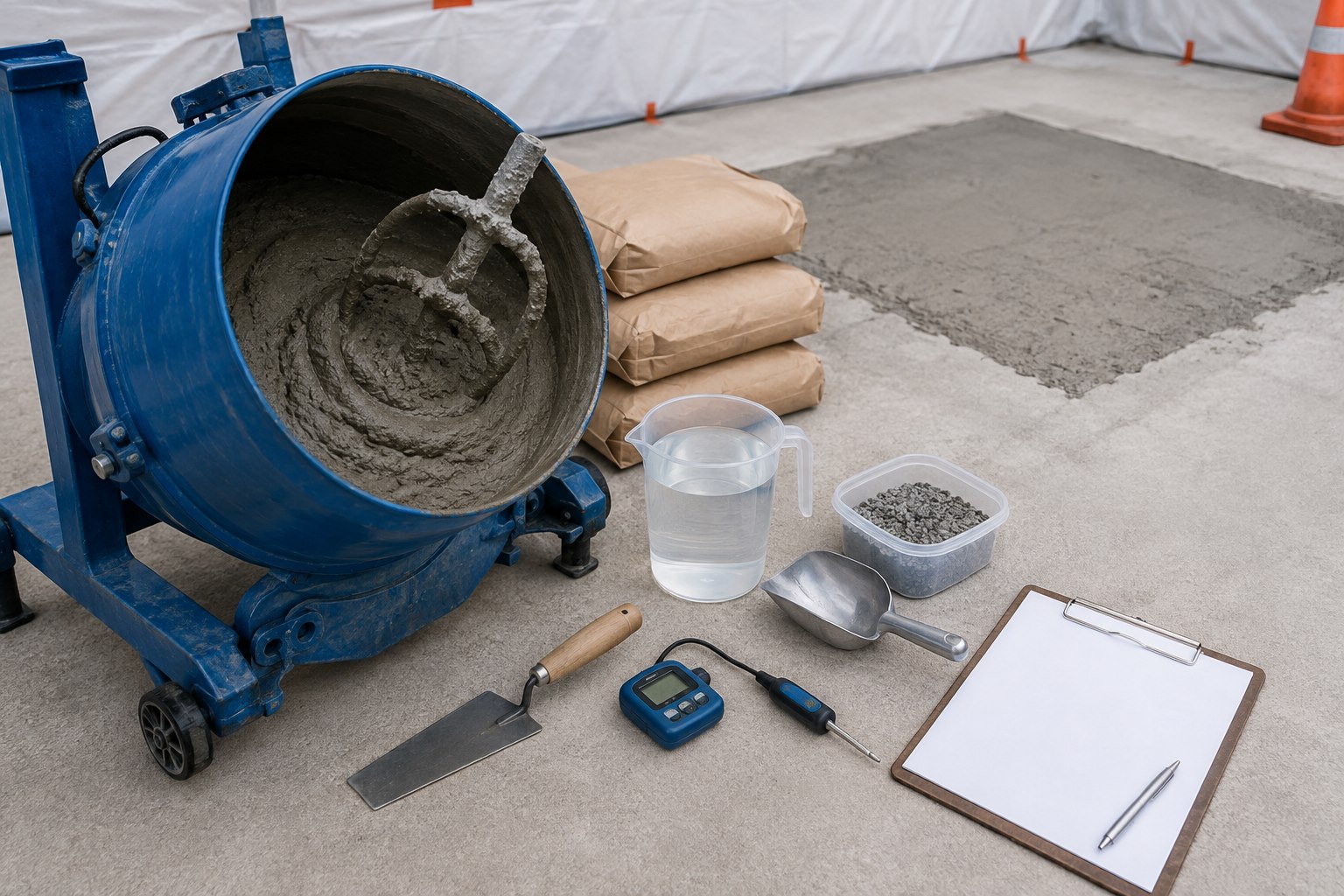
Jobsite mixing of packaged concrete repair materials is a production control, not a minor preparation step. A sound substrate and a well-selected product can still produce a weak, porous, cracked, or poorly bonded repair when bags are damp, water is guessed, components are split casually, the wrong mixer is used, or working time is extended by retempering.
The practical rule is to treat every batch as a traceable operation. Verify the product and lot, protect it in storage, measure each component, follow the published sequence and mixing time, record material and weather conditions, and place only the quantity the crew can finish and cure within the permitted time. The field team should never use added water to make an aging batch look workable.
Why mixing control matters in concrete repair
Packaged cementitious repair products are proportioned systems. Their fresh consistency, setting behavior, strength, shrinkage, permeability, bond, color, and resistance to sag can change when the liquid content, aggregate extension, temperature, mixing energy, or batch size changes. A repair may appear acceptable at placement while excess water or incomplete mixing creates later cracking, dusting, segregation, low strength, or debonding.
ACI PRC-546.4-20 is specifically devoted to jobsite quality control and quality assurance for cementitious packaged materials. Its scope includes delivery, storage, handling, batching and mixing, fresh-material testing, placing, curing, verification, mockups, package weight, cured-material testing, and daily logs. The guide reinforces a useful distinction: the manufacturer’s instructions define the product-specific process, while the project specification defines acceptance and documentation.
This article addresses field execution after the engineer has selected an appropriate material. For compatibility, exposure, modulus, shrinkage, and service-life decisions, first review concrete repair material selection.
Approve the batch plan before repair begins
Before production, compile the current product data sheet, safety data sheet, project specification, approved submittal, and any written manufacturer clarification. Confirm the exact product version, package size, permitted liquid range, component sequence, mixer type, mixing speed and time, aggregate-extension rules, temperature limits, yield, working time, placement thickness, curing method, and cleaning procedure.
Do not combine instructions from similar products or old data sheets. A repair mortar, flowable microconcrete, vertical patch material, and rapid-setting pavement product may require different equipment and sequencing even when their bags look alike. If the documents conflict, stop and obtain a written disposition from the responsible parties.
A trial batch or approved mockup should demonstrate that the proposed mixer, batch size, water-measuring equipment, crew, access, transport route, placement method, finishing, and curing work together. The existing guide to concrete repair mockups and trial panels explains how to turn that demonstration into a production reference.
Inspect delivery and storage
Record manufacturer, product name, lot or batch number, package date or expiration information, quantity, and visible condition at delivery. Reject or quarantine torn, wet, hardened, contaminated, unlabeled, expired, or otherwise questionable packages until the manufacturer and engineer provide an acceptable disposition. Lumps can indicate moisture exposure; breaking them apart does not restore the original material.
Store bags dry, covered, ventilated as required, and off the ground. Protect liquid components from freezing, overheating, direct sun, contamination, and unauthorized dilution. Rotate stock so accepted material is used within its permitted shelf life. Separate products and lots clearly enough that a worker cannot introduce the wrong component during a busy placement.
For hot climates, material temperature deserves advance planning. Shade, conditioned storage, chilled clean water, smaller batches, or adjusted work hours may be needed, but only within the approved product and project requirements. Cold material may also change setting and early strength. Temperature control is not permission to add unapproved admixtures or exceed the stated liquid range.
Measure water and components; do not estimate
Use clean, potable-quality water unless the product documents permit another source. Measure it with calibrated or verified equipment suitable for the batch volume. A marked pail can be acceptable only when its actual volume has been checked and the reading method is consistent; a dedicated graduated container or metered dispenser is easier to audit.
Establish the target water or liquid amount during the approved trial, within the manufacturer’s stated range. Record the amount for every batch. Do not choose the maximum automatically, and do not add water because the substrate is dry, the mixer is coated with residue, or the previous batch waited too long. Substrate moisture conditioning and mixer cleanliness are separate controls.
Splitting a bag is risky unless the manufacturer expressly permits it and the project has a controlled procedure. Dry ingredients can segregate in transport, and a field scoop does not prove that cement, aggregate, fibers, polymers, and admixtures were divided proportionally. When partial units are authorized, weigh the dry material and every component with suitable calibrated equipment and document the calculation.
Aggregate extension must also follow written limits for type, grading, cleanliness, moisture, size, and dosage. Wet aggregate contributes water; dirty or poorly graded aggregate changes performance. Never use site sand or leftover aggregate merely to increase yield.
Use the correct mixer and a repeatable sequence
Choose the mixer type and capacity recommended for the material. Paddle, mortar, drum, or high-shear mixers do not impart the same energy. A drill and mixing blade may be suitable for a small product unit but inadequate for a large or stiff batch. Avoid overloading: the mixer must circulate all material without dry pockets or dead zones.
Before each batch, confirm that the mixer, blades, containers, and tools are clean, functional, and free of hardened residue or standing wash water. Check electrical protection, guards, leads, and stable setup. Stage all approved components and timing equipment before mixing begins so the process does not pause while someone searches for water or aggregate.
Follow the specified component order and start timing at the defined point. Some systems require liquid first; others require staged addition, a wet-out period, or separate blending of components. Mix for the stated duration and observe whether the batch becomes homogeneous. Scraping unmixed powder from container sides may be part of the approved procedure, but arbitrary extra mixing can consume the usable placement period or alter air content and consistency.
The FHWA partial-depth repair manual warns that both water content and mixing time need careful control for rapid-setting packaged materials. Longer mixing reduces the already short time available for placement and finishing, while added water can reduce patch strength. Production planning should therefore match batch size to crew capacity rather than trying to rescue oversized batches.
Control working time without retempering
Working time is affected by material temperature, ambient conditions, substrate temperature, batch size, mixer energy, transport, and placement geometry. Record the time mixing starts and, when required, the time placement is complete. Do not rely on a generic clock value without checking the product’s conditions and the behavior demonstrated in the trial.
Once a cementitious batch begins to stiffen, do not add water, liquid component, or admixture to restore flow unless the current written instructions specifically authorize a defined action. Retempering can change water-to-cementitious ratio, strength, shrinkage, permeability, bond, setting, and appearance. Discard expired or abnormal material through the project’s approved waste procedure.
Coordinate mixing with the repair area’s readiness. Forms, substrate condition, reinforcement, access, equipment, inspection releases, and cure materials should already have passed the pre-placement concrete repair hold point. The batch clock should not run while the team finishes cleaning a cavity or searches for an inspector.
Define field tests and acceptance before placement
Fresh-material checks must suit the product and the specification. Depending on the system, the plan may include material temperature, flow or consistency, unit weight, air content, yield, working time, or specimens. ASTM C1064/C1064M provides a method for measuring freshly mixed concrete temperature, but not every mortar test method automatically applies to every proprietary repair product. Use only methods adopted by the project or recommended for that material.
Record results with product, lot, batch number, location, time, water or liquid quantity, aggregate addition, temperatures, mixer, operator, and disposition. A result without traceability cannot reliably identify affected repair areas. If cylinders, cubes, prisms, or other specimens are required, define sampling, molding, curing, transport, test age, and acceptance in advance. See concrete repair test cylinders for the distinction between material acceptance and in-place release decisions.
Do not treat a passing compressive-strength specimen as proof of bond or workmanship. Repair performance also depends on removal boundaries, substrate soundness, surface profile, moisture condition, consolidation, thickness, curing, and exposure. Direct-tension testing may be specified for selected systems; interpret it using the failure location and project criteria described in pull-off testing for concrete repair bond.
Daily batch log and hold points
A concise daily log should capture enough evidence to reconstruct the work:
- repair area and drawing or location reference;
- product, component, lot, package condition, and expiration check;
- batch size, measured liquid, aggregate extension, and any approved additions;
- material, air, substrate, and mixed-batch temperatures when required;
- mixer identification, operator, sequence, start time, mixing duration, and placement completion;
- fresh and hardened tests, specimen IDs, results, and acceptance status;
- weather, substrate release, placement method, curing start, protection, and photographs;
- rejected batches, nonconformances, corrective actions, and engineering dispositions.
Useful hold points include receipt of questionable material, first production batch, any change of lot or mixer, temperature outside the approved range, inconsistent yield or flow, unapproved water addition, abnormal setting, failed testing, and restart after a long interruption. The inspector should have clear authority to stop batching until the responsible person resolves the condition.
Common failures and safe responses
- Material is lumpy or the bag is damp: quarantine it; do not screen out lumps and continue.
- Consistency varies between batches: check water measurement, package weight, mixer loading, timing, temperature, sequence, and residue before altering the mixture.
- The batch stiffens before placement: reduce future batch size or improve coordination; do not retemper an expired batch.
- Yield is unexpectedly low or high: verify component quantities, aggregate moisture, package integrity, mixing, and measuring devices; isolate affected work.
- Fresh test fails: follow the prewritten rejection and retest procedure; appearance alone is not a disposition.
- Repair cracks or debonds later: preserve batch and placement records, map the distress, and investigate material, substrate, thickness, curing, restraint, and exposure together.
Limitations and safety
This guidance does not provide a universal water content, mixing duration, temperature limit, flow value, batch size, working time, test frequency, or acceptance threshold. Those requirements depend on the approved product, repair design, project specification, placement method, geometry, exposure, governing standards, and site conditions. Product data should not be used to bypass engineering assessment or project-specific trials.
Dry cementitious powders may create respirable dust, and wet portland-cement mixtures can cause serious skin and eye injury. OSHA identifies caustic burns and dermatitis as wet-cement hazards. Contractors must assess silica and chemical exposures, control dust, provide appropriate ventilation, guards, electrical protection, hygiene facilities, training, and task-specific PPE, and follow current safety data sheets and applicable regulations.
Frequently asked questions
Can workers add water within the manufacturer’s published range?
The project should establish a target amount during submittal review or trials, within the permitted range. Workers should not vary water casually from batch to batch. Any adjustment needs a documented reason, continued compliance, and authorization under the quality plan.
Is it acceptable to mix half a bag?
Only when the manufacturer permits partial batching and a validated procedure proportionally measures the dry blend and every other component. Full units are generally easier to control because packaged dry ingredients may segregate and field volume estimates are unreliable.
Can a stiff batch be retempered?
Not unless the current written product instructions expressly permit a defined procedure. For most cementitious repair batches, adding water after stiffening changes critical properties and masks expired working time. Reject the batch and correct production planning.
What should be checked on the first production batch?
Verify the product and lot, package condition, temperatures, component quantities, mixer, sequence, duration, consistency, yield, fresh tests, transport, placement, finish, and curing. Treat it as a hold point before repeating the process at scale.
Does compressive strength prove the repair is acceptable?
No. It can verify a specified material property, but it does not by itself prove substrate bond, consolidation, thickness, curing, crack control, durability, or structural adequacy.
Sources and further guidance
- ACI PRC-546.4-20, Guide for Job Site Quality Control and Quality Assurance of Cementitious Packaged Materials
- ICRI Concrete Surface Repair Technician pre-placement inspection checklist
- FHWA-RD-99-152, Materials and Procedures for Rapid Repair of Partial-Depth Spalls
- ASTM C1064/C1064M-23, Temperature of Freshly Mixed Hydraulic-Cement Concrete
- OSHA concrete-products hazard controls
Need help reviewing packaged-material submittals, trial batches, inspection hold points, or traceable repair records? Book a Structural Rehab consultation or download the site’s free structural health ebook to organize the project questions before work begins.
Need a professional structural assessment?
Book a consultation with Structural Rehab to evaluate repair priorities, corrosion risks, and rehabilitation options before damage escalates.
Book Consultation