Concrete repair succeeds or fails at the interface. A repair material can be correctly batched and placed yet still perform poorly if it is applied over weak, dusty, contaminated, or wrongly profiled concrete. That is why concrete repair surface profile QA/QC needs a written acceptance process, not a quick visual judgment at the start of placement.
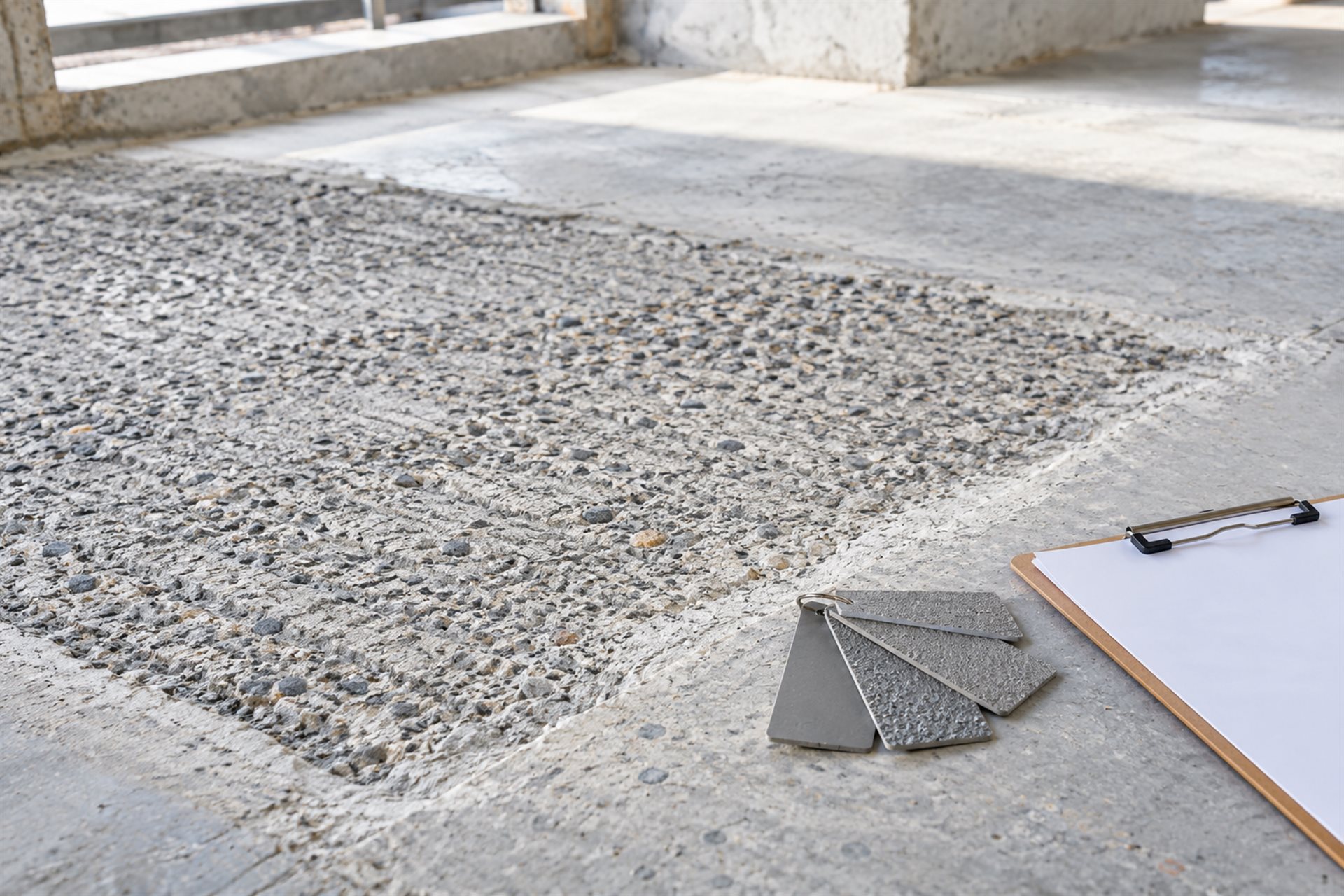
Surface profile is the texture left after removal and cleaning. It is often discussed with the International Concrete Repair Institute (ICRI) Concrete Surface Profile, or CSP, comparator system. The right texture is not automatically the roughest one. It must suit the specified repair material, bond mechanism, member condition, access method, and manufacturer instructions. The designer remains responsible for the repair design and acceptance criteria.
Start with a repair-system requirement
Write the required condition before demolition or abrasive work begins. A useful requirement names the repair area, the approved preparation method, the specified profile or acceptable range, cleanliness expectations, inspection locations, and the disposition of nonconforming areas. It should also identify the governing repair specification and the product data that applies to the actual mortar, overlay, adhesive, coating, or lining.
Do not transfer a profile requirement blindly from one system to another. A thin bonded coating, a polymer overlay, a hand-applied mortar, and a form-and-pump repair can have different substrate requirements. Material selection should follow compatibility, exposure, placement method, and structural demand; see our guide to concrete repair material selection. Where the specification and manufacturer literature differ, stop and obtain a documented engineering resolution rather than allowing the field team to choose the more convenient instruction.
What CSP acceptance actually checks
A profile comparison is only one part of substrate acceptance. ICRI describes its technical resources as guidance for concrete repair and surface preparation, while its CSP comparator concept provides a common visual reference. The newer ICRI R³ guide listing also identifies the use of CSP replica chips as a focused field topic. These references support a repeatable observation process; they do not replace project-specific design judgment.
A rough-looking substrate is not, by itself, evidence that the repair interface is ready. An acceptance record should separately address:
- Soundness: unsound concrete, delaminations, laitance, and weak surface mortar have been removed to the defined limits.
- Texture: representative prepared locations compare with the required CSP range or other stated profile criterion.
- Cleanliness: dust, loose particles, oils, curing compounds, coatings, and other bond breakers are absent or treated as specified.
- Geometry: perimeter cuts, edges, reinforcement clearance, and repair depth still conform to the approved detail.
- Condition at placement: moisture state, temperature, elapsed time after preparation, and any primer or bonding-agent window meet the repair system requirements.
This is why profile inspection belongs with, not instead of, pre-placement controls. The related saw-cut boundary QA/QC workflow helps define stable repair edges, while SSD substrate moisture guidance helps the team document the moisture condition required for cementitious repairs.
Build a practical inspection plan
1. Divide the work into inspectable lots
Do not accept an entire deck, wall, or soffit from one convenient observation. Divide work by pour, elevation, repair type, access zone, preparation shift, or material system. The lot size and sample frequency should be set in the project quality plan. Record exact locations using grids, sketches, chainage, member marks, or marked-up photographs so an observation can be traced to a repair area.
2. Confirm the preparation method can achieve the intended result
Scarifying, shot blasting, hydrodemolition, abrasive blasting, and mechanical chipping do not create identical textures or cleanliness conditions. Select the method around structural limitations, reinforcement exposure, dust and water control, access, and the specified system. FHWA guidance for high-friction treatments, for example, calls for abrasive cleaning of concrete to remove contaminants that could interfere with bonding or curing; the same principle is useful context, but it does not prescribe a repair profile for every system.
3. Compare and document representative areas
Use the approved comparator or project method under suitable lighting. Photograph the representative condition with an area reference, not just a close-up that hides the surroundings. Record the observed result, inspector, date, lot, method, and whether the comparison is before or after final cleaning. If replica putty or depth measurements are specified, follow that method exactly. AMPP SP21513-2026 identifies CSP chips, replicas, and depth-micrometer approaches as alternative means for characterizing compliance with concrete surface-profile requirements; that is a useful reminder to specify the measurement method rather than writing only “roughen surface.”
4. Hold placement until readiness is signed off
Preparation can deteriorate between inspection and placement. Windborne dust, rain, condensation, traffic, corrosion debris, or a missed bonding window can change the substrate. The daily record should show the inspection time and release, then any required re-cleaning or re-inspection immediately before placement. Our concrete repair daily-log checklist shows how to connect that release to batch, weather, and deviation records.
Resolve common nonconformances
If the profile is smoother than specified, do not simply add more mortar or hope a bonding agent compensates. Rework with an approved method, remove residue, re-clean, and re-inspect. If preparation is too aggressive, the engineer should assess whether it has exposed aggregate, damaged the substrate, reduced cover, or changed repair limits. Local overbreak may call for a revised repair detail rather than a field patch.
Dust is a different nonconformance from profile. A good-looking CSP covered in loose fines is not acceptable for a bonded system. Likewise, clean steel and sound patch limits matter when reinforcement has been exposed. Coordinate any observed bar condition and repair geometry with the approved design rather than treating profile inspection as a stand-alone finish check.
Acceptance records owners should request
A defensible turnover package is short but traceable. It should include the approved substrate requirement; repair-area map; preparation method; lot and inspection locations; comparator, replica, or measurement method; observations; photos; cleanliness and moisture checks; disposition of failed locations; release signatures; and the linkage to placement records. These records help distinguish an observed surface condition from a claim of final structural acceptance.
For critical or disputed work, a project may also specify bond testing after cure. That is a different question from initial profile acceptance. Read our guide to pull-off testing for concrete repairs before selecting test locations, timing, and acceptance criteria.
Limits and engineering judgment
CSP comparison is a field-control tool, not a universal strength test. It cannot prove that hidden concrete is sound, that a repair design is adequate, or that every material will bond under every exposure. It also cannot override manufacturer requirements, environmental restrictions, safety controls, or the engineer of record. Complex conditions—active corrosion, moisture-sensitive resins, post-tensioned concrete, thin cover, elevated work, or uncertain substrate condition—need a project-specific engineering decision.
FAQ
What CSP should be specified for a concrete repair?
There is no single correct CSP. Specify the profile that the approved repair system and project design require, then state how it will be compared and recorded. Consult the material manufacturer and engineer rather than copying a number from an unrelated project.
Can a bonding agent make up for inadequate surface preparation?
No. A bonding agent is part of a system only when the design and product instructions call for it. It does not turn weak, contaminated, or improperly prepared concrete into an acceptable substrate. See our bonding-agent open-time QA/QC guide for timing controls.
When should surface profile be rechecked?
Recheck after rework, after contamination or weather exposure, when the preparation method changes, and whenever the interval before placement could affect readiness. The quality plan should define the formal hold points.
Plan the interface before the repair material arrives
Good repair QA/QC makes the interface visible: define the target condition, verify representative areas, record what was observed, and resolve deviations before placement. Structural Rehab can help owners and project teams develop practical repair scopes, inspection hold points, and documentation plans for existing concrete structures. This article is general information, not a substitute for an engineered repair design or site-specific safety plan.
Sources
- ICRI: Understanding Concrete Surface Preparation and Guideline 310.2R
- ICRI R³ Concrete Guides
- AMPP SP21513-2026: Conformance to Concrete Surface Profile Requirements
- FHWA: Concrete Surface Preparation and Installation Context
Need a professional structural assessment?
Book a consultation with Structural Rehab to evaluate repair priorities, corrosion risks, and rehabilitation options before damage escalates.
Book Consultation