Water can carry chlorides and other dissolved agents into unsaturated concrete, but not every concrete surface absorbs water at the same rate. Sorptivity testing provides a controlled laboratory measure of capillary water uptake. Used carefully, it can help compare existing concrete, repair materials, curing trials, or treated and untreated specimens before a repair or protection decision.
This guide explains concrete sorptivity testing for owners, engineers, laboratories, and repair teams. It focuses on ASTM C1585 test planning, specimen control, interpretation, and limitations. Sorptivity is useful durability evidence, but it is not a direct measurement of permeability, chloride diffusion, bond strength, corrosion rate, or structural capacity.
What sorptivity testing measures
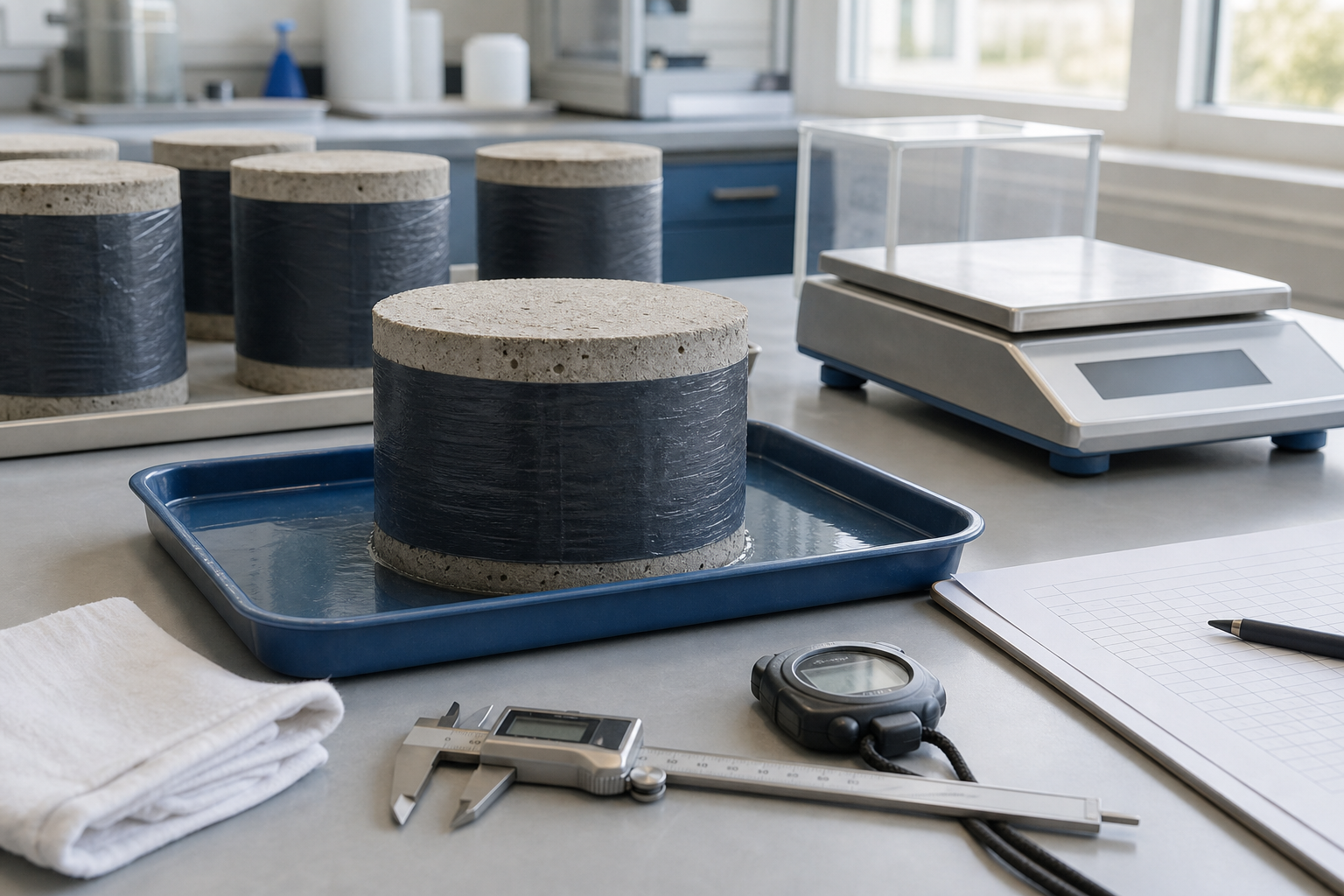
ASTM C1585-20 measures the rate at which an unsaturated hydraulic-cement concrete specimen absorbs water through one exposed face. The specimen is conditioned to establish a controlled internal moisture state, its sides are sealed to promote one-dimensional flow, and the exposed face is placed in shallow water. Mass gain is recorded over prescribed time intervals.
The absorption result is calculated from mass gain, exposed area, and water density, then plotted against the square root of time. Slopes over defined portions of the plot describe initial and secondary absorption behavior. FHWA guidance calls this capillary-suction response sorptivity and distinguishes it from tests intended to estimate total water-permeable pore space.
The test is sensitive to the concrete mixture, curing, age, air content, microcracking, surface finishing, treatments, and moisture condition. That sensitivity is useful only when sampling and conditioning are controlled. A low result from one laboratory series should not automatically become a universal acceptance value for unrelated concrete.
Choose the question before taking cores
Existing structure characterization
Cores can be used to compare an exposed surface with interior concrete or to compare zones with different exposure histories. ASTM notes that absorption at the exterior may differ from absorption deeper in the member because the surface experiences curing, finishing, weathering, cracking, and treatments. Record the core orientation and depth so each tested face remains traceable to the structure.
Use the site’s concrete core testing guide to plan safe locations, structural review, reinstatement, and laboratory coordination. Do not core through reinforcement or critical zones without approved locating and engineering controls.
Repair-material or curing comparison
Project-made specimens can compare candidate repair mixtures or curing regimes when age, geometry, conditioning, and test direction are identical. This is particularly helpful when water uptake is one performance concern among several. The repair-material selection guide explains why strength alone is insufficient; dimensional compatibility, bond, exposure, placement, and curing also govern performance.
Surface-treatment evaluation
Paired specimens may help compare treated and untreated surfaces, but the protocol must state whether the treated face, a cut face, or interior material is being tested. Sealers can change absorption at the surface without proving performance against every exposure mechanism. Selection should still follow the concrete surface-protection guide and the product’s verified suitability for the substrate and service environment.
Build a defensible sampling plan
A laboratory result represents the submitted specimen, not an entire deck, wall, column, or repair lot. Before sampling, map exposure, cracking, repairs, curing conditions, surface treatments, drainage, wetting, and visible deterioration. Divide unlike conditions into separate populations and select enough specimens to describe variability.
The plan should define:
- the decision the results will support and who will interpret them;
- structure, element, location, elevation, orientation, and exposure face;
- specimen source, age, dimensions, cutting direction, and test face;
- whether surfaces are as-cast, finished, cut, repaired, or treated;
- conditioning, sealing material, water-contact arrangement, and weighing schedule;
- replicates, control specimens, outlier review, and reporting units;
- companion strength, petrography, chloride, resistivity, moisture, and bond evidence.
Avoid comparing a weathered field surface with a freshly cut laboratory face as if they were equivalent. Avoid mixing specimens of different ages or conditioning histories in one acceptance population. Record deviations rather than silently adjusting the procedure.
Control specimen conditioning
Moisture condition is one of the strongest influences on absorption. ASTM C1585 therefore uses a specified conditioning sequence rather than casual oven drying or testing directly after field delivery. Follow the current purchased standard and laboratory quality system for temperature, humidity, duration, cooling, storage, and tolerances.
Overheating may alter the pore structure or microcracking; incomplete conditioning may leave different specimens with incompatible internal moisture. The FHWA materials-distress guidance notes that sorptivity conditioning uses temperatures below those associated with some bulk-absorption methods. The objective is repeatable capillary moisture, not the driest specimen achievable.
For repair interfaces, field substrate moisture remains a separate construction issue. USBR research shows that substrate absorption and available moisture can affect transport at the repair interface. Laboratory sorptivity does not replace the material manufacturer’s surface condition requirement or the project’s pre-placement hold point. Coordinate it with concrete moisture assessment and approved repair procedures.
Laboratory workflow and QA/QC hold points
- Log and photograph each specimen. Record source, orientation, dimensions, condition, cracks, coatings, and intended test face.
- Prepare without damage. Saw and handle specimens using an approved method that does not create avoidable cracks or contaminate the absorption face.
- Condition consistently. Apply the governing ASTM sequence and document chamber conditions, times, and deviations.
- Measure geometry. Determine the exposed area accurately; an area error affects every calculated absorption value.
- Seal the sides. Prevent unintended lateral water entry while leaving the selected face exposed.
- Establish shallow contact. Support the specimen so the exposed face contacts the specified water depth without wetting other faces.
- Weigh on schedule. Blot consistently, minimize delay, record mass and time, and return the specimen promptly.
- Plot before accepting. Review absorption versus square root of time, regression ranges, fit, anomalies, and specimen-to-specimen variation.
A useful hold point comes after plotting raw results but before averaging. A leaking side seal, changing water depth, missed early measurement, damaged face, balance drift, or transcription error can distort the slope. The laboratory should investigate and report the anomaly under its quality procedure rather than deleting an inconvenient result without justification.
Interpret the result without overclaiming
Compare like with like: the same method edition, specimen geometry, age, test face, conditioning, temperature, and calculation ranges. Report individual values as well as summary statistics. A comparison based only on averages can hide high variability, which may itself matter for repair quality.
ASTM C1585 does not supply a universal pass/fail sorptivity limit for every structure. Project criteria should be tied to validated reference mixtures, exposure requirements, relevant specifications, and demonstrated test precision. If the question concerns chloride resistance, use a suitable chloride-related method. If it concerns coating readiness, follow the coating system’s moisture and surface-preparation requirements. If it concerns repair bond, use the specified bond test.
Sorptivity also does not diagnose the cause of an unusual result. High absorption may relate to curing, mixture proportions, cracking, finishing, deterioration, or sampling position. Combine results with visual evidence and, where appropriate, petrography, mixture records, and the concrete resistivity testing guide. Resistivity and sorptivity address different transport and electrical properties; neither substitutes for the other.
Minimum owner deliverables
Require the governing standard and edition, laboratory identity, test dates, personnel, equipment IDs, balance resolution and checks, specimen log, photographs, dimensions, exposed area, conditioning record, sealing method, water temperature and depth control, raw mass-and-time data, calculations, plots, regression ranges, individual results, variability, deviations, and observations.
The report should answer the original project question in qualified language. It should identify limitations, explain whether comparisons are valid, and state what complementary evidence is required. Keep raw data so later reviews can distinguish a material effect from a conditioning, geometry, or calculation difference.
FAQ
Is sorptivity the same as concrete permeability?
No. Sorptivity describes capillary water absorption into unsaturated concrete under the test conditions. Permeability concerns flow driven by a pressure gradient and is a different property.
Is ASTM C1585 the same as ASTM C642?
No. C1585 exposes one face and measures absorption rate after controlled conditioning. ASTM C642 uses different drying, immersion, and boiling procedures to assess density, absorption, and voids. Results are not interchangeable.
Can sorptivity prove that a sealer will stop chlorides?
No. It may show a change in water uptake for the tested specimens, but it does not by itself prove chloride resistance, long-term weathering performance, crack bridging, adhesion, or suitability for the exposure.
Can field cores be compared with laboratory cylinders?
Only with great caution. Surface history, consolidation, curing, age, orientation, damage, and conditioning may differ. Define the comparison before sampling and disclose those differences.
Does a low sorptivity result mean the repair is durable?
Not by itself. Durable repairs also require correct diagnosis, compatible material properties, preparation, reinforcement treatment, placement, curing, bond, detailing, and exposure control.
Authoritative sources
- ASTM C1585-20, Standard Test Method for Measurement of Rate of Absorption of Water by Hydraulic-Cement Concretes
- FHWA-RD-01-164, Guidelines for Detection, Analysis, and Treatment of Materials-Related Distress in Concrete Pavements
- FHWA-HIF-17-009, Performance Engineered Concrete Pavement Mixtures
- Bureau of Reclamation, Concrete Substrate Moisture Requirements for Effective Concrete Repairs
- ACI 562 Repair Code Portal
Turn absorption data into a practical specification
Structural Rehab helps owners and project teams plan condition testing, material trials, repair hold points, and protection decisions around the actual structure and exposure. To develop a project-specific investigation or QA/QC plan, book a consultation. Final acceptance criteria and repair decisions should remain with the responsible engineer using the governing standards and complete project evidence.
Need a professional structural assessment?
Book a consultation with Structural Rehab to evaluate repair priorities, corrosion risks, and rehabilitation options before damage escalates.
Book Consultation