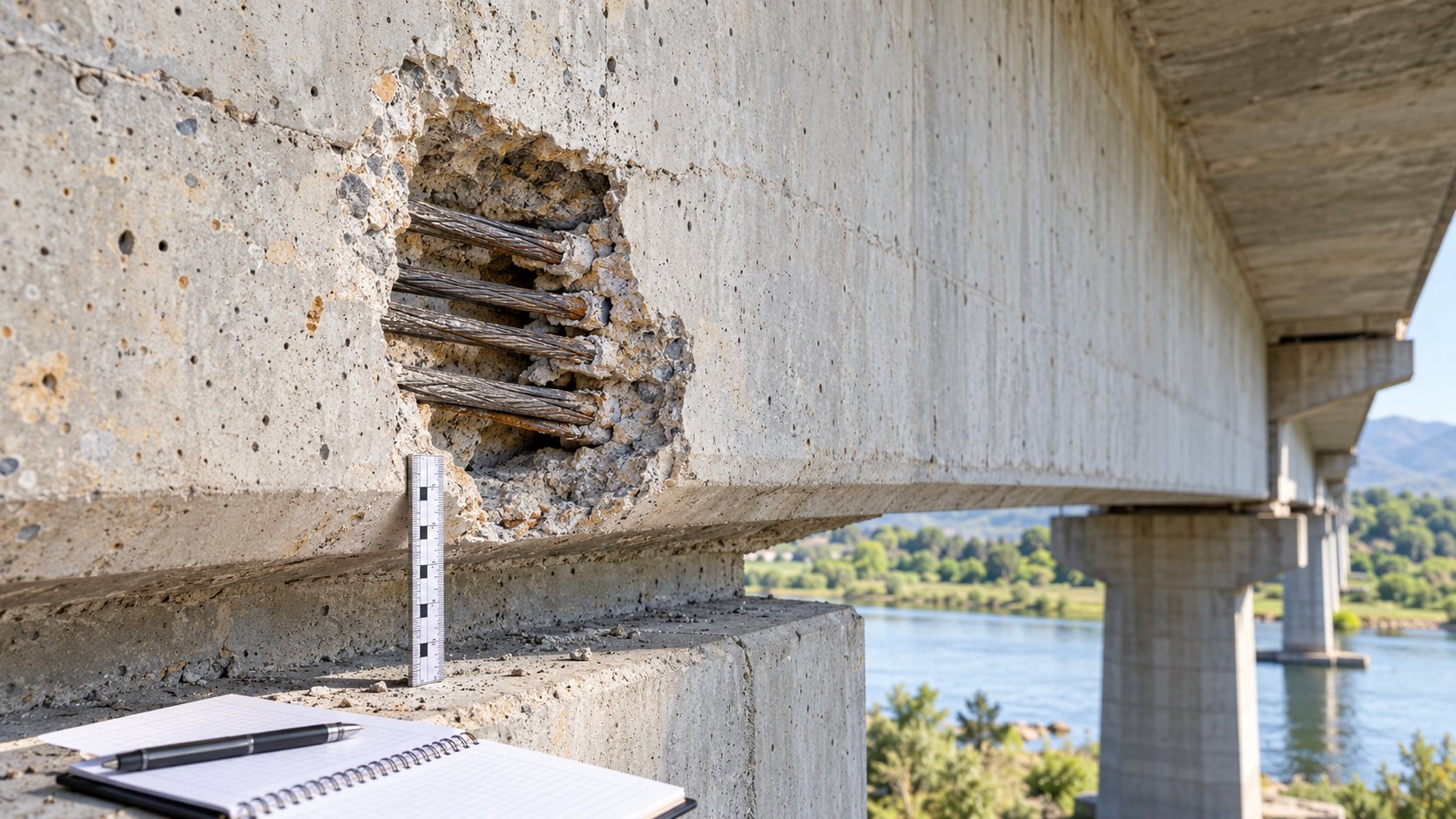
Finding exposed prestressing strand in damaged concrete changes the repair conversation. A strand may be part of the member’s load-carrying system, and its condition, position, bond and force cannot be established by looking at a photograph. Treat the discovery as a hold point: secure the area under the project safety plan, stop intrusive work nearby, document what is visible and ask the responsible structural engineer for a disposition.
This guide helps owners, inspectors and contractors organize that decision. It does not authorize cutting, heating, cleaning, stressing or patching a strand. An engineered response depends on the member, construction records, damage, loading and governing requirements. The concrete structure remains the subject of the assessment; exposed steel is evidence that the concrete repair may affect its structural system.
Why a prestressed concrete spall needs a different response
In a prestressed member, high-strength tendons introduce forces that influence the concrete’s behavior in service. The system may be pretensioned, with strands bonded to concrete, or post-tensioned, with tendons arranged in ducts or other systems. An individual exposed wire, strand, duct or anchorage cannot safely be treated as ordinary reinforcing bar simply because it looks similar.
Damage may involve concrete cover alone, but corrosion, impact, fire, concrete loss or prior intervention can also affect the strand, its anchorage or bond. A patch can conceal the visible defect without resolving the cause or establishing capacity. For the broader process of recording concrete distress, see our condition survey mapping guide; use this article when prestressing components introduce a specific structural hold point.
TxDOT’s intermediate spall repair guidance directs teams to consult the engineer when prestressing strands are exposed and cautions against chipping around them away from the immediate member end. That guidance is specific to its context; it is not a universal detail or permission to work on another project’s tendons.
First response: stop, protect and report
Stop removal, drilling, grinding and other intrusive work in the affected area. Do not strike, cut, bend, weld, heat or attempt to tension a visible strand. Keep personnel out of any area identified as unsafe by the project safety plan and notify the responsible engineer and owner through the agreed reporting chain. The engineer should determine whether access restrictions, temporary support, load restrictions or other immediate measures are necessary. Do not improvise shoring or change loads without a designed and authorized plan.
Record the location using the member designation, elevation, span or grid reference and photographs from a safe position. Note the size of the concrete loss, the exposed component’s apparent location and orientation, visible corrosion or broken wires, water or staining, adjacent cracks, impact evidence and any recent changes. Distinguish observed facts from assumptions. For example, “three visible wires appear broken” is more useful than claiming a percentage of capacity lost without knowing the tendon arrangement.
Record what is inaccessible or hidden. Preserve pieces and prior inspection records when the engineer requests them, but do not pull on loose wires or remove protective material merely to improve a photograph. A documented stop is an engineering input, not a delay to be erased from the daily log.
What the engineer needs before deciding
Identify the member and prestressing system
Gather drawings, shop records, calculations, tendon profiles, design loads, construction dates, maintenance history and earlier repair details if available. Confirm whether the element is pretensioned or post-tensioned, how strands are arranged, and whether the exposed feature is a strand, a duct, an anchorage or another embedded component. Field conditions may differ from drawings, so the engineer should define how to resolve discrepancies.
The location matters. An exposed strand end at a member end is not automatically equivalent to a damaged strand along a span, and a post-tensioning duct is not equivalent to a bonded pretensioning strand. A procedure written for one detail should not be copied to another. If identification remains uncertain, maintain the hold and obtain specialist input.
Assess damage and consequences
The engineer may consider the extent and cause of concrete deterioration, water paths, corrosion, visible wire breaks, surrounding concrete, support conditions, loading and evidence of movement. Investigation can include document review, close inspection, nondestructive methods and carefully planned openings or sampling where justified. Each method has limitations: a cover scan may help locate embedded steel but does not determine strand force or prove its condition along a hidden length. Our embedded-steel locating guide explains why scanning needs verification and a safe work plan.
For post-tensioning systems, the FHWA guidance on defective grout in bridge ducts addresses tendon inspection, sampling, interpretation and restoration. Its procedures apply to particular bridge post-tensioning investigations; they do not turn a field observation into a general strand-repair recipe. The engineer decides whether such guidance is relevant and what investigation is safe.
Where capacity or stability is uncertain, analysis and temporary measures may be needed before further investigation. A numerical loss of visible wires alone does not automatically establish a safe load or repair scope. Avoid assigning a universal corrosion, section-loss or broken-wire threshold; project requirements and the structural system govern the decision.
Turn the disposition into a concrete repair plan
Once the condition is understood, the design team can specify whether the concrete needs localized restoration, a more extensive repair, strengthening, replacement, monitoring or a combination. The choice should address both structural function and durability. Correcting a leak or drainage problem may be essential to prevent renewed deterioration; reinstating cover without addressing its cause can leave the system exposed to the same environment.
The written plan should identify permitted removal boundaries and methods, protection of embedded components, inspection points, repair material and compatibility requirements, placement sequence, curing, access and acceptance records. It should state who may approve a changed condition and how work is suspended if additional damage is found. Where temporary works are required, use a separate engineered design and release sequence. Our temporary shoring guide explains the importance of load paths and controlled sequencing.
Specific agency details can be useful references but are not interchangeable. TxDOT’s strand-end recessing procedure, for example, describes a particular detail. It must not be applied to an exposed or tensioned strand elsewhere without an approved project-specific design and procedure. Cutting or heating a stressed tendon can have serious consequences.
QA/QC hold points and records
Before work resumes, the owner should be able to trace the following decisions to named responsible parties and current approved documents:
- Identification: member, system, affected location, available records and unresolved uncertainty.
- Immediate controls: access, loads, protection, temporary support and the authority to change them.
- Investigation release: approved methods, limits, sequencing and a stop rule for unexpected findings.
- Repair release: written design, contractor procedure, materials, component protection and inspection hold points.
- Closeout: photographs, measured limits, changes, test results, material records, curing, acceptance and future monitoring responsibilities.
Use a consistent repair-area identifier on drawings, photographs, inspection requests and material records. Record the condition after each approved opening and before it is concealed. Any unexpected wire break, additional corrosion, duct damage, changed concrete condition or departure from the design should trigger a new hold rather than a field assumption. The pre-placement inspection guide covers the general concrete repair release; prestressing-specific approvals are additional to that check.
Common mistakes to avoid
Calling every exposed steel element rebar. Identification is a prerequisite to choosing a safe method. A strand, tendon or anchorage may have a different role and risk.
Covering the damage before assessment. A neat patch can hide evidence needed to understand corrosion, concrete loss or tendon condition. Keep the affected area accessible as directed until the engineer releases the next step.
Copying a detail from another structure. A published agency procedure is tied to its application, materials and authority. It does not replace the approved repair documents for this member.
Assuming visible condition represents the whole tendon. Corrosion and damage may extend beyond the opening. Conversely, staining alone does not quantify capacity. Define the investigation around the decision that must be made.
Leaving the water source untreated. Document drainage, joints, leakage and exposure, then have the design team address the relevant cause alongside the concrete repair.
Frequently asked questions
Can a contractor patch over an exposed strand?
Only after the responsible engineer has assessed the condition and approved a project-specific repair. The patch alone does not establish tendon integrity or structural capacity.
Is an exposed strand end always a broken strand?
No. The system and its details must be identified from records and inspection. Do not infer that an exposed end is harmless, broken or safe to cut based on appearance alone.
Can a cover meter establish whether a strand is sound?
No. A locating device can support a planned investigation, but it cannot by itself establish strand force, continuity or hidden corrosion. Select methods with the engineer and recognize their limits.
When can normal loading resume?
The responsible engineer and owner should define the conditions for release. These may include completed repairs, documented inspections, material acceptance, curing, analysis and controlled removal of any temporary measures. A calendar date or a single strength test is not a universal release criterion.
Plan the next decision with evidence
Exposed prestressing strand is a signal to pause and assess the concrete member as a system. Structural Rehab can help owners organize an assessment scope, repair documentation and inspection hold points. Book a consultation to discuss the project. This article is general information and does not replace a site-specific engineering assessment, design or safety plan.
Sources
- TxDOT Concrete Repair Manual: Intermediate Spall Repair
- TxDOT Concrete Repair Manual: Recessing Prestressed Strands
- FHWA: Guidelines for Sampling, Assessing, and Restoring Defective Grout in Prestressed Concrete Bridge Post-Tensioning Ducts
Need a professional structural assessment?
Book a consultation with Structural Rehab to evaluate repair priorities, corrosion risks, and rehabilitation options before damage escalates.
Book Consultation