
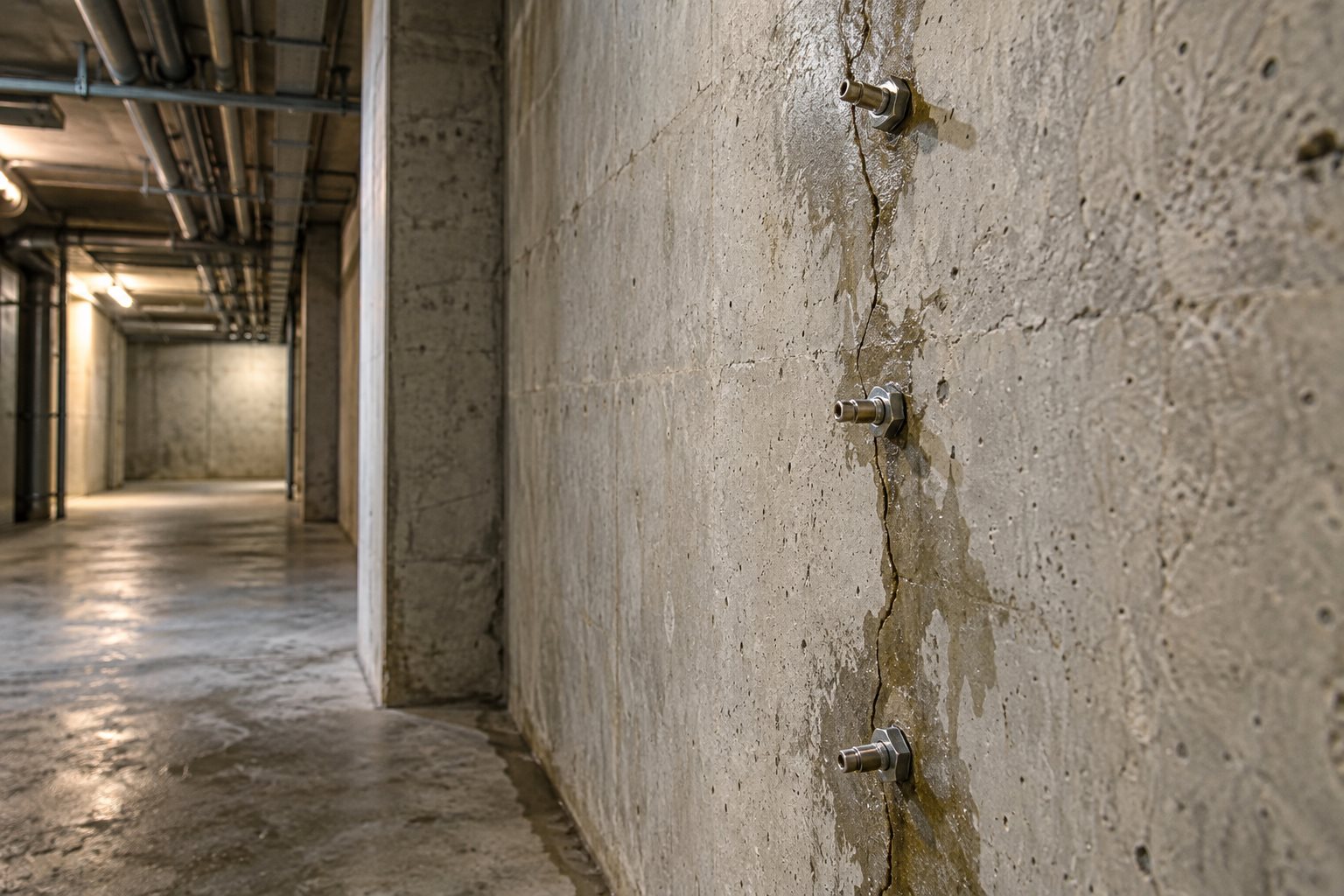
Polyurethane injection for leaking concrete cracks can be part of a rehabilitation plan for basement walls, retaining structures, and water-containing concrete. The immediate objective is to control water passing through a defect. A dry surface after injection is useful evidence, but it does not establish that the concrete has regained structural capacity or that every water path has been treated.
For owners, the most useful specification connects the observed leak to a defined repair objective, a suitable grout, a controlled installation, and a repeatable acceptance check. This article offers an inspection and decision framework; the project engineer and specialist installer must establish the actual drilling pattern, materials, pressures, and acceptance limits.
Separate water control from structural repair
Start by deciding what the intervention must accomplish. Is water entering an occupied basement, leaving a tank, or carrying contaminants toward reinforcement? Does the crack also indicate settlement, excessive loading, corrosion, or another unresolved mechanism? Obtain an engineering assessment where the damage may affect safety or serviceability before covering the evidence.
ASTM D8109-25 addresses chemical-grout waterproofing repair of concrete, with structural injection outside its scope. Its public guidance also explains that blocking a leak at one location can divert water elsewhere. It does not remove the water source. Owners should therefore agree on follow-up and the possibility of additional treatment before work starts.
If bonding a crack is necessary, review the separate requirements for structural epoxy injection. Do not accept a water-stopping proposal as a substitute for an engineered capacity-restoration scheme. Conversely, a rigid bonding repair should not be selected merely because the surface crack looks narrow.
Build a baseline that makes the result measurable
A useful survey assigns each leak a location and records its condition before treatment. Use photographs that show both the surrounding wall and the defect. Note whether water is seeping, dripping, or flowing; identify stains that are old rather than currently wet. Where practical, record an observable leakage measure consistently so later inspections can be compared.
Record the circumstances too: rainfall, groundwater observations, tank operating level, drainage condition, and any recent change in pumping. A wall inspected during a dry week cannot automatically be compared with a wall inspected after a storm. The baseline should distinguish a surface observation from a confirmed through-wall water path.
Check movement and construction details
Review available drawings for joints, penetrations, wall thickness, embedded services, and previous repair campaigns. Mark nearby defects so that water appearing beside the treated crack is investigated rather than dismissed. If movement is uncertain, use an appropriate concrete crack-monitoring plan to inform selection. A one-time width reading is not a movement history.
Before drilling, establish where reinforcement, tendons, and utilities may be present. The principles in rebar locating before concrete repair support planning, but scanning results still need interpretation. An injection contractor should not improvise around a suspected tendon or an unidentified embedded item.
Select the grout for its service conditions
Request evidence for the exact proposed product and formulation. The words polyurethane, hydrophilic, or hydrophobic describe material families; they do not establish suitability for every combination of movement, water chemistry, temperature, and drying. Product data should be connected to the observed exposure rather than compared only through expansion claims.
An ACI presentation on leaking cracks in containment walls discusses drying sensitivity of some hydrophilic grouts and the importance of compatibility and chemical resistance. Use that distinction to ask better questions: will the repaired location stay wet, cycle between wet and dry, or experience long shutdowns? Its discussion is limited to nonstructural cracks in conventionally reinforced liquid-containment structures; it is not a blanket procedure for post-tensioned or corrosion-damaged concrete.
Ask for a service-specific submittal
- Identify the resin, any catalyst or other component, approved proportions, storage requirements, shelf life, and relevant safety information.
- Describe the expected water exposure and submit supporting information for chemical compatibility and dimensional stability in that environment.
- Explain how the material accommodates the assessed movement and how that evidence relates to the installed system.
- State installation and reaction conditions, including temperature dependence, and the manufacturer’s response to changing field conditions.
- For drinking-water contact, provide evidence of applicable approval for the exact product and intended use; a general marketing statement is insufficient.
The ICRI resource on selecting leakage-control grouts addresses grout chemistry, crack geometry, and leakage conditions. It is useful background for the submittal discussion. Selection should also address how injection interacts with existing membranes, joint components, coatings, and earlier repair materials.
Use a trial area to establish a workable procedure
Choose a representative location with the engineer and installer. Document what makes it representative: access, apparent crack configuration, concrete condition, and water exposure. A convenient dry crack may be a poor trial for the wet locations that dominate the contract. Define what must be demonstrated and who can authorize production work.
In its research on underwater polymeric crack repairs, the Bureau of Reclamation reports laboratory testing and a subsequent field demonstration, with different outcomes between grouts and temperature-dependent optimization. That work supports checking the proposed system in relevant conditions; it does not justify transferring a laboratory result directly to a different building.
Record observations and revise the method if the trial reveals unexpected communication between defects, unsuitable reaction behavior, or poor access. Resolve the cause before extending the same approach across the structure. Owners can integrate this stage with their wider repair mockup and trial-panel process.
Control installation through hold points and records
The following is a suggested project record structure, not a universal injection recipe. The approved method statement should specify equipment, port arrangement, sequencing, operating limits, monitoring, cleanup, and stop conditions. Actual pressures and drilling dimensions depend on the concrete, defect, equipment, and selected system; copying settings from another job is not an acceptance method.
Before injection
Confirm the approved materials, batch identification, expiry, storage, and equipment condition. Verify that access, water collection, ventilation, and chemical-handling arrangements are ready. Confirm the authorized drilling locations and protection of adjacent assets. Record the initial condition immediately before work because it may differ from the original survey.
During injection
Link the log to each crack and port. Capture time, relevant temperatures, materials used, equipment readings required by the method, and observed response. Note grout or water emerging at adjacent ports, joints, penetrations, or unexpected locations. Material consumption is useful for investigation, but it is not proof of complete filling or successful waterproofing.
Stop and seek the specified review if new cracking, surface displacement, uncontrolled discharge, or unexplained material take occurs. Do not make increasing pressure the default response to poor penetration. The approved process should define who can change the sequence or formulation and how that change is recorded. Close out departures from the method before accepting the affected area.
Verify performance under an agreed water exposure
Agree the acceptance protocol before installation. Define the area being assessed, the relevant water condition, the observation period, and what constitutes an unacceptable result. The engineer should determine whether a controlled test is appropriate and safe. Changing tank levels, groundwater conditions, or drainage operation can affect loads and requires suitable authorization.
A dry photograph without a recorded water condition is not a leak-repair acceptance test. At inspection, document the original location and its surroundings, including penetrations and the wall-to-floor interface. Explain whether the exposure represents normal service or only an interim check. Identify follow-up inspections that remain necessary after rainfall or another meaningful operating condition.
Where leakage persists, preserve the observations and review the likely pathway before prescribing more injection. Where the original crack is dry but a nearby area becomes wet, investigate the whole local water-control detail. Closeout should distinguish accepted locations, provisional observations, and locations requiring further work so the owner can plan access and budget realistically.
Keep a usable handover package
Provide an as-built location map, photographs, approved submittals, installation records, departures and their dispositions, acceptance observations, and follow-up responsibilities. Record how ports and drilled holes were finished and how any interrupted protective system was reinstated. Future inspectors should be able to identify the repair without relying on the memory of the original crew.
Include a response route for renewed leakage and any maintenance obligations under the agreed contract. Avoid promising permanent dryness based solely on a successful initial inspection. A bounded, documented acceptance decision gives the owner a clearer basis for maintenance than an unsupported lifetime claim.
Frequently asked questions
Does polyurethane injection strengthen the concrete wall?
This article addresses water-control injection. Any claim of structural restoration requires a separate engineering basis for the selected system and damaged member. Leak stoppage alone is insufficient evidence.
Is hydrophobic grout always better than hydrophilic grout?
No universal choice follows from those names. Ask for evidence matching the exact formulation to water exposure, drying, movement, chemistry, and installation conditions. Resolve gaps through supplier input and appropriate trials.
Can the inspector accept the work immediately after pumping stops?
Only if the agreed procedure’s required conditions and observations have been satisfied. Reaction, finishing, and service-condition checks may remain outstanding. Record interim observations separately from final acceptance.
What should an owner prepare before requesting advice?
Collect drawings, dated photographs, leakage history, water-level or rainfall observations, movement records, and earlier repair details. These make the first review more useful and help identify what investigation is still missing.
Discuss the repair objective before selecting a product
If a concrete structure has recurring leakage, request a Structural Rehab consultation to discuss the assessment information and repair scope. Bring the baseline records and proposed grout submittal. A consultation can help organize the next engineering questions; site-specific assessment and design remain necessary where conditions require them.
Need a professional structural assessment?
Book a consultation with Structural Rehab to evaluate repair priorities, corrosion risks, and rehabilitation options before damage escalates.
Book Consultation