Epoxy injection for structural concrete cracks can be a strong repair method, but it is only appropriate when the crack is stable enough, dry enough, clean enough, and meaningful to the load path. It is not a universal crack filler. A repaired crack can look sealed while the original cause continues to move, corrode reinforcement, leak water, or overload the member.
The engineering value of epoxy injection is continuity. When the crack separates concrete that should act together, a properly selected low-viscosity structural epoxy can bond the crack faces and help restore stiffness across that plane. When the crack is active, contaminated, leaking, too wide, too tight to fill, or caused by continuing movement, other repair approaches may be safer.
When epoxy injection makes engineering sense
Use epoxy injection when the repair objective is to bond separated concrete, not merely to hide a crack. Typical candidates include dormant cracks in beams, slabs, walls, columns, pile caps, and other reinforced concrete members where the crack interrupts stiffness or load transfer. Before specifying injection, the engineer should determine the crack cause, movement history, moisture condition, reinforcement corrosion risk, and whether strengthening or section restoration is also required.
ACI PRC-224.1 discusses causes, evaluation, and repair of concrete cracks, including the need to determine whether cracks are active or dormant before choosing a method. ACI PRC-224.1 is useful because it treats crack repair as a diagnosis problem first. ACI PRC-546 also places crack repair within the broader repair process, including surface preparation, materials, replacement concrete, anchorage, protection, and quality control.
Do not inject until the crack has been classified
A crack should be classified by cause and behavior. Shrinkage cracks, flexural cracks, shear cracks, restraint cracks, thermal cracks, settlement cracks, corrosion-driven cracks, alkali-silica reaction cracks, and overload cracks do not call for the same repair. The injection decision should also consider whether the crack is moving seasonally, widening under service load, transmitting water, or associated with spalling and delamination.
If corrosion is active, injection alone may seal a symptom while reinforcement continues to deteriorate. Pair the crack review with chloride, cover, half-cell, resistivity, and delamination data where exposure suggests corrosion. Structural Rehab’s guides to chloride testing before concrete repair, half-cell potential testing, and concrete delamination survey explain how those inputs support repair decisions.
Key design checks before epoxy injection
Crack activity
Epoxy is generally rigid after cure. If the crack is still moving, the repaired crack may reopen beside the injected plane or transfer stress elsewhere. Active movement may require joints, flexible sealants, waterproofing, load reduction, strengthening, or movement-control details rather than rigid bonding.
Crack width and continuity
The resin must be able to penetrate the crack. Very fine cracks may need a low-viscosity product and controlled pressure. Wide cracks or voided cracks may need a different material, staged injection, routing, or partial removal. Crack continuity matters because injection ports only work when resin can travel through the intended plane.
Moisture and contamination
Many structural epoxies require dry or condition-specific substrates. Water, laitance, dust, oils, corrosion products, and previous failed sealants can prevent bond. Where moisture is unavoidable, the product data and field trial should confirm compatibility with damp or wet conditions.
Structural demand
Injection does not add reinforcement, confinement, or missing concrete section. If the member has inadequate capacity, section loss, shear distress, or reinforcement corrosion, injection may be only one part of a larger repair. For broader material compatibility questions, see concrete repair material selection.
Installation sequence owners should expect
- Document crack location, width, pattern, and movement evidence.
- Confirm the crack is suitable for rigid bonding or define a different repair objective.
- Clean the crack surface and remove weak or contaminated material.
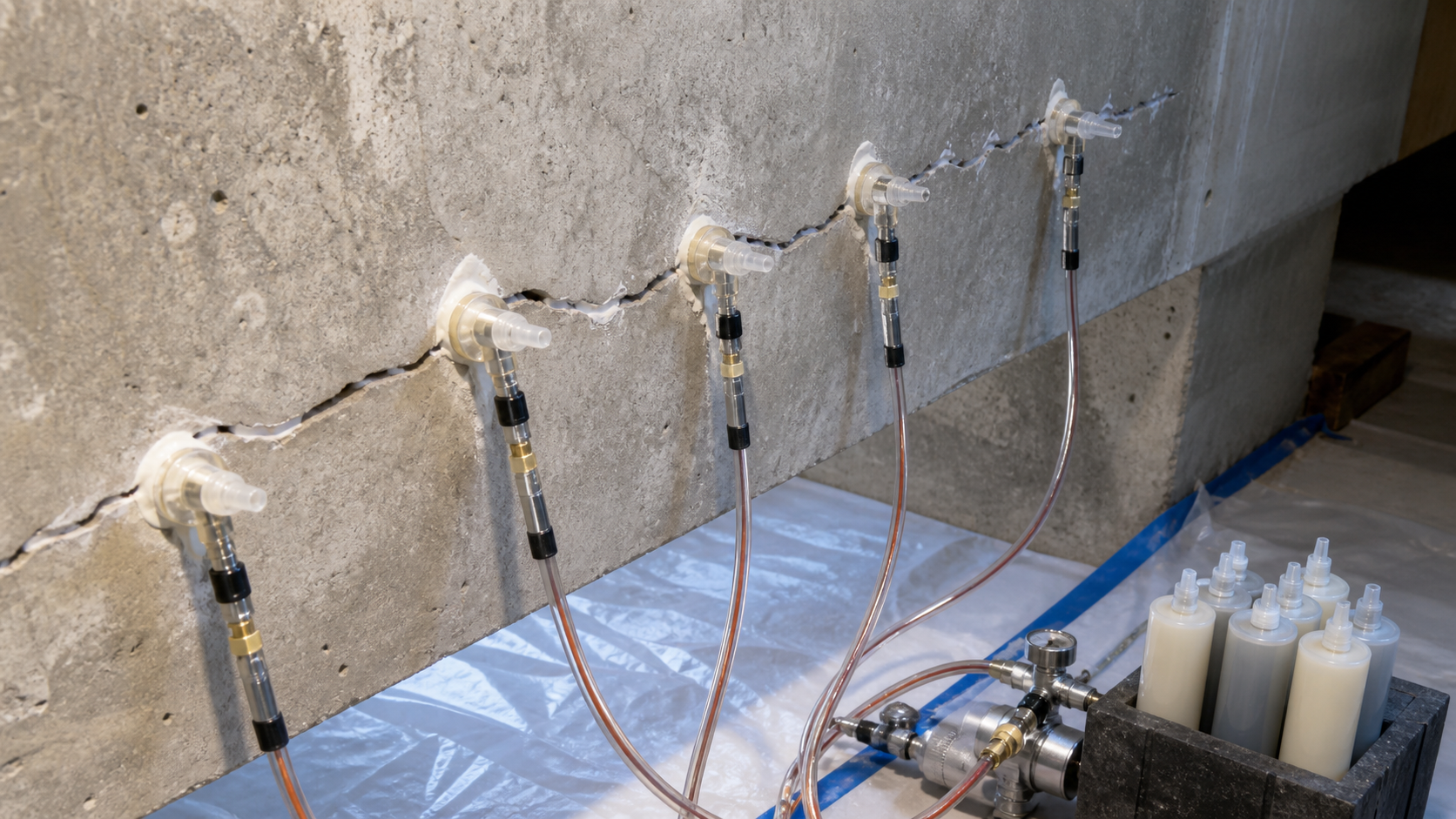
- Install injection ports at spacing matched to crack width and depth.
- Seal the crack face between ports so resin travels through the crack, not out of the surface.
- Inject from the lowest port or one end using controlled low pressure.
- Observe resin travel at adjacent ports before capping and moving to the next port.
- Allow the epoxy to cure under manufacturer-approved temperature and moisture conditions.
- Remove ports, finish the surface, and verify the repair by visual, sounding, coring, or other project-specific tests.
Quality control and acceptance
QC should record product batch, mix ratio, substrate condition, temperature, injection pressure, port spacing, resin take, refusal points, and cure time. Unusual resin consumption can indicate hidden voids, leakage, or incomplete crack continuity. Low resin consumption can indicate blocked ports, too much viscosity, or a crack that is not being filled.
For critical repairs, acceptance should not rely only on a neat finished surface. Verification may include sounding, core sampling, load testing, monitoring, or other project-specific evidence. Where the repaired crack is part of a larger strengthening program, acceptance should align with the design documents and ACI CODE-562 quality assurance requirements. Structural Rehab’s article on load testing existing concrete structures explains when testing can reduce uncertainty.
When to choose another repair method
Do not rely on epoxy injection when the crack is active, the member needs added capacity, the crack is leaking under pressure, the concrete is delaminated, corrosion is driving expansion, or the crack is part of a distributed durability problem. Polyurethane injection, routing and sealing, removal and replacement, external strengthening, waterproofing, joint repair, corrosion mitigation, or structural redesign may be more appropriate.
Pre-injection questions that prevent misuse
Before approving epoxy injection, ask what the completed repair is expected to prove. If the goal is restored stiffness, the engineer should explain why the crack is dormant and why bonding the crack faces is sufficient. If the goal is water control, the team should identify the water source and decide whether the resin is structural epoxy, flexible polyurethane, or part of a broader waterproofing repair. If the goal is durability, the crack repair should be coordinated with corrosion testing, surface protection, and drainage correction.
The specification should also define what happens if injection does not proceed as expected. Resin that exits an unintended joint, refuses to travel between ports, or disappears into a hidden void is field evidence. It should trigger engineering review instead of simply adding more pressure. Controlled injection protects the member because excessive pressure can widen cracks, create new leakage paths, or damage weak concrete at the crack edge.
How to document a successful injection repair
A useful closeout record includes pre-repair crack maps, photos, product data, batch numbers, port layout, injection sequence, pressure range, resin consumption by port, ambient and substrate temperature, cure time, observed leaks, and verification method. These records help future inspectors understand whether the crack was treated as structural bonding, water control, or a temporary stabilization measure.
FAQ
Does epoxy injection make cracked concrete as good as new?
Not automatically. It can bond suitable dormant cracks, but it does not remove the cause of cracking, replace lost reinforcement, or solve ongoing corrosion or movement.
Can epoxy injection stop water leaks?
Structural epoxy is mainly for bonding. Active leaks often require polyurethane injection, drainage, waterproofing, joint repair, or source control before structural work is finalized.
Should cracks be injected before strengthening?
Sometimes. If cracks interrupt load transfer under a strengthening system, injection may be part of surface preparation. The sequence should be defined by the repair engineer.
Sources
- ACI PRC-224.1, Causes, Evaluation, and Repair of Cracks in Concrete Structures
- ACI PRC-546-14, Guide to Concrete Repair
- ACI CODE-562-25, Assessment, Repair, and Rehabilitation of Existing Concrete Structures
- International Concrete Repair Institute technical guidelines
Need help deciding whether to inject a structural crack? Structural Rehab can review crack patterns, deterioration evidence, and repair objectives before epoxy injection is specified. You can also download our concrete and steel rehabilitation ebook for owner-focused repair planning guidance.
Need a professional structural assessment?
Book a consultation with Structural Rehab to evaluate repair priorities, corrosion risks, and rehabilitation options before damage escalates.
Book Consultation