A steel coating can look dry while its chemical cure is still incomplete. That matters before the next coat is applied, before coated members are handled, and before the structure is returned to service. A solvent-rub check can provide useful field evidence of cure development, but only when the coating type, solvent, test procedure, and acceptance criterion have been defined in advance.
This guide explains solvent rub testing for steel coatings for owners, engineers, inspectors, and applicators. It separates two commonly confused practices: ASTM D5402 for organic coatings that become more solvent-resistant as they cure, and ASTM D4752 for ethyl-silicate inorganic zinc-rich primers. Most importantly, it explains why a passing rub result is not, by itself, proof of full cure or fitness for service.
What a solvent-rub test tells you
ASTM D5402 describes a manual solvent-rub technique for assessing the solvent resistance of organic coatings that chemically change during curing. ASTM identifies examples such as epoxies, vinyl esters, polyesters, alkyds, and urethanes. As these films cure, they generally resist the specified solvent more effectively. The practice can be used in a laboratory, fabrication shop, or field setting.
The limitation is essential: ASTM states that solvent resistance alone does not indicate full cure, and some coatings can become solvent-resistant before they are sufficiently cured for service. Temperature, film thickness, air movement, and humidity for water-borne or water-reactive products can affect the time required to reach a specified resistance. Solvent rubs therefore answer a narrow question defined by the project and manufacturer; they do not certify every aspect of coating performance.
For ethyl-silicate inorganic zinc-rich primers, ASTM D5402 directs users to ASTM D4752 as the preferred practice. That separate method uses methyl ethyl ketone (MEK) resistance to assess cure. Never substitute one designation for the other simply because both involve rubbing a coated surface.
Choose the governing procedure before work starts
Identify the coating chemistry
Start with the approved coating-system schedule, current product data sheet, safety data sheet, and batch information. Confirm whether the layer under evaluation is an organic coating covered by the intended D5402 procedure or an ethyl-silicate zinc-rich primer requiring D4752. A generic phrase such as “zinc primer” is insufficient because zinc-rich products can use different binder chemistries.
The specification or manufacturer should state the test solvent, required number of double rubs, pressure or technique expectations, evaluation method, and acceptable result. ASTM D5402 does not prescribe a universal solvent, rub count, or pass threshold. Those choices depend on coating type and intended service. Inventing a field threshold after a result is obtained turns a useful check into subjective evidence.
Define the decision the test will support
A solvent-rub check may be used as one input before topcoating, handling, testing, or service exposure. Write down the decision and the other prerequisites. For example, approval to overcoat may also require compliance with the manufacturer’s minimum and maximum recoat window, acceptable surface condition, absence of contamination or amine blush, and compliant environmental conditions.
The pre-application meeting should confirm:
- coating product, binder type, coat number, and batch;
- the exact ASTM practice and current project specification;
- approved solvent and its safety controls;
- required double-rub count and evaluation criteria;
- test frequency and representative locations;
- witness, documentation, repair, and retest requirements;
- actions for a marginal or failed result;
- which other cure and recoat requirements remain applicable.
Prepare a defensible field test
Verify conditions and film history
Record mixing time, induction time where required, application time, batch, thinner addition, wet and dry film records, and the environmental history during application and cure. The existing dew point monitoring guide explains why surface temperature, humidity, and condensation risk must be controlled. Cure time printed on a data sheet is normally tied to stated conditions; colder steel, excessive thickness, poor ventilation, or incompatible thinning can change the outcome.
Review the cured coat’s dry film thickness results. An excessively heavy film can retain solvent or cure more slowly, even when the surface appears hard. Wet-film records can also help explain whether an unusual area received excess material during application.
Select representative, traceable locations
Do not test only the easiest horizontal plate. Include representative orientations, sheltered areas, thick-film locations, repair zones, and areas exposed to the least favorable curing conditions. Avoid using an edge, weld, bolt head, or intentional stripe coat as the sole evidence for a broad member unless that detail is specifically under evaluation.
Mark or map each location without contaminating the film. When production work is sensitive to cosmetic marks or solvent exposure, use an approved companion panel prepared and cured with the work only if the specification permits it. A companion panel is useful only when its substrate, preparation, product, thickness, application, and curing environment genuinely represent the structure.
Control solvent and personal exposure
Solvents can be flammable, harmful by inhalation or skin contact, and restricted by site or environmental rules. Follow the current safety data sheet, ventilation plan, ignition controls, waste procedure, and required PPE. Keep solvent containers identified and closed when not in use. The test standard does not replace the project’s health, safety, and environmental controls.
How the manual rub is performed
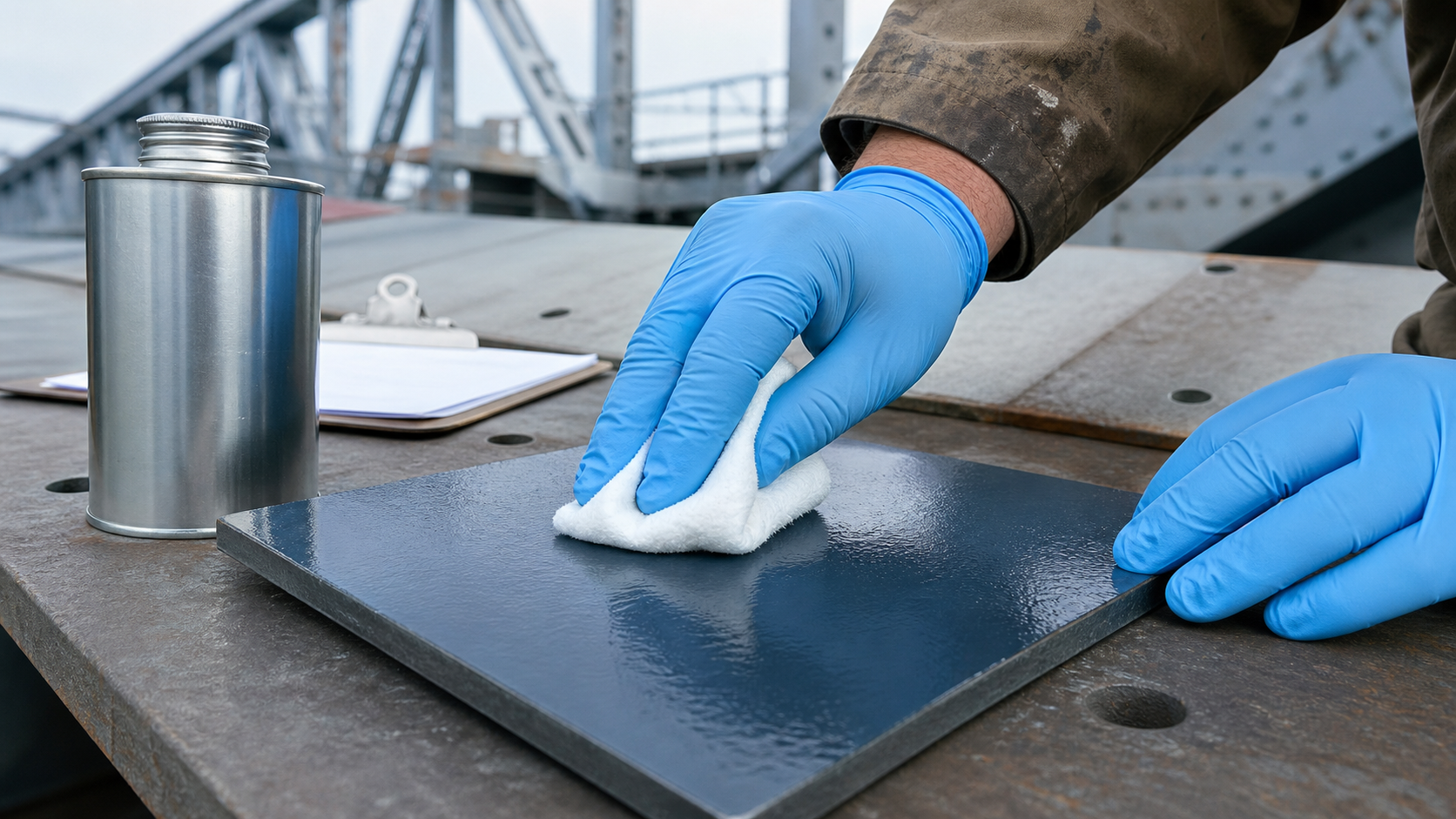
Use the apparatus, cloth or pad, solvent, wetting method, stroke length, and technique required by the governing practice and approved procedure. One double rub consists of a complete forward-and-back movement over the same path. Maintain a consistent motion and pressure without changing operators midway through a comparison set unless the procedure accounts for operator variation.
- Confirm authorization. Verify the coating, elapsed cure time, location, solvent, criterion, and safety controls.
- Inspect before rubbing. Record pre-existing softness, staining, contamination, damage, or surface irregularity.
- Prepare the rubbing material. Saturate it as the specified procedure requires without uncontrolled dripping.
- Count double rubs consistently. Use a counter or a second person where practical; do not estimate.
- Observe the film and cloth. Record softening, transfer, breakthrough, gloss change, color change, or other specified endpoint.
- Stop at the defined endpoint. Do not continue merely to produce a dramatic failure.
- Document and protect the location. Photograph or map the result and repair the test spot when required.
A defensible solvent-rub record connects the observation to a specific coat, location, batch, cure history, solvent, operator, and acceptance rule. A note saying only “MEK test passed” is too thin to support a later dispute or failure investigation.
Interpret results without overclaiming
Compare the observation with the pre-approved criterion, not with another inspector’s memory. Depending on the procedure, evaluation may consider the completed double-rub count, coating removal, softening, or transfer to the cloth. Report what occurred rather than converting the observation into an unsupported claim of “100% cured.”
A passing result can support the specified decision only when all associated requirements also pass. It does not prove adhesion, final film thickness, holiday-free coverage, impact resistance, chemical-service readiness, or long-term durability. Those properties require their own controls. Where specified, continue with pull-off adhesion testing and holiday detection at the appropriate stage.
What a failed or marginal result may mean
Possible causes include insufficient cure time, low temperature, high or low humidity for a moisture-sensitive chemistry, excessive film thickness, poor ventilation, wrong mixing ratio, incomplete mixing, omitted induction time, expired pot life, unapproved thinner, contamination, or an incorrect test solvent. The rub result identifies a condition requiring investigation; it does not diagnose the cause by itself.
Quarantine the affected area or lot from topcoating, handling, or service if the specification requires it. Review records, expand testing using an approved sampling plan, and obtain written direction from the coating manufacturer and responsible engineer. Simply waiting and retesting may be appropriate in some cases, but it cannot repair a wrong mix ratio, contamination, or chemically damaged film.
Minimum QA/QC record
Record the structure, member and exact location; date and time; product, coat and batch; application and mixing times; elapsed cure time; ambient and surface conditions during application and cure; DFT at or near the location; governing procedure; solvent identity; cloth or pad; operator; specified double-rub count and endpoint; actual observations; photographs; disposition; repair; and retest result.
Link this record to surface preparation, soluble-salt testing, environmental logs, application reports, and final coating inspection. The resulting chain of evidence is more valuable than an isolated pass box.
FAQ
Does a solvent-rub pass prove full cure?
No. ASTM D5402 explicitly cautions that solvent resistance alone does not indicate full cure. Use the result only for the decision and criterion established by the specification and coating manufacturer.
Is ASTM D5402 the correct test for every steel coating?
No. It applies to specified organic coatings that change chemically during cure. ASTM identifies D4752 as the preferred practice for ethyl-silicate zinc-rich primers.
How many double rubs are required?
There is no universal D5402 number. The manufacturer or project specification must define the solvent, number of double rubs, and acceptable result for the coating and service.
Can the coating be topcoated immediately after it passes?
Not automatically. Confirm the approved recoat window, surface condition, cleanliness, environmental limits, and every other manufacturer and contract requirement.
Should a failed test area be coated over?
No, not without an approved disposition. Protect the affected work, investigate the likely cause, consult the responsible parties, and repair or retest under written direction.
Authoritative sources
- ASTM D5402-19(2024), Standard Practice for Assessing the Solvent Resistance of Organic Coatings Using Solvent Rubs
- ASTM D4752-20(2024), Standard Practice for Measuring MEK Resistance of Ethyl Silicate (Inorganic) Zinc-Rich Primers by Solvent Rub
- UFGS 09 97 13.27, High Performance Coating for Steel Structures
- FHWA-RD-98-084, Field Manual for Bridge Painting Inspection
Turn coating checks into clear decisions
Structural Rehab helps owners and project teams translate coating requirements into practical hold points, traceable inspection records, and defensible repair decisions. For project-specific review of a steel coating QA/QC plan, book a consultation. Project decisions should remain with the responsible engineer, coating specialist, and manufacturer using the actual structure, exposure, and contract documents.
Need a professional structural assessment?
Book a consultation with Structural Rehab to evaluate repair priorities, corrosion risks, and rehabilitation options before damage escalates.
Book Consultation