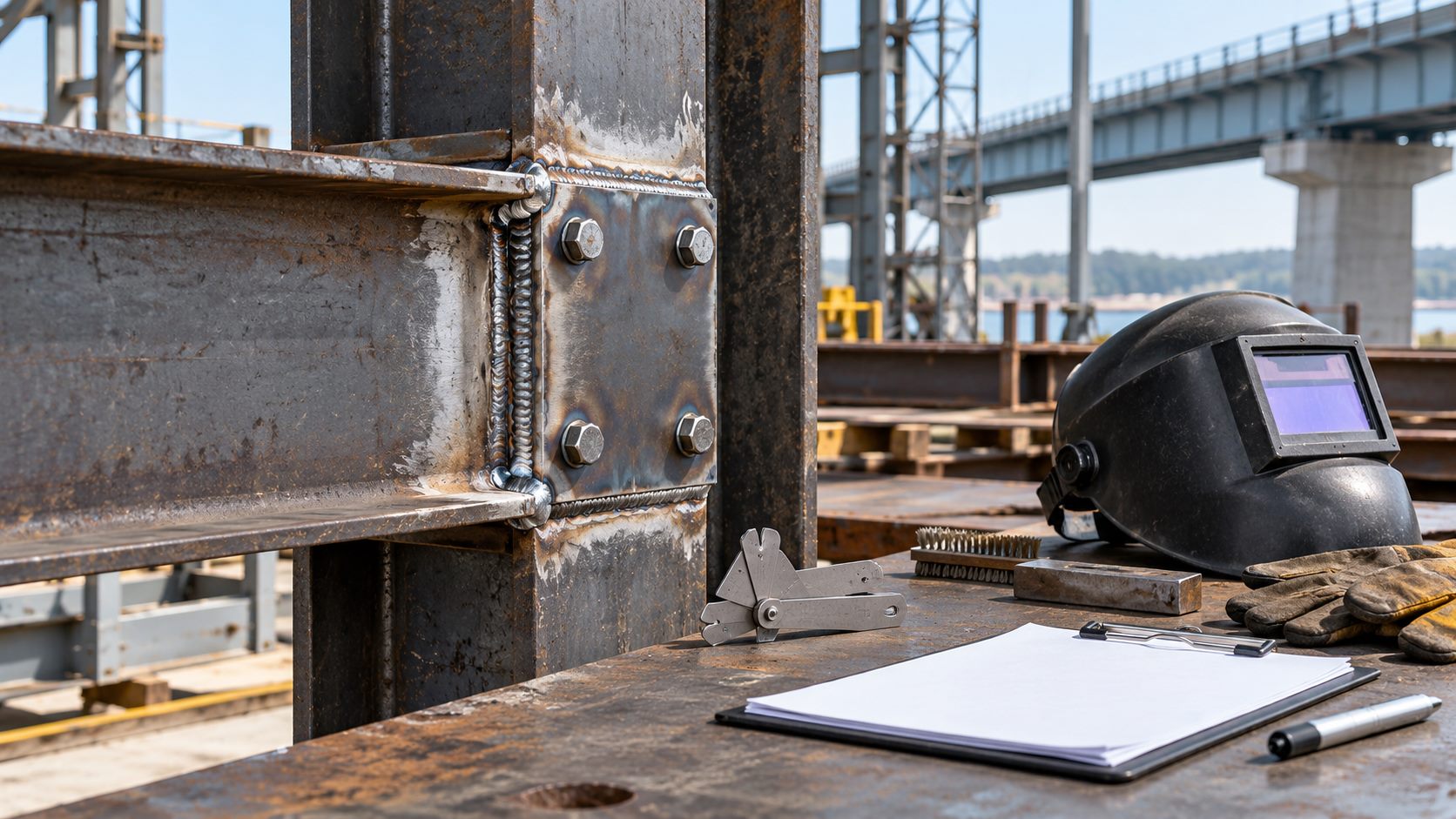
Structural-steel repair welding needs more than a welder, equipment and a drawing. Before heat is applied to a load-carrying member, the project team needs a controlled connection between the approved repair detail, the applicable welding procedure specification (WPS), the welder’s current performance qualification and the inspection plan. That connection is especially important in field repair, where access, restraint, weather, existing coatings, base-metal condition and repair geometry can differ from ordinary shop work.
Structural steel repair WPS and welder qualification QA/QC is the practical process of checking that the planned weld can be made under an approved procedure by a person qualified for the applicable process and conditions. It is not a substitute for an engineered repair design, nor does a qualification record authorize a change to a member, weld size or load path. The engineer of record and governing contract documents decide what repair is permitted.
Separate the repair design, WPS and welder record
These documents answer different questions. The repair design identifies the distress, load path, detail, materials and acceptance requirements. A WPS records the controllable welding variables selected for a joint. A welder performance qualification record shows that a welder, welding operator or tack welder has demonstrated qualification within the applicable code limits. A procedure qualification record (PQR), where required, supports a procedure qualified by testing.
AISC explains that a written WPS records the controllable and measurable variables used for each joint, while the qualification of procedures and welders is part of establishing reliable welded assemblies. In other words, a person may be a skilled welder yet not be qualified for the process, position, joint type or other limits needed for a particular repair. Conversely, a suitable WPS cannot make an unapproved repair detail acceptable.
Start by resolving the repair question before selecting the welding paperwork. If an inspection identifies a crack, corrosion loss, damaged connection plate or deficient weld, preserve evidence, establish temporary controls where needed, and obtain engineering direction. The existing steel repair dimensional-survey workflow can help document the actual geometry before a repair is detailed. Do not use a generic field WPS to decide whether a member should be welded at all.
Build a pre-weld release package
A short, project-specific release package prevents the common failure mode of discovering a missing record after welding has begun. The package should identify the repair location and drawing revision, governing welding code or specification, planned joint, approved WPS, required base and filler materials, weld sequence, inspection hold points and responsible parties. For bridge work, owner approval requirements can be more specific; for buildings and industrial facilities, the contract documents and engineer’s requirements remain controlling.
Before the first arc, the contractor’s quality-control team should be able to show:
- the approved repair detail, including weld symbol, size, extent and any sequence restrictions;
- the WPS identified for the actual process, joint and intended welding conditions;
- supporting procedure qualification evidence when the WPS is not prequalified or when the governing requirements call for it;
- the assigned welder’s performance qualification and continuity evidence required by the applicable code;
- material and consumable controls, including any storage or conditioning requirements;
- the fit-up, environmental, access and safety conditions required to start; and
- the inspection plan, acceptance criteria and stop-work authority.
Names on forms are not enough. Match the documents to the work in front of the team. A WPS may be limited by process, base-metal grouping, position, thickness, filler metal and other essential variables. A welder’s qualification has its own limits. AISC notes that qualifications are dependent on weld type, position and whether the joint is tubular or non-tubular, among other applicable code limits. The qualified welding coordinator or inspector should resolve mismatches before work starts, not after a weld is concealed by coating.
Use hold points that are meaningful in repair work
1. Engineering and document release
Confirm that the latest repair drawing and any field-change disposition are present at the work location. Make the WPS available to the welder and inspector. FHWA describes the WPS as the recipe for a weld and notes that it should be available near the point of welding. If the observed field condition differs from the drawing—such as a different plate thickness, inaccessible weld position, hidden corrosion or altered joint preparation—stop and obtain a written disposition. Do not create a field workaround by silently changing procedure variables.
2. Personnel and consumable release
Verify the assigned welder’s documented qualification for the intended process and applicable work. Track any continuity requirement using actual project records; do not infer continuity from a badge, a prior employer or a verbal assurance. Make sure the electrode or wire is the specified product and has been protected as required. The related material traceability guide explains why records must connect the item at the repair location to approved documentation, not merely to a folder at closeout.
3. Fit-up and environmental release
Inspect joint preparation, alignment, backing where applicable, root opening, access and cleanliness before welding. The weld fit-up inspection article covers this field check in more detail. Remove or manage coatings, moisture, contaminants and other conditions in accordance with the approved plan. Repair sites can contain old coatings or hazardous materials, so safety controls and exposure management must be planned separately from weld acceptance.
4. First-pass and sequence release
For work with a sequence restriction, confirm the specified sequence before the first production pass. Welding can introduce shrinkage and residual stress; an improvised order can change alignment or restraint. Use the project plan together with the weld-sequence distortion-control workflow to document readings and escalation points. A successful welder qualification does not prove that an unplanned sequence is structurally acceptable.
5. Inspection, repair and closeout release
Visual inspection begins before welding and continues during and after the work. The applicable documents determine whether visual examination, magnetic-particle testing, ultrasonic testing, radiography or another method is required. Distinguish a discontinuity from a rejectable defect using the governing acceptance criteria. If a repair is needed, determine the cause and obtain the required approval before repeating the same conditions. FHWA’s Bridge Welding Reference Manual emphasizes that major repair situations can require approval and that the applicable approved WPS must be followed.
What owners should ask for
Owners do not need to prescribe welding variables, but they should require a clear record trail. Ask who has authority to release the repair, which code and contract requirements govern, whether the observed condition matches the approved detail, what WPS applies, how welder qualification and continuity will be checked, and what inspection results must be accepted before coating or demobilization. For critical members, fracture-sensitive details, restricted access or uncertain existing material, require the responsible engineer to define the decision path before work begins.
A complete record can include the repair drawing revision, approved WPS and supporting qualification documentation where applicable, welder assignment and continuity record, material records, fit-up and environmental checklists, inspection reports, nonconformance reports, corrective actions and final acceptance. It should identify the exact member and location. “Field weld completed” is not a useful future maintenance record.
Limitations and consultation guidance
Qualification paperwork cannot determine the capacity of a damaged member, validate unknown base-metal properties, approve welding to a fatigue-sensitive detail, replace a required engineer’s repair design or compensate for poor fit-up. It also cannot decide whether a field weld is safe while a structure is loaded or restrained. The governing code, owner requirements and engineer of record control every repair. When documents conflict or field conditions differ, pause work and obtain a written engineering decision.
Structural Rehab can help owners organize repair observations, QA/QC questions and closeout records for review by the responsible engineer. That support does not replace site-specific design, welding engineering, inspection authority or professional engineering judgment.
FAQ
Is a welder qualification record the same as a WPS?
No. The WPS describes the procedure variables for a weld. A welder performance qualification record documents an individual’s demonstrated qualification within applicable limits. Both must align with the approved repair and governing requirements.
Can a previous qualification be used on a repair project?
Possibly, if it is properly documented, remains effective under the governing code and covers the planned work. The authorized project party should verify the applicable process, position, joint and any continuity requirements rather than assuming that an older certificate applies.
What if the WPS does not fit the field repair condition?
Stop the affected work and obtain direction from the responsible engineer and qualified welding authority. Changing the joint, process or other controlled variables in the field can require a different approved procedure or revised repair detail.
Sources
- AISC Engineering FAQ: welding procedures and welder qualifications
- FHWA Bridge Welding Reference Manual
- FHWA LRFD for Highway Bridge Superstructures Reference Manual
- FHWA steel erection construction review checklist
Need a professional structural assessment?
Book a consultation with Structural Rehab to evaluate repair priorities, corrosion risks, and rehabilitation options before damage escalates.
Book Consultation