Concrete resistivity testing before repair helps engineers understand how easily electrical current can move through concrete pore solution. That matters because reinforcement corrosion is an electrochemical process. Concrete with low resistivity often has higher moisture and ion transport, which can support faster corrosion when oxygen, chlorides, carbonation, or other exposure conditions are present.
Resistivity testing is not a standalone repair design. It is a diagnostic layer. Used with visual inspection, chloride testing, half-cell potential mapping, delamination survey, cover measurement, carbonation checks, and exposure review, it helps define where concrete repair should be localized, where protection is needed, and where monitoring may be sufficient.
What concrete resistivity tells you
Electrical resistivity indicates the concrete’s resistance to ionic movement. Dense, dry, well-cured concrete normally shows higher resistivity than saturated or highly connected pore systems. In corrosion assessment, lower resistivity can mean the concrete environment is more favorable for corrosion current flow if reinforcement depassivation has already occurred.
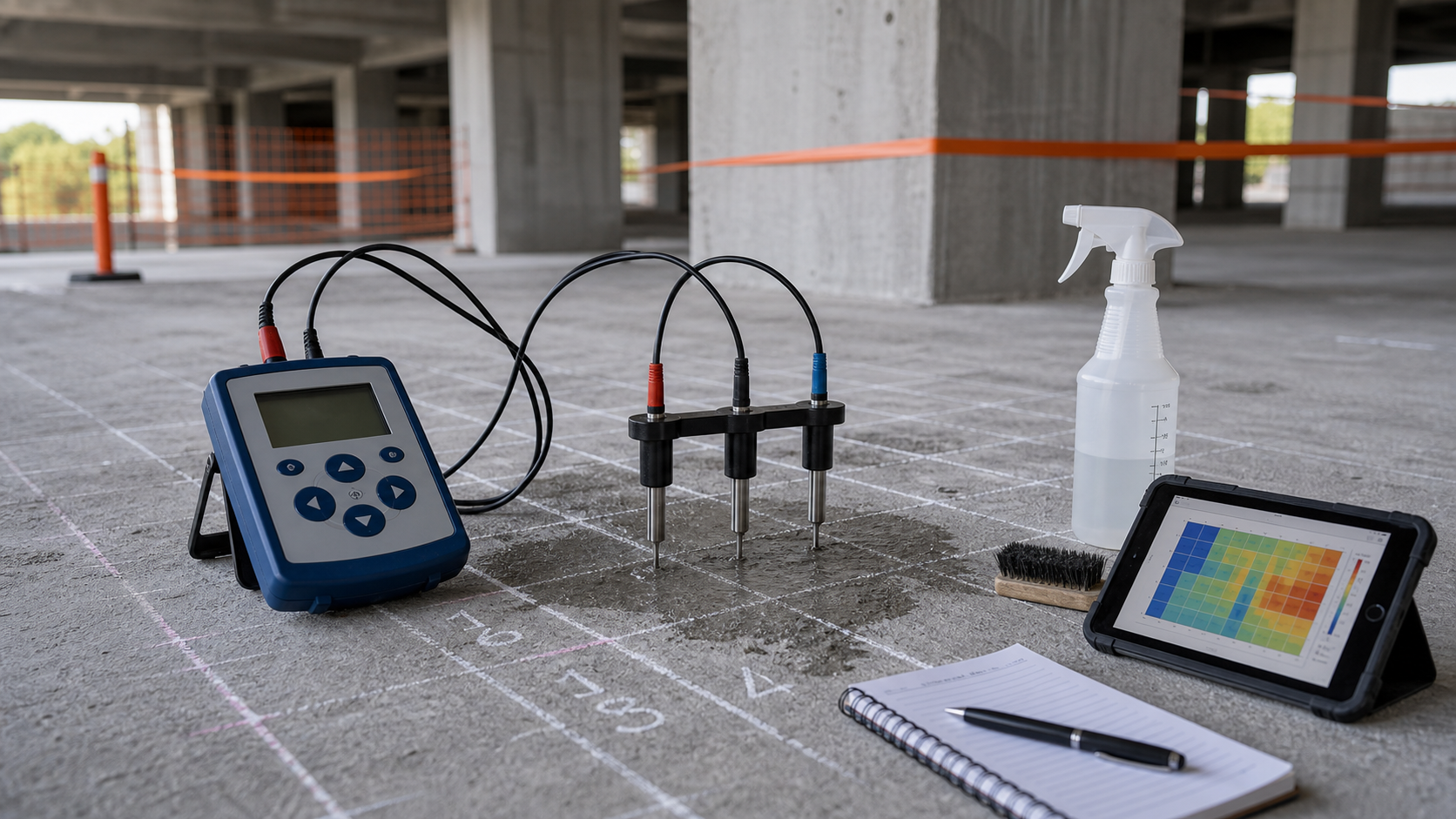
The method is commonly performed with surface resistivity equipment, such as a four-point Wenner probe, or with bulk resistivity tests on samples. Relevant standard references include ASTM C1876 for bulk electrical resistivity of concrete and transport-agency procedures for surface resistivity testing of concrete.
When to use resistivity testing before repair
Use resistivity testing when a structure has corrosion-related cracking, spalling, water leakage, marine exposure, de-icing salt exposure, wet parking areas, industrial wash-down zones, or recurring patch repairs. It is also useful when deciding whether a repair should include waterproofing, corrosion inhibitor, cathodic protection, drainage correction, protective coatings, or service-life monitoring.
If chloride contamination is suspected, resistivity should not replace chloride sampling. It explains the concrete environment’s ability to support corrosion current; chloride testing explains whether the passive layer around reinforcement may be broken down. For that workflow, see Chloride Testing Before Concrete Repair: How to Map Corrosion Risk.
How to run a practical field survey
1. Start with exposure and defect mapping
Mark cracks, rust stains, spalls, wet zones, previous repairs, joints, drains, and traffic or chemical exposure areas. Resistivity readings only become useful when they are tied to real locations and real deterioration mechanisms.
2. Select a grid that matches the decision
Use tighter spacing near damage and high-exposure areas. Use wider spacing for screening large slabs or decks. The grid should be detailed enough to separate repair zones from protection-only or monitoring zones.
3. Control surface condition
Surface moisture, coatings, temperature, contamination, and contact quality can influence readings. Record the condition at the time of testing. If readings are compared between zones or repeated later, the conditions should be comparable.
4. Combine resistivity with corrosion-potential data
Half-cell potential testing indicates areas where corrosion is more likely to be active. Resistivity helps judge whether the concrete environment can support corrosion current. Used together, they produce a stronger corrosion-risk map than either method alone. See Half-Cell Potential Testing Before Concrete Repair for the companion method.
5. Turn readings into repair zones
The output should be a plan view or elevation map, not only a table. Mark zones with low, moderate, and high durability concern, then compare them with visible damage, chloride results, cover depth, and structural importance.
How resistivity affects repair decisions
Low-resistivity areas near visible spalling may justify wider repair boundaries or corrosion-control measures. Low-resistivity areas away from visible damage may indicate a need for waterproofing, surface protection, drainage improvement, or monitoring before damage becomes visible. Higher-resistivity areas are not automatically risk-free, but they may support a more selective intervention when other evidence agrees.
For exposed reinforcement and patch repair sequencing, review Concrete Spalling Repair: How to Diagnose, Patch, and Prevent Reinforcement Corrosion. For wider rehabilitation planning, Structural Rehab provides structural rehabilitation services covering assessment, concrete repair, strengthening, waterproofing, protective coatings, and durability planning.
Limitations to document
Concrete resistivity does not directly measure steel section loss, corrosion rate, chloride content, carbonation depth, or structural capacity. It can be affected by moisture, temperature, mix quality, pore structure, surface condition, coatings, saturation, and contact quality. This is why resistivity results should be interpreted by an engineer as part of an assessment package, not as a single pass/fail test.
Repair planning for existing concrete should also consider code-aware assessment and rehabilitation requirements. ACI’s repair code framework is represented by ACI CODE-562, Assessment, Repair, and Rehabilitation of Existing Concrete Structures.
Recommended decision path
- Map visible defects and exposure sources first.
- Use resistivity testing to identify concrete zones that may support faster corrosion activity.
- Use chloride testing, half-cell potential mapping, cover depth, carbonation checks, and delamination survey to explain why the risk exists.
- Define repair boundaries and protection zones from combined evidence.
- Specify waterproofing, coating, inhibitor, cathodic protection, drainage correction, or monitoring only when the diagnosis supports it.
If the structure already shows urgent warning signs, review 7 Critical Signs Your Concrete Structure Needs Immediate Repair before deciding how much testing is needed.
FAQ
Is concrete resistivity testing destructive?
Surface resistivity testing is generally non-destructive. Bulk resistivity requires a sample, so it is normally used on cores, lab specimens, or project samples rather than untouched in-place concrete.
Does low resistivity always mean active corrosion?
No. Low resistivity means the concrete environment can more readily support ionic movement and corrosion current. Active corrosion also depends on reinforcement depassivation, moisture, oxygen, chlorides, carbonation, and electrical continuity.
Should resistivity be used with half-cell potential testing?
Yes. Half-cell testing helps locate probable active corrosion zones. Resistivity helps interpret whether the concrete environment supports corrosion current. Together they improve repair-zone decisions.
Can resistivity testing decide the repair material?
Not by itself. It supports the diagnosis. Repair material selection should also consider exposure, structural demand, compatibility, surface preparation, bond, curing, moisture control, and long-term protection.
Need a durability-focused repair plan?
Structural Rehab helps owners and engineers convert inspection data into practical repair and protection decisions. For corrosion-risk mapping, concrete repair planning, waterproofing, protective coatings, strengthening, or service-life assessment, book a structural repair consultation. The free guide and full ebook on the home page can also support preventive maintenance planning.
Affiliate note: No affiliate links are included in this article because no approved Structural Rehab affiliate URLs were available at publishing time.
Sources
- ASTM C1876, bulk electrical resistivity or bulk conductivity of concrete
- ASTM C876-22b, corrosion potentials of uncoated reinforcing steel in concrete
- ACI CODE-562, Assessment, Repair, and Rehabilitation of Existing Concrete Structures
Need a professional structural assessment?
Book a consultation with Structural Rehab to evaluate repair priorities, corrosion risks, and rehabilitation options before damage escalates.
Book Consultation