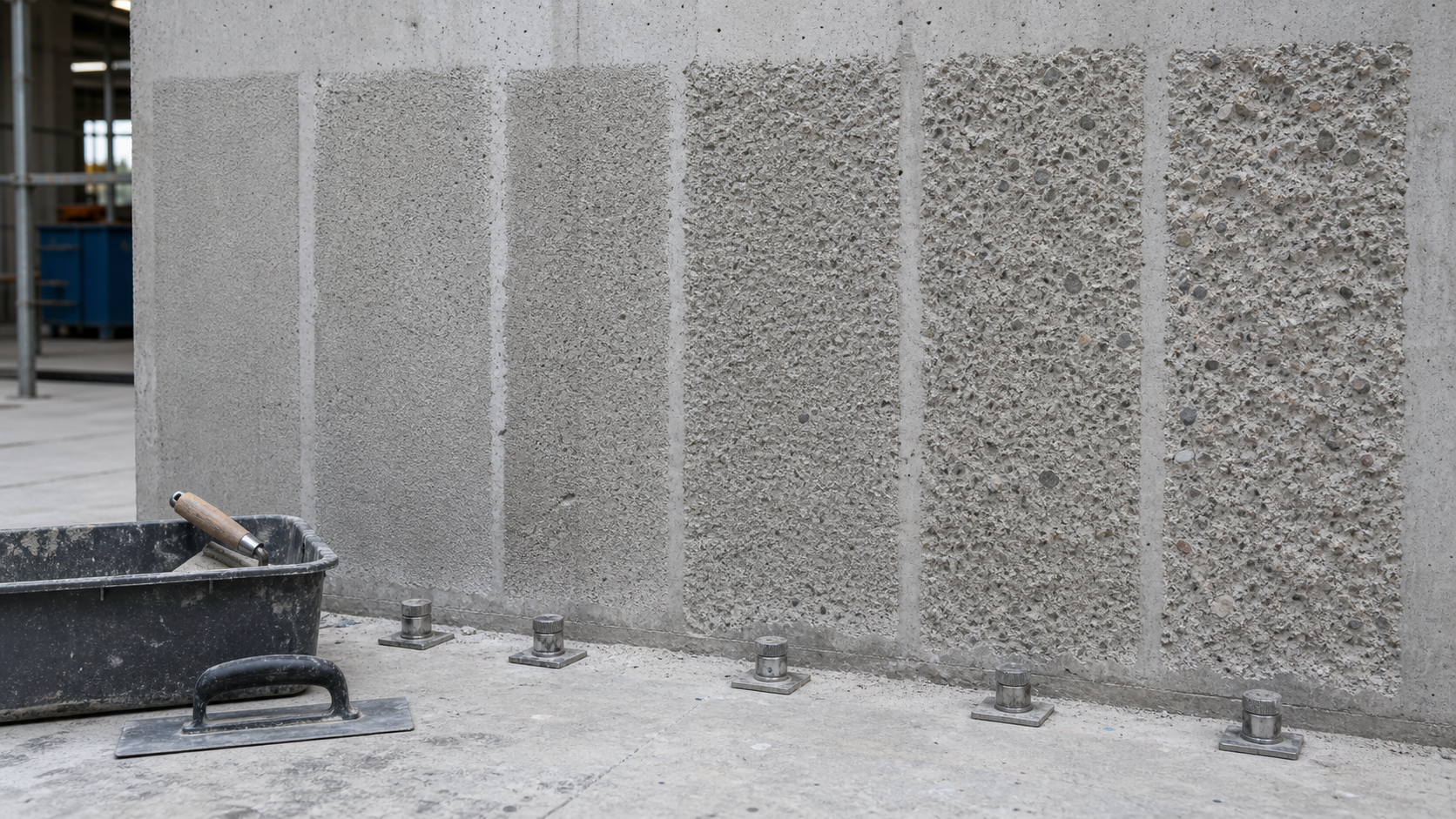
Concrete repair durability depends on more than choosing a strong repair mortar or coating. The existing concrete must be prepared to the right roughness, cleanliness, soundness, and moisture condition before any material is installed. That prepared roughness is commonly described as the concrete surface profile, or CSP.
If the surface is too smooth, repair mortars, overlays, waterproofing membranes, and protective coatings may not bond. If the surface is too aggressive for the selected material, thin coatings can bridge peaks, trap voids, or consume more product than planned. A durable specification should define the required profile, the removal method, the inspection method, and the acceptance testing before repair begins.
What Concrete Surface Profile Means
Concrete surface profile is the visible and tactile texture left after surface preparation. It is affected by the original concrete quality, laitance, contamination, carbonation, previous coatings, preparation tools, aggregate hardness, and the depth of removal. Light grinding may leave a fine profile. Scarifying, scabbling, hydrodemolition, or abrasive blasting can expose aggregate and create a much deeper profile.
The practical goal is not simply to make concrete look rough. The goal is to expose sound concrete, remove weak layers, create mechanical key where needed, and leave a surface that is compatible with the repair or protection system. The American Concrete Institute highlights surface preparation as a core repair topic because bond is central to repair performance.
Why One CSP Does Not Fit Every Repair
A thin protective coating and a thick cementitious repair overlay do not need the same surface. A coating may need a clean, open, uniform texture without sharp peaks. A bonded repair mortar may need more mechanical key and removal of weak surface paste. A waterproofing membrane may need profile control that supports adhesion while avoiding puncture risk.
Thin coatings and sealers
For coatings, the surface should usually be sound, clean, open, and free from dust, laitance, curing compound, grease, loose particles, and incompatible previous coatings. Excessively rough surfaces can make film thickness uneven and increase pinhole risk. Coating manufacturers often define the acceptable profile in their product data sheets.
Waterproofing membranes
Waterproofing systems require bond, continuity, and detail control. The substrate should be prepared enough to remove weak layers and expose a stable surface, but sharp projections should be repaired because they can damage membranes or create weak points at corners, joints, and penetrations.
Repair mortars and overlays
Patch repairs, overlays, and section restoration normally need a stronger mechanical profile than thin coatings. The prepared concrete should be cut to sound material, feather edges should be avoided where the repair system does not allow them, and exposed aggregate may be appropriate for thicker bonded repairs. Pull-off testing can help confirm that the prepared substrate and installed repair have enough tensile bond strength for the intended work.
A Practical Specification Workflow
Use this workflow before issuing a repair method statement or contractor instruction:
- Define the repair objective. Decide whether the work is cosmetic protection, waterproofing, load-related repair, overlay placement, coating renewal, or section restoration.
- Confirm the substrate condition. Check for delamination, carbonation, chloride contamination, moisture movement, previous coatings, and weak concrete.
- Select the preparation method. Match grinding, abrasive blasting, scarifying, hydrodemolition, needle scaling, or mechanical removal to the required depth and profile.
- State the required profile and cleanliness. Do not leave surface preparation as a generic instruction. Define the acceptable range and require dust removal before bonding.
- Verify before placement. Inspect profile uniformity, soundness, moisture condition, and contamination. Use pull-off testing where bond performance is critical.
- Document acceptance. Keep photos, test values, environmental readings, material batch records, and inspection notes.
How CSP Connects With Other Testing
Surface profile is one part of a larger repair decision. If chloride levels are high, the repair may need corrosion mitigation in addition to patching. If half-cell potential or resistivity testing suggests active corrosion risk, a simple surface repair may not be enough. If pull-off adhesion is low, the substrate may need deeper removal or a different repair system.
For related assessment steps, read our guides on chloride testing before concrete repair, half-cell potential testing, concrete resistivity testing, and pull-off adhesion testing.
Common Failure Modes When CSP Is Wrong
The most common failures are debonded patch repairs, blistered coatings, hollow overlays, membrane leakage, excessive material consumption, pinholes, cracking at repair edges, and repeated delamination. These failures often look like material problems, but the root cause is frequently surface preparation, moisture, contamination, or an incompatible repair detail.
Limitations
CSP alone does not prove that a repair will perform. It does not measure chloride content, corrosion activity, substrate tensile strength, moisture vapor drive, structural capacity, or compatibility between materials. For structural repairs, surface profile must be specified by a qualified engineer together with material requirements, load-path checks, curing conditions, quality control tests, and protection strategy.
Field Checklist Before Repair Placement
- Unsound concrete and delamination removed.
- Edges cut or detailed according to the repair material requirements.
- Surface profile matches the selected mortar, overlay, coating, or membrane.
- Dust and loose particles removed.
- Moisture condition meets the product data sheet.
- Contaminants, laitance, curing compounds, and incompatible coatings removed.
- Bond-critical work verified by pull-off testing where specified.
- Photos and inspection records saved before covering the surface.
FAQ
Is a rougher concrete surface always better?
No. Rougher is not automatically better. The correct profile depends on the repair system thickness, resin or cement chemistry, membrane sensitivity, coating film thickness, and manufacturer requirements.
Can grinding alone prepare concrete for repair?
Grinding can be suitable for some coatings and thin systems, but it may not remove enough weak concrete for deeper repairs. For delaminated or contaminated concrete, mechanical removal or blasting may be required.
When should pull-off testing be used?
Pull-off testing is useful when bond strength is critical, when the substrate condition is uncertain, or when the repair specification requires proof of adhesion. ASTM C1583 is a commonly referenced test method for tensile strength of concrete surfaces and bond strength of bonded materials.
Does CSP solve corrosion problems?
No. CSP improves bond and preparation quality. Corrosion risk must be assessed separately using inspection, cover depth, carbonation, chloride testing, half-cell potential, resistivity, and engineering judgment.
Sources
- American Concrete Institute: Surface Preparation topic
- American Concrete Institute: Concrete Repair topic
- ASTM C1583/C1583M: Tensile strength of concrete surfaces and bond strength of bonded materials
- ACI 562 Code Requirements for Assessment, Repair, and Rehabilitation of Existing Concrete Structures
Need a Repair Surface Preparation Review?
Structural Rehab can help define the correct surface preparation, testing sequence, repair material requirements, and protection strategy for existing concrete and steel structures. Book a consultation or review our structural repair and rehabilitation services before starting repair work.
Need a professional structural assessment?
Book a consultation with Structural Rehab to evaluate repair priorities, corrosion risks, and rehabilitation options before damage escalates.
Book Consultation