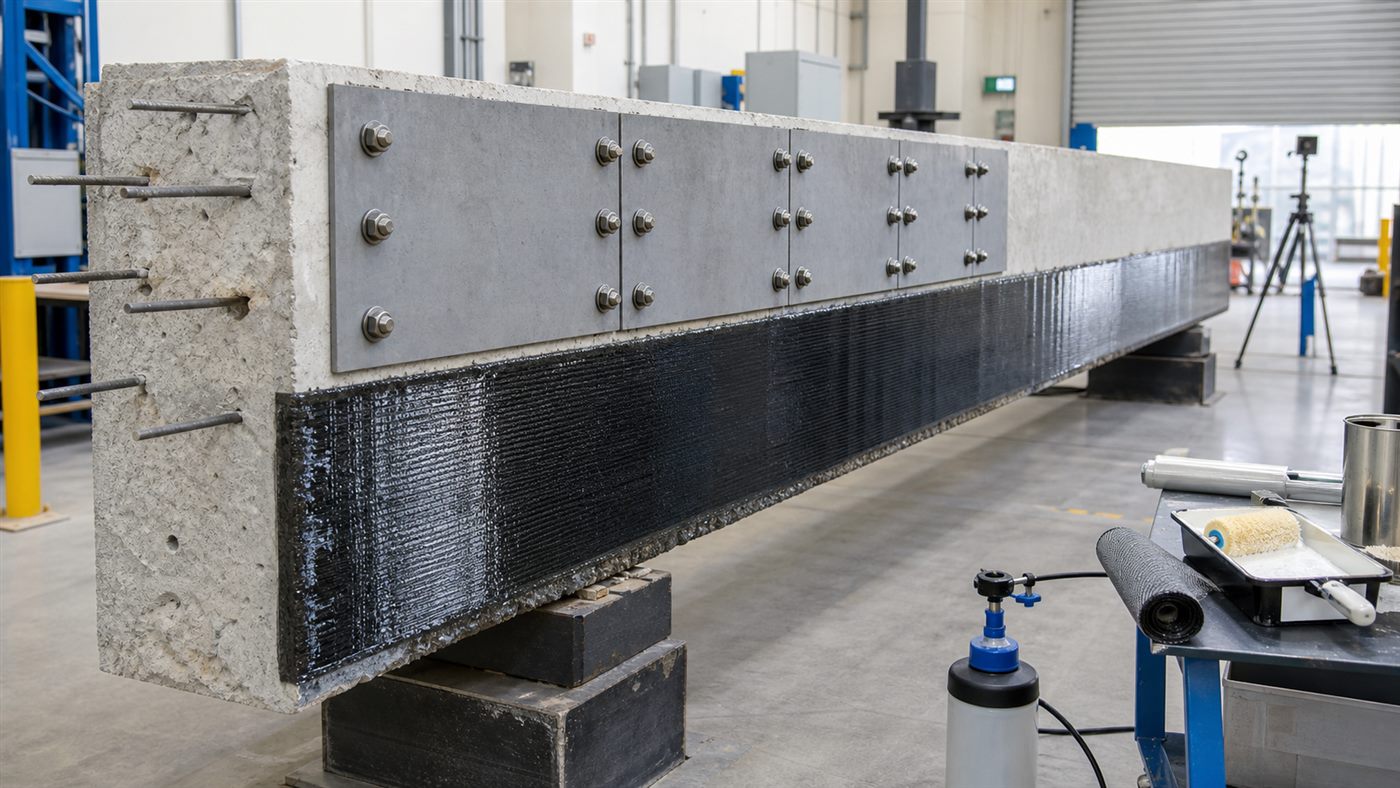
Hybrid strengthening systems are structural repair solutions that deliberately combine two or more strengthening materials, such as steel plates with externally bonded CFRP, bolted steel with bonded laminates, repair mortar with anchors, or localized steel reconstruction with composite confinement. The attraction is clear: steel can provide ductility, familiar connection behavior, impact tolerance, and inspectable load paths, while fiber-reinforced polymers can add high tensile capacity with low weight and minimal section buildup.
The risk is also clear. A hybrid repair can become an expensive stack of materials if the engineer has not defined what each layer is meant to carry. A hybrid repair should be specified because the combined system solves a defined load-path problem, not because two products sound stronger than one. This article explains where hybrid strengthening makes engineering sense, where it can create new risks, and which quality checks should be written into the repair plan.
What Counts as a Hybrid Strengthening System?
In structural rehabilitation, a hybrid system is not just a repair with many components. It is a repair where different materials share, transfer, or protect structural demand in a planned way. Examples include a reinforced concrete beam strengthened with steel plates for bearing or anchorage and CFRP laminates for flexural tension; a corroded steel member rebuilt with bolted plates and then protected or supplemented with bonded composite reinforcement; or a concrete column repaired with compatible mortar, steel confinement, and FRP wrapping where each component has a defined role.
This is different from a simple comparison between materials. For a direct choice between common beam strengthening methods, see our guide to CFRP vs steel plate strengthening for RC beams. For a broader owner-level comparison of carbon fiber and steel jacketing, see carbon fiber reinforcement vs steel jacketing.
When Hybrid Strengthening Makes Sense
A hybrid solution is usually worth studying when a single method cannot satisfy strength, serviceability, durability, constructability, and inspection constraints at the same time. A bridge girder, parking structure beam, industrial frame, transfer slab, or coastal building column may need added capacity, corrosion management, crack control, and rapid return to service. One material may be excellent for strength but weak for fire exposure. Another may be durable but too heavy or too disruptive. Hybrid design tries to use each material where it performs best.
Common drivers for hybrid repair
- Anchorage limits: steel plates, bolts, anchors, or clamps can provide a mechanical load path where a bonded FRP-only system would be sensitive to end debonding.
- Ductility and warning before failure: steel components can add yielding capacity and visible distress mechanisms that some brittle bonded systems lack.
- Weight and access limits: FRP can add tensile strength where heavy steel jackets or large plates would overload handling equipment or reduce clearance.
- Corrosion exposure: composites do not corrode like steel, but the existing reinforcement, anchors, plates, and concealed interfaces still need a corrosion strategy.
- Local damage with global demand: steel may rebuild a bearing zone while FRP improves flexure or shear over a wider length.
- Construction staging: hybrid repairs can sometimes separate temporary stabilization from final strengthening.
The Load Path Must Be Explicit
The most important design question is simple: what force enters each component, where does it go, and how is it transferred? For reinforced concrete, the answer may involve cracked-section analysis, strain compatibility, shear flow, development length, anchorage, concrete cover, and substrate strength. For steel structures, the answer may involve net section, bolt slip, weld access, fatigue category, heat input, and how a bonded composite behaves under service cycling.
ACI 440 guidance on externally bonded FRP systems is useful because it emphasizes design limits, substrate condition, environmental reduction factors, debonding considerations, and detailing. ACI 562 is also important because existing concrete repair design must account for assessment, repair objectives, material compatibility, strength, durability, and construction quality. These documents do not make a hybrid repair automatically code-compliant; they help frame the checks the engineer must perform.
Interface Failures Are Often the Weak Point
Hybrid systems create more interfaces than single-material repairs. That means more places for bond loss, corrosion cells, trapped moisture, differential movement, or workmanship defects. The concrete-to-adhesive interface, adhesive-to-FRP interface, steel-to-concrete contact, bolt holes, plate edges, patch boundaries, and coating terminations all need detailing.
Surface preparation is not a minor specification item. Pull-off testing, concrete surface profile, dust removal, moisture condition, chloride contamination, steel cleaning, coating compatibility, and cure temperature can control the final behavior. For related QA guidance, see pull-off adhesion testing before concrete repair.
Practical interface checks
- Confirm that the concrete substrate can develop the intended bond stress without pulling off weak cover concrete.
- Keep bonded FRP away from active water leakage unless the system is designed and tested for that exposure.
- Avoid unsealed steel plate edges that can trap water behind a repair.
- Detail anchors and bolts so they do not cut through critical reinforcement or create local splitting.
- Specify inspection windows or monitoring points when a repair conceals old steel or existing cracks.
Fire, Impact, Fatigue, and Inspection Limits
Hybrid strengthening is not only a strength calculation. FRP systems can lose performance at elevated temperatures unless protected and designed for the required exposure. Steel plates can handle impact better than many composites, but they can corrode, add dead load, and introduce fatigue-sensitive details. Adhesives may be sensitive to temperature, moisture, creep, and surface preparation. Bolted details may be inspectable, but they need hole quality, edge distance, pretension or snug-tight requirements, and corrosion protection.
For steel members, hybrid composite repairs should be approached carefully where fatigue cracks, weld defects, or cyclic loads control the decision. Our article on steel structure repair for cracks, corrosion, weld defects, and fatigue explains why crack cause and inspection access matter before strengthening is selected.
Where UHPC or Repair Mortar Fits
Ultra-high-performance concrete and engineered repair mortars may form part of a hybrid strategy when the objective is to rebuild cover, protect steel, improve local bearing, or create a durable transition between old and new materials. FHWA’s UHPC bridge report describes UHPC as a high-performance fiber-reinforced cementitious material with strong durability and mechanical properties compared with conventional concrete. In a repair, however, UHPC is not a magic coating. It still needs proper substrate preparation, load-transfer design, curing control, and joint detailing.
Decision Framework for Owners
- Define the objective. Is the project restoring lost section, increasing live load capacity, improving seismic behavior, reducing deflection, or extending durability?
- Measure the substrate. Do not design a bonded or anchored system without concrete strength, cover, cracking, chloride, corrosion, moisture, and steel condition data.
- Assign each material a role. Steel, FRP, mortar, anchors, and coatings should each have a reason to exist in the system.
- Check failure sequence. A good repair should not move the controlling risk to brittle debonding, concrete cover peel-off, hidden corrosion, or an uninspectable detail.
- Write quality gates into the specification. Include surface profile, pull-off testing, adhesive handling, bolt or weld inspection, cure records, coating checks, and final documentation.
- Plan maintenance access. If the repair hides an old defect, the owner needs a monitoring strategy.
Common Mistakes to Avoid
The first mistake is adding CFRP over steel or steel over CFRP without checking strain compatibility. The second is strengthening a member before stopping water leakage, corrosion, or movement. The third is treating product data sheets as structural design. The fourth is ignoring constructability: access, temperature, dust, moisture, cure time, lifting, jacking, and traffic staging can decide whether a technically sound repair actually performs.
A hybrid system may be the right answer for complex rehabilitation, but it requires disciplined design. Owners should ask for calculations, drawings, inspection requirements, and a clear explanation of why a combined system is preferable to a simpler repair.
When to Talk to Structural Rehab
If your asset has corrosion, cracking, section loss, load-rating concerns, recurring deflection, or a failed previous repair, Structural Rehab can review the available records and help decide whether a hybrid strengthening concept is worth developing. Start with a focused assessment through our consultation booking page.
FAQ
Is hybrid strengthening always stronger than CFRP or steel alone?
No. A hybrid repair is only better when each material has a defined role and the interfaces can transfer force reliably. Poorly detailed hybrid systems can fail at the bond line, plate edge, anchor, or old substrate.
Can FRP be used with steel plates?
Yes, but the engineer must check bond, strain compatibility, fire exposure, corrosion protection, fatigue behavior, and inspection access. It should not be treated as a simple material overlay.
What testing is needed before hybrid strengthening?
Typical checks include visual survey, crack mapping, cover survey, concrete strength, chloride or corrosion testing where relevant, pull-off adhesion testing, steel thickness checks, and confirmation of moisture and surface profile before bonding.
When should a hybrid repair be avoided?
Avoid it when the substrate is unsound, water leakage is active, corrosion remains untreated, fire or impact exposure cannot be managed, or future inspection would be blocked without a monitoring plan.
Sources
- ACI 440.2R: Guide for the Design and Construction of Externally Bonded FRP Systems
- ACI CODE-562-25: Assessment, Repair, and Rehabilitation of Existing Concrete Structures
- FHWA: Ultra-High Performance Concrete, A State-of-the-Art Report for the Bridge Community
- FHWA: Steel Bridge Design Handbook
Need a professional structural assessment?
Book a consultation with Structural Rehab to evaluate repair priorities, corrosion risks, and rehabilitation options before damage escalates.
Book Consultation