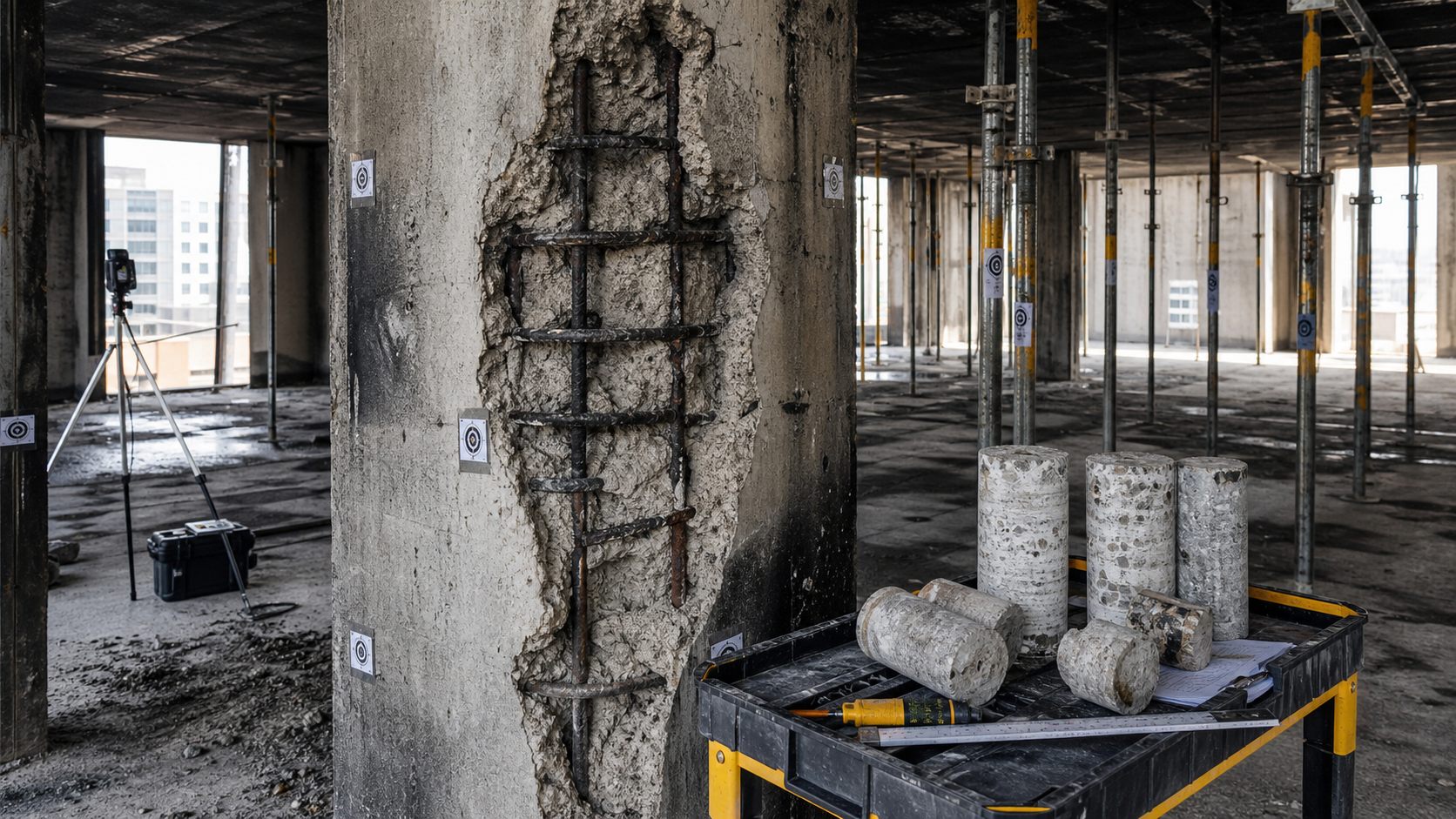
A fire-damaged concrete assessment is not a cosmetic walk-through. Heat can reduce concrete strength, damage the bond around reinforcing steel, crack cover concrete, change moisture movement, and hide distress behind soot or loose material. Owners who patch visible spalls before the structure is evaluated can spend money twice and, more importantly, may miss a residual-capacity problem.
This guide explains how to scope an engineering assessment before repair. It is written for owners, facility managers, and project teams who need a practical checklist, not a laboratory treatise. The exact procedure still belongs to a licensed structural engineer familiar with the building, the fire event, and local code requirements.
Start with life safety and stabilization
The first question is whether the area can be entered. Fire exposure may have weakened slabs, beams, columns, connections, or temporary supports. Before sampling or cleaning begins, the engineer should review fire department information, identify collapse hazards, define restricted zones, and decide whether shoring is required. Do not let cleaning crews remove loose concrete, charred finishes, or fireproofing until the engineer records the condition.
Useful early records include the approximate fire duration, fuel source, sprinkler performance, peak temperature indicators, photographs taken during and after the event, and the location of the most severe heating. These records help the engineer separate local surface damage from structural heat exposure.
Map damage before choosing repair methods
A structured survey should classify each member by observed condition: soot only, surface crazing, delamination, spalling, exposed reinforcement, deflection, joint distress, or suspected loss of section. Sounding, hammer survey, chain drag on slabs, cover measurement, crack mapping, and selective removals can reveal hidden delamination. If the fire affected prestressed concrete, post-tensioning, transfer girders, or punching-shear zones, the assessment should be more conservative because local damage can have disproportionate consequences.
Repair limits should be drawn from the survey, not from what happens to be loose on the first day. The team should mark removal boundaries, reinforcement exposure, test locations, and areas where additional investigation is needed after cleaning.
Test for residual material properties
Concrete cores, petrographic examination, rebound hammer readings, ultrasonic pulse velocity, and pull-off testing may all help, but none should be treated as a single magic answer. Fire exposure is variable across depth and location. Core results must be interpreted with knowledge of original design strength, member demand, aggregate type, moisture condition, and whether the sample came from an unheated reference area or a severely heated zone.
Reinforcing steel should be checked for exposure, corrosion, buckling, yielding signs, and bond loss. If bars were heated enough to change mechanical properties, the repair design may need replacement bars, supplemental reinforcement, jackets, overlays, or load restrictions. Where chloride exposure or pre-existing corrosion is present, combine the fire assessment with a durability review rather than treating the fire as the only cause of deterioration.
Decide whether analysis or load testing is needed
Not every fire-damaged member requires a load test. Many projects can be resolved with drawings, field measurements, material tests, and structural analysis. Load testing may be useful when records are incomplete, the observed damage is borderline, or the owner needs evidence that a repaired member can safely remain in service. The test should have a specific question, an engineered loading plan, monitoring, acceptance criteria, and emergency stop rules.
For heavily damaged or critical members, the engineer should check both strength and serviceability. Capacity after repair depends on remaining section, reinforcement anchorage, bond, stiffness, load path, and future exposure. A patch that restores appearance is not the same as a repair that restores capacity.
Choose repairs that match the damage mechanism
Common repair options include removal and replacement with repair mortar or concrete, formed concrete replacement, shotcrete, supplemental reinforcement, externally bonded FRP, steel jacketing, concrete jacketing, cathodic protection where corrosion risk remains, and protective coatings. The right choice depends on depth of damage, member demand, access, fire rating requirements, corrosion environment, and the owner’s tolerance for shutdown.
Repair documents should state removal limits, substrate preparation, reinforcement cleaning or replacement, lap and anchorage details, repair material requirements, curing, testing, and hold points. If fire protection was damaged, restore required fire resistance as part of the work, not as an afterthought.
QA/QC hold points owners should require
At minimum, require pre-removal documentation, engineer approval of final removal limits, substrate cleanliness checks, reinforcement condition checks, material batch records, curing records, pull-off or bond tests where appropriate, and final as-built repair maps. Photographs should show the member after removal and before cover is replaced. This is the moment when the real condition is visible.
For occupied buildings, the closeout package should also state any remaining restrictions, inspection intervals, coating maintenance, and future monitoring needs. The goal is not just to reopen the space; it is to know what capacity and durability were restored.
When to call Structural Rehab
Structural Rehab helps owners and engineers turn post-fire uncertainty into a repair scope that can be priced, sequenced, and verified. We can review fire-damage observations, recommend assessment steps, coordinate repair details, and help define QA/QC hold points for concrete and steel rehabilitation projects.
For a deeper overview of assessment and repair planning, download our free ebook or request a consultation through the site.
FAQ
Can fire-damaged concrete simply be patched?
Only after the engineer verifies that the remaining concrete, reinforcement, bond, and load path are adequate. Cosmetic patching can hide damage and make later assessment harder.
Are cores always required?
No. Cores are useful when residual strength or heat-affected depth is uncertain, but the testing plan should match the damage, member importance, and available records.
Does soot mean structural damage?
Soot alone does not prove structural damage. It does show where cleaning and closer inspection are needed, and it may hide cracking, delamination, or spalling.
When is load testing justified?
Load testing is justified when analysis and investigation leave a specific capacity question unresolved and the structure can be tested safely under engineered controls.
Documentation that protects the owner
A good fire-damage repair file should let a future reviewer understand what was damaged, what was removed, what was tested, and why the final repair was accepted. Keep the original survey drawings, photographs, test reports, repair calculations, material submittals, inspection reports, curing records, and final marked-up drawings together. This record is valuable for insurance review, future sales, tenant questions, and later maintenance.
Owners should also ask the engineer to distinguish between immediate repair needs and longer-term monitoring. Some members may be acceptable after repair but still deserve follow-up inspections because cracking, corrosion, moisture movement, or coating damage can appear after the building returns to service. Clear closeout notes reduce confusion when the next inspection team arrives years later.
Red flags that justify a deeper investigation
Escalate the assessment when the fire affected columns, transfer beams, long-span slabs, prestressed or post-tensioned concrete, heavily loaded supports, or members with pre-existing corrosion. Also investigate more deeply when deflection changed, reinforcement is exposed over large areas, concrete can be removed by hand, cores show inconsistent strength, or the structure has limited drawings. These conditions do not automatically mean replacement is required, but they do mean the repair scope should be based on evidence rather than visual appearance alone.
Related Structural Rehab guides
- ACI 562 concrete repair code guide
- load testing existing concrete structures
- concrete spalling repair
- concrete delamination survey
Sources and further reading
- ACI CODE-562-25: Assessment, Repair, and Rehabilitation of Existing Concrete Structures
- ACI PRC-546-14: Guide to Concrete Repair
- ACI PRC-364.1-19: Guide for Assessment of Concrete Structures before Rehabilitation
- FEMA Building Science post-disaster guidance
Need a professional structural assessment?
Book a consultation with Structural Rehab to evaluate repair priorities, corrosion risks, and rehabilitation options before damage escalates.
Book Consultation