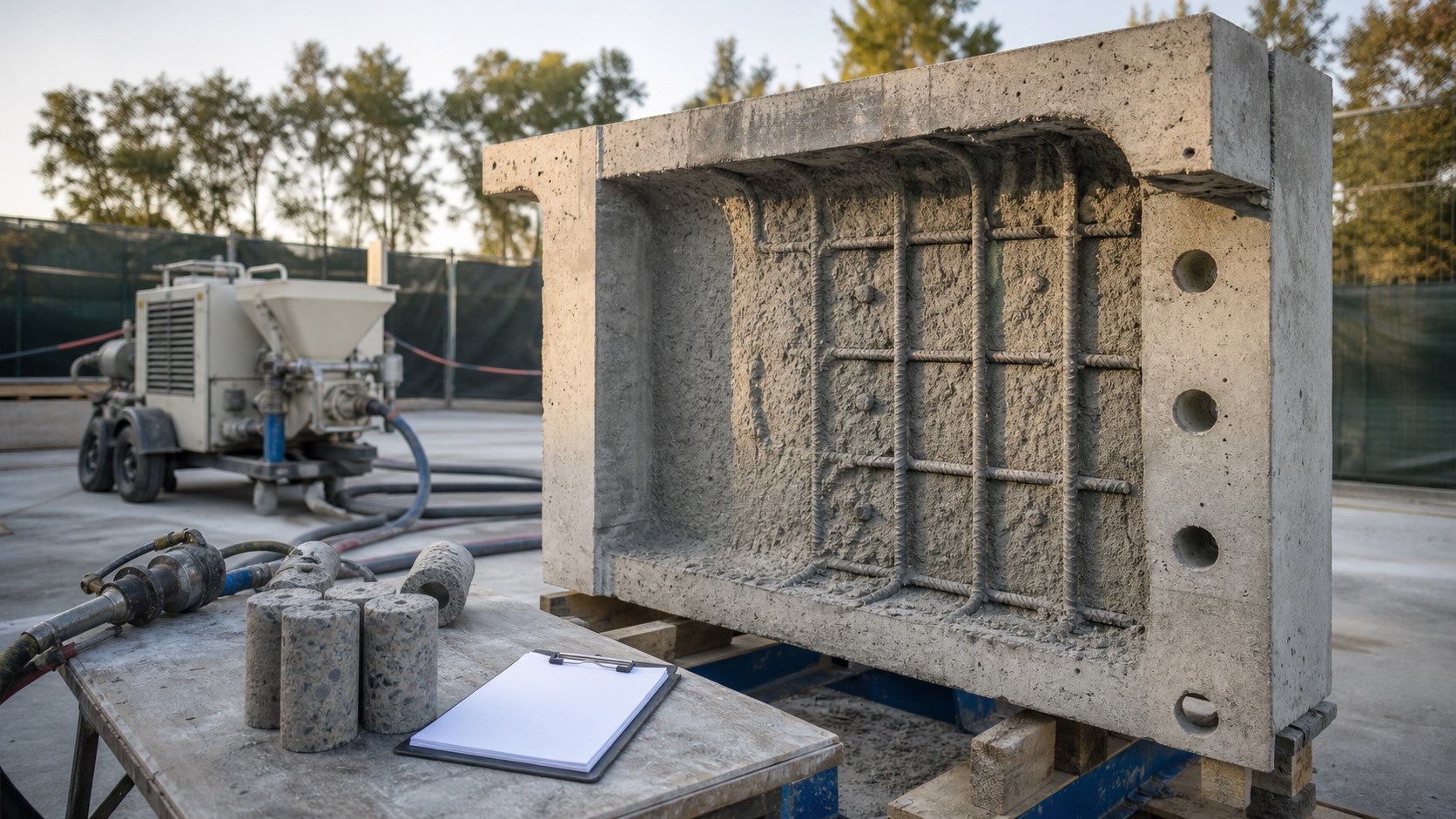
Shotcrete preconstruction mockups for concrete repair are not display samples. A useful mockup reproduces the difficult parts of the actual work—orientation, thickness, reinforcement congestion, edges, corners, embedments, access, mixture, equipment, crew, and finishing—so the team can find problems before defective material is placed on the structure.
The central QA/QC principle is simple: a flat, lightly reinforced test panel cannot qualify an overhead repair behind congested bars. The trial must represent the construction challenge and produce evidence tied to written acceptance criteria. It should help the engineer, owner, inspector, and contractor agree on what acceptable shotcrete looks like, how it will be tested, and what happens when results are uncertain.
What a shotcrete mockup should prove
A preconstruction mockup should answer project-specific questions. Can the proposed crew fill the space behind reinforcement without shadows or trapped rebound? Can the nozzle be held at a workable angle and distance? Can the selected wet- or dry-mix process build the required thickness overhead without sloughing? Can the surface be finished without tearing the fresh material? Can curing and protection begin quickly enough under the actual access and weather constraints?
ACI PRC-506.7-23 specifically addresses why shotcrete preconstruction mockups are performed and how they are designed and evaluated. ACI 506R explains that certified nozzlemen may still lack experience with heavily reinforced or complex work, which is why representative preconstruction testing matters. Certification is an important baseline, but it is not proof that a particular crew, mixture, machine, and geometry will succeed together.
The mockup does not prove structural capacity by itself. Repair design, substrate assessment, load paths, reinforcement development, temporary stability, durability exposure, and fire or protective requirements remain the responsibility of the qualified design professional. Structural Rehab’s broader guide to shotcrete structural concrete repair explains where the method fits in a repair program.
Replicate the governing field conditions
Orientation and access
Build the mockup in the orientation that governs the work. If the repair is overhead, shoot overhead. If it wraps a beam corner or pier cap, include that return. If scaffolding, tunnel clearance, utilities, or occupied-space containment restrict nozzle movement, simulate the restriction. Convenient access can hide placement problems that will appear immediately in production.
Reinforcement and geometry
Use representative bar sizes, spacing, laps, anchors, mesh, cover, repair depth, edges, and embedded items. Congestion affects whether the nozzle stream can reach the substrate and encase bars. The mockup should include the worst credible congestion, not merely an average detail. Before any trial, confirm actual reinforcement position and repair boundaries using appropriate records, scanning, and selective openings.
Substrate and moisture condition
The substrate should represent the specified surface preparation, cleanliness, roughness, and moisture condition. A shotcrete layer placed against smooth formwork does not demonstrate bond to prepared existing concrete. If hydrodemolition or mechanical removal will be used, reproduce the resulting profile or construct a representative substrate. Define how dust, slurry, debris, bruised concrete, and standing water will be excluded. The project’s concrete surface profile acceptance should be decided before shooting begins.
Materials, equipment, and crew
Use the proposed mixture, fibers or admixtures when applicable, batch method, delivery hose, pump or gun, air supply, nozzle, accelerator system, and curing method. The production nozzleman and core crew members should perform the trial. Substituting a specialist demonstration crew or different equipment weakens the connection between the mockup and field performance. Record the people, equipment identifiers, mixture batch, ambient conditions, settings, interruptions, and material changes.
Plan the trial as a controlled hold point
Write the mockup procedure before mobilization. It should identify who may authorize shooting, who observes placement, what tests and inspections are required, where specimens will come from, how long curing will continue, what constitutes acceptance, and whether a failed trial can be repeated. Production work should not begin until the responsible parties approve the documented results.
Start with a pre-shoot inspection. Confirm the substrate, bar condition, anchorage, clearances, forms or shooting wires, access, lighting, ventilation, containment, equipment, backup plan, and cure materials. This should align with the project’s broader pre-placement concrete repair hold point.
During shooting, observe nozzle angle, distance, material flow, air pressure consistency, encasement sequence, layer thickness, rebound removal, overspray control, trimming, finishing, construction joints, and interruptions. Rebound and overspray must not be buried in the repair. When a layer must set before the next is placed, the procedure should define surface treatment and timing rather than leaving the decision undocumented.
Inspect the inside, not only the finish
An attractive surface can conceal voids, sand pockets, laminations, poor bar encasement, or weak bond. After the specified cure, examine the mockup using the project’s chosen combination of visual inspection, sounding, sawn sections, cores, strength testing, and bond testing. ACI 506 guidance and ASTM procedures should be applied using the edition and acceptance language adopted by the project documents.
ASTM C1140 covers preparing and testing specimens from shotcrete test panels. ASTM C1604 covers drilled cores of shotcrete for measurements and strength-related tests. Core location and orientation matter: cores should sample representative and difficult zones, avoid reinforcement when required for the intended test, and be traceable to the panel and shooting direction. The American Shotcrete Association notes that core orientation relative to application can affect measured strength and that cores can also reveal thickness, workmanship, bond, and reinforcement encasement.
Do not reduce acceptance to compressive strength alone. Strength specimens can pass while the in-place repair contains voids or poor bond. Sawn faces and cores can reveal internal defects; sounding can screen for separation; and project-specific direct-tension testing can evaluate the substrate or repair interface. Where bond is critical, coordinate mockup evidence with the acceptance approach described in pull-off testing for concrete repair bond.
Set acceptance criteria before seeing results
Acceptance criteria should be written by the design team before the trial. They may address minimum thickness, dimensional tolerance, bar cover, strength, internal consolidation, absence of unacceptable voids or laminations, substrate bond, surface finish, cracking, curing, and documentation. The criteria should also distinguish cosmetic imperfections from defects that threaten bond, durability, or load transfer.
Avoid inventing acceptance numbers in the field. Requirements must come from the project specification, governing code, adopted standards, repair design, exposure, and material system. If a core intersects a bar, breaks during extraction, or produces an ambiguous result, the engineer should decide whether it is valid for the intended evaluation and whether supplemental investigation is needed. One isolated number should not be used without its location, failure mode, specimen condition, and relationship to the repair objective.
Turn the accepted mockup into a production control
Approval is not the end of the mockup’s value. Preserve photographs, inspection notes, sawn sections or cores where practical, mixture records, test results, and the approved procedure as a reference standard. Production inspectors can compare surface texture, layer sequence, rebound control, bar encasement practices, curing, and documented settings with the accepted trial.
Define what changes require requalification. A different nozzleman, major equipment change, revised mixture, substantially different reinforcement congestion, new orientation, unusual cold or hot weather, or repeated defective work may justify another trial. The contract documents should state who makes that decision. Daily production testing is not automatically identical to preconstruction qualification; its frequency and purpose should be defined separately.
Closeout records should connect each production area to crew, dates, mixture batches, test panels, cores, repairs, and acceptance decisions. Pair those records with curing documentation because even well-placed shotcrete can develop early cracking or weak surface zones if moisture and temperature protection fail. See concrete repair curing and protection for owner-focused controls.
Common mockup failures and safe responses
- Voids or shadows behind bars: revise access, shooting sequence, nozzle technique, bar spacing or repair detailing; do not hide the condition with finish material.
- Rebound trapped in the section: improve removal access and lift sequencing, then repeat the representative trial.
- Sloughing overhead: review mixture consistency, lift thickness, accelerator use, equipment, substrate condition and timing with the responsible team.
- Poor bond: investigate substrate soundness, profile, cleanliness, moisture condition, contamination, placement delay and curing before changing acceptance criteria.
- Low or variable core results: verify sampling, orientation, dimensions, curing, test age and test validity, then assess internal quality and production implications.
- Excessive finishing damage: adjust timing and finisher technique; finishing should not tear, delaminate or conceal weak material.
If a mockup fails, the safest response is to identify the mechanism, correct the method, and repeat the relevant demonstration. Lowering a requirement after seeing a poor result needs a documented engineering basis; schedule pressure is not evidence. No mockup authorizes work that conflicts with structural drawings, temporary works, safety controls, or the manufacturer’s limitations.
Owner checklist for shotcrete preconstruction mockups
- Does the geometry reproduce the hardest production orientation and congestion?
- Are the proposed crew, mixture, equipment, access and finishing method represented?
- Are substrate preparation and moisture condition realistic?
- Are inspection, coring, sectioning, strength and bond tests linked to written criteria?
- Is production prohibited until the responsible professional accepts the evidence?
- Are triggers for retraining, repair, rejection or requalification defined?
- Will the accepted trial and records remain available as production references?
Limitations
This guidance is educational and does not provide a universal mockup size, testing frequency, strength value, bond threshold, defect limit, or acceptance rule. Those choices depend on the governing contract documents, code, member function, exposure, repair materials, geometry, risk, and adopted standards. Shotcrete work also involves high-pressure equipment, hoses, dust or overspray, work at height, falling material, confined spaces, and chemical admixtures; contractors must provide task-specific safety controls and trained personnel.
Frequently asked questions
Is a standard shotcrete test panel enough for an overhead repair?
Usually not by itself. A standard panel can support material testing, but an overhead or congested repair may need a representative mockup that demonstrates access, placement direction, reinforcement encasement, lift stability, trimming and finishing.
Does an ACI-certified nozzleman eliminate the need for a mockup?
No. Certification confirms an important competency baseline. A project mockup evaluates whether the actual crew, materials, equipment and geometry can produce the specified result under representative conditions.
Should cores come from the mockup or the structure?
They answer different questions. Preconstruction mockup cores help qualify the proposed process. Production panels or in-place cores may support construction acceptance when specified. The engineer should define locations, orientation, frequency, validity and consequences before testing.
Can compressive strength alone accept shotcrete?
No. Strength is only one property. Internal consolidation, voids, laminations, thickness, cover, bond, curing, finish and dimensional compliance may also govern acceptance.
When should the mockup be repeated?
Repeat or supplemental qualification may be appropriate after a failed trial, a material or equipment change, a different nozzleman, a new governing orientation or congestion condition, or production evidence that the approved method is not being reproduced.
Sources and further guidance
- ACI PRC-506.7-23, Shotcrete Preconstruction Mockup—TechNote
- ACI 506R-16, Guide to Shotcrete preview
- ASTM C1140/C1140M, Preparing and Testing Specimens from Shotcrete Test Panels
- ASTM C1604/C1604M, Obtaining and Testing Drilled Cores of Shotcrete
- American Shotcrete Association guidance on shotcrete coring plans
- FHWA Technical Manual for Design and Construction of Road Tunnels—Civil Elements
Need help defining a representative mockup, inspection hold points, or acceptance records for a concrete repair project? Book a Structural Rehab consultation or download the site’s free structural health ebook to organize the questions before production begins.
Need a professional structural assessment?
Book a consultation with Structural Rehab to evaluate repair priorities, corrosion risks, and rehabilitation options before damage escalates.
Book Consultation