
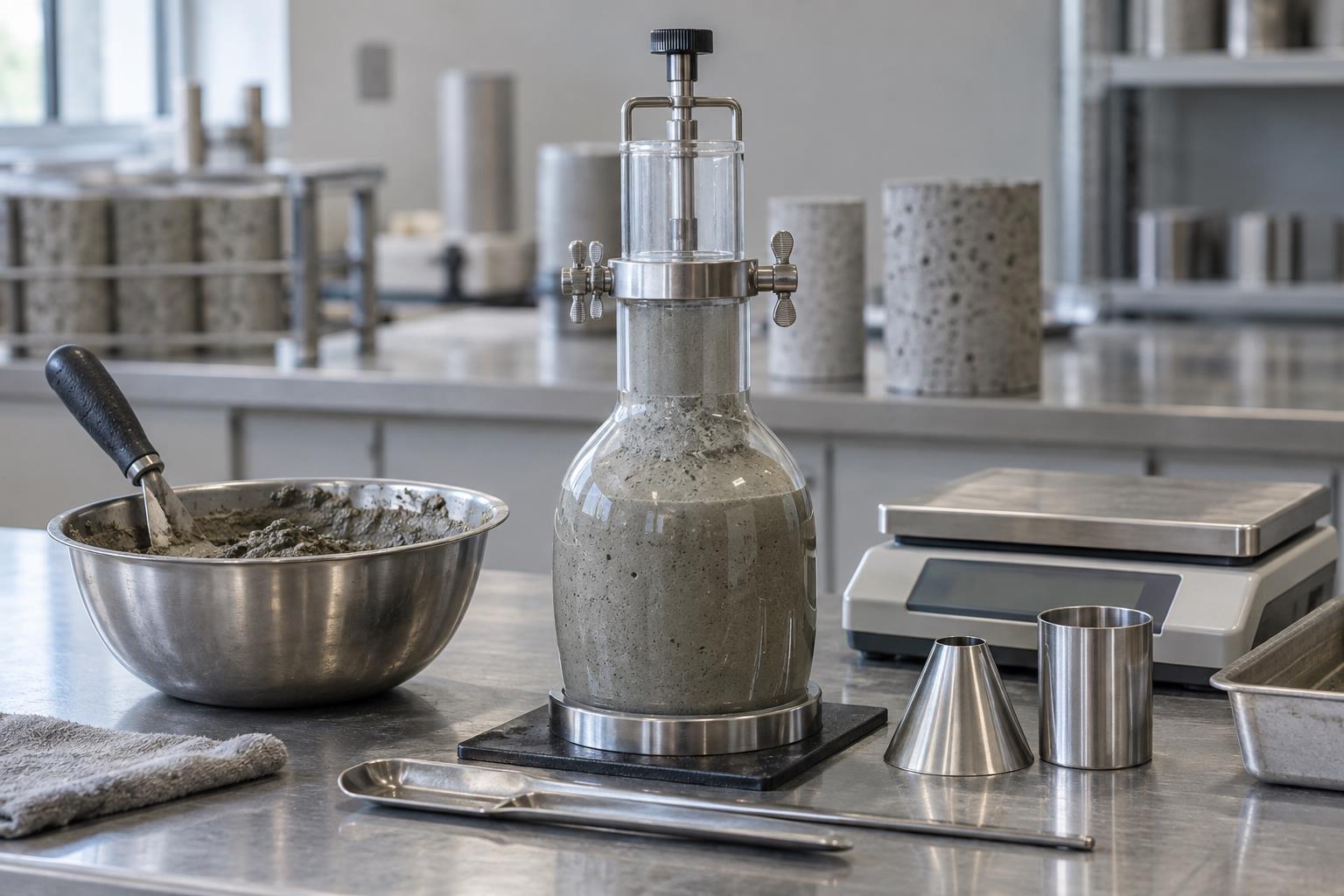
Air-content testing for concrete repair mortars is useful only when it answers a defined project question. A reading taken from fresh material cannot, on its own, prove bond, strength, freeze-thaw durability or suitability for a particular repair. It can, however, help a team detect a changed fresh mixture when the repair design, approved product information and test plan identify air content as a relevant control.
This guide focuses on cementitious repair mortar, not ordinary ready-mixed concrete. Its purpose is to help owners, engineers and inspectors decide when an air-content record is meaningful, how to make it comparable, and what to do with an unexpected result. The specification, repair design and current manufacturer instructions always control the work.
Start with the question the test must answer
Before scheduling a test, identify the material, intended repair function, batch size, mixing equipment, water range, conditioning and acceptance authority. A project may use fresh-property testing to confirm that an approved packaged material is being mixed consistently, to qualify a trial batch, or to investigate a visible change in workability. Those are different questions from proving in-service durability.
ACI’s jobsite QA/QC guide for cementitious packaged materials treats delivery, storage, batching, mixing and testing as connected controls. That supports planning the test before work begins. It does not create a universal air-content limit for every repair mortar or allow a field result to override the product data sheet.
Use the broader concrete repair material selection process to establish whether the selected material and exposure are appropriate. Then document whether air content is a production control, a comparative qualification check or an investigation tool.
Choose a method that fits mortar rather than assuming a concrete meter applies
ASTM C185 covers determination of air content of hydraulic cement mortar under its specified conditions. Its scope matters: a method has controlled specimen preparation, apparatus and calculation steps, so a number produced with a different field device or a changed sample cannot automatically be compared with a C185 result.
Pressure and volumetric air tests commonly used for fresh concrete have their own scopes and sampling assumptions. The FHWA notes that conventional fresh-concrete air tests report total air rather than the complete hardened air-void system. That distinction is especially important when a repair discussion involves freeze-thaw exposure: a single fresh reading does not establish bubble size, spacing or long-term field performance.
Do not improvise a conversion between a mortar result and a concrete acceptance limit. Ask the engineer and material manufacturer which method, sample preparation and reporting basis are appropriate for the supplied repair system. If the plan needs an air-void-system question answered, it may require a different investigation rather than a faster fresh-mortar test.
Make every result comparable
A comparable record starts before the mixer is switched on. Record the product name and revision, lot number, package condition, water quantity, mixing time, rest period, remixing, ambient conditions, material temperature and operator. For field work, identify the repair location and the exact batch or portion sampled.
Small departures can change fresh behavior. Adding water without authorization, extending mixing to recover workability, changing the mixer volume or sampling after an unrecorded delay may make the result unsuitable for comparison with the qualification batch. A test report should say what actually occurred, not merely list a final percentage.
- Use the approved material and stated water range.
- Identify the method, apparatus, calibration status and technician.
- State the sampling time in relation to mixing and placement.
- Record temperature and visible condition without inventing a cause.
- Link the result to the repair area, batch and disposition.
An air-content number is comparable only when the material history is comparable too. This traceability complements the jobsite mixing QA/QC record; it does not replace the approved water, mixing or placement controls.
Set acceptance before production, not after a surprising reading
Acceptance needs a project-specific basis. It may be a manufacturer-supported qualification range, a repair specification, or a documented comparison with a tested trial batch. Agree who can accept, hold, retest or reject material before the first production batch. Avoid writing a target after seeing the field result.
For concrete subject to freeze-thaw cycles, FHWA explains that total air content alone does not reveal whether the hardened air-void system is adequate. It also describes hardened-concrete microscopy under ASTM C457 as a route to evaluate air-void parameters. These resources are useful limits on interpretation: neither statement turns a laboratory or field fresh-mortar result into a universal durability certificate.
When the repair specification gives no air-content requirement, do not silently impose one from an unrelated concrete mixture. The team can still record a consistent procedure as information, but the report should clearly state that it is not a pass/fail acceptance criterion unless the authorized design documents establish one.
Respond to an unexpected result without hiding the batch history
An unusual result should trigger a controlled review, not an automatic diagnosis. First confirm the sample identity, method, apparatus condition, timing and calculations. Compare the actual mix record with the approved procedure and inspect whether the product, lot, water or mixing sequence changed. Keep the original result and observations in the record even if a valid repeat is performed.
Do not add water, admixture or extra mixing solely to move a number toward a desired range unless that adjustment is expressly allowed and approved. A repeat test can resolve a demonstrable test error, but it does not erase a documented difference in the production batch. The engineer and manufacturer should direct any technical disposition.
Where an affected batch has already been placed, connect the investigation to the repair location, placement time and related records. The appropriate response could range from no further action to additional inspection or sampling; that decision depends on the repair system and observed condition, not on a generic online rule.
Keep fresh testing in the full repair QA/QC plan
Air-content information is one part of a larger quality picture. Depending on the repair, the plan may also require substrate preparation review, moisture conditioning, material storage checks, fresh consistency controls, test specimens, curing records and bond verification. The pull-off testing guide explains why a bond result addresses a different question from fresh mixture testing.
For repairs in frost-prone exposure, evaluate the original deterioration mechanism and the repair design together. The site’s freeze-thaw damaged concrete assessment guide can help frame that investigation. Do not treat testing of a repair mortar as a substitute for diagnosing saturation, drainage, scaling, delamination or other conditions affecting the host structure.
A practical reporting checklist
A clear report lets another qualified reviewer reconstruct the decision. Include the project and repair-area reference; product and lot; stated test purpose; approved procedure; method and apparatus; technician; mixing and sampling timeline; temperatures; individual readings; acceptance basis; any departure; and the responsible person’s disposition. Attach photos only when they add useful evidence and are permitted by the project record system.
Retain the report with batch tickets, material-release records and curing documentation. A later investigation is much stronger when it can distinguish a genuine material change from a change in sampling or mixing practice.
Frequently asked questions
Does a higher fresh air-content result prove a repair mortar will resist freeze-thaw damage?
No. Fresh total air is not a complete measure of the hardened air-void system or field durability. Evaluate the exposure, design, approved material evidence and any required durability testing together.
Can a concrete pressure meter be used for repair mortar?
Do not assume so. Confirm the method’s applicability, apparatus and acceptance basis with the repair specification and material manufacturer before testing.
Should every bagged repair batch be tested?
Test frequency should be set in the project QA/QC plan. Frequency depends on the repair’s risk, material system, batch controls and the purpose of the test.
Is a repeat test enough to clear an outlier?
Only when the authorized procedure supports it and the investigation documents why the first result was not representative. Preserve both records and seek the required technical disposition.
Discuss your concrete repair QA/QC plan
If your project needs a usable testing and traceability plan, request a Structural Rehab consultation. Bring the repair specification, product information, proposed test method and trial records so the discussion can focus on the decisions that require project-specific engineering judgment.
Need a professional structural assessment?
Book a consultation with Structural Rehab to evaluate repair priorities, corrosion risks, and rehabilitation options before damage escalates.
Book Consultation