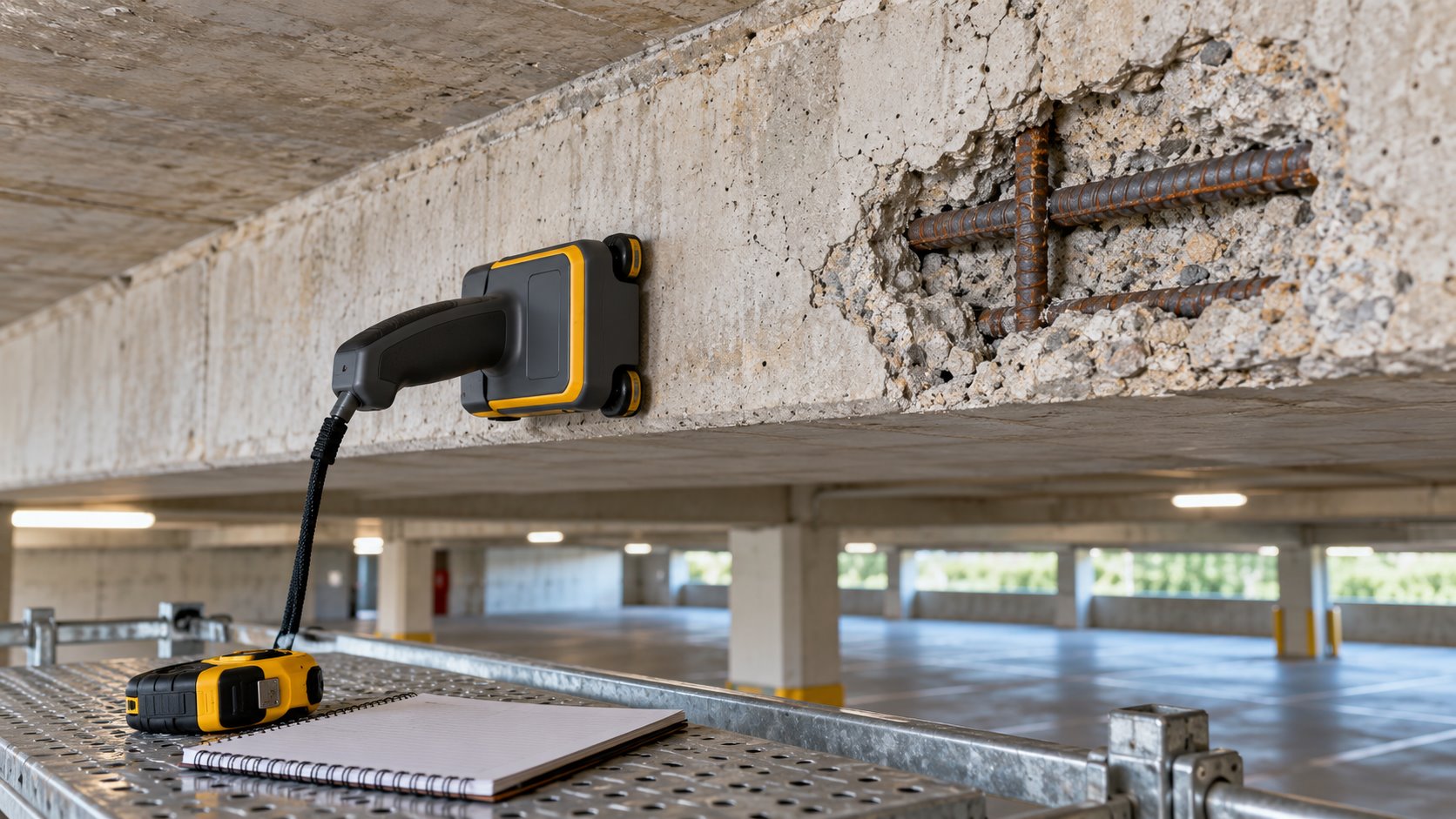
Before concrete is removed, cored, drilled, or prepared for anchors, the project team needs a reliable way to locate what may be close to the surface. A concrete repair cover meter survey can help map near-surface reinforcing steel and identify areas that need a different investigation plan. Used correctly, it supports safer repair planning, better records, and fewer surprises when the work starts.
A cover meter is not a repair design tool and it does not prove bar size, condition, development, remaining capacity, or the absence of other embedded items. Its value is practical: it produces a traceable locating record that the engineer, contractor, and inspector can use before they select removal limits or intrusive test locations. That distinction matters when the structure has limited drawings, congested reinforcement, prior repairs, or uncertain corrosion damage.
Decide what the survey must support
Start with the decision the scan is intended to inform. Common uses include planning concrete removal around reinforcement, selecting low-risk core locations, checking a proposed anchor or dowel layout, documenting apparent cover variation, or helping establish the reinforcement layout for a broader assessment. FHWA describes magnetometers, also called cover meters or pachometers, as tools for locating reinforcing steel, estimating cover, and avoiding reinforcement during drilling. Those uses are different from confirming a repair design or evaluating structural strength.
Write the purpose on the field sheet before scanning. Identify the member, faces to be surveyed, grid or station references, approximate survey limits, expected reinforcement information, access restrictions, and the person responsible for reviewing unexpected results. If the work could affect a prestressed member, embedded conduit, post-tensioning, or a critical load path, the engineer should define the investigation and permitted work before any intrusive action.
A scan is a locating record, not permission to cut, drill, or redesign the member. The project documents should keep that language clear. A contractor may use the result to avoid a bar while laying out a small investigation, but changes to repair limits, anchors, reinforcement, or structural details need the approved project process.
Know what a cover meter can and cannot show
Magnetic cover meters respond to embedded ferrous steel. They can be useful for identifying the approximate location, orientation, and depth of near-surface reinforcing steel when conditions are suitable. FHWA notes that rebar size, orientation, and location affect the response. The ACI 437R preview also cautions that meter performance is affected by design, bar spacing, concrete cover, multiple layers, magnetic aggregates, nearby electrical equipment, and the practical depth range of the equipment.
Do not report a cover-meter output as a confirmed bar diameter or exact cover value unless the project has established an appropriate correlation and verification method. Closely spaced bars and layered reinforcement can merge into a difficult-to-interpret signal. A surface patch, tie wire, embedded steel item, or unusual aggregate can also affect a reading. Where the decision is consequential, use selective verification planned by the engineer rather than converting a scan into an as-built drawing by assumption.
For a different view of embedded conditions, ground-penetrating radar, impact-echo, radiography, or targeted openings may be appropriate. They have different strengths, access needs, and limitations. A combined investigation should state which method answers which question instead of treating every non-destructive test as interchangeable. See our guide to concrete repair condition survey mapping for a broader field-to-scope record process.
A practical field workflow
1. Review records and establish control
Collect available drawings, previous repair records, reinforcement details, utility information, and known access limitations. Establish a stable coordinate system using member marks, grid lines, stations, or measured offsets. Photograph the overall area before marking it. Where an existing coating, ceiling, finish, or moisture condition could affect access or interpretation, record it rather than silently omitting it.
2. Confirm the instrument setup
Use the manufacturer’s prescribed checks and settings for the expected bar arrangement and cover range. ACI’s existing-building evaluation guidance recommends verifying the device operation and notes that project-specific mockups may help explain performance where multiple reinforcement layers are present. Record the instrument model, probe, calibration or functional-check information, settings, operator, date, and environmental conditions that materially affect the work. A photo of the reference layout is often more useful later than an unlocated screen capture.
3. Scan a planned pattern and mark uncertainty
Scan in a repeatable grid or line pattern that is adequate for the decision. Mark detected bar traces and note areas where the pattern becomes ambiguous, inaccessible, or inconsistent with the drawings. Do not connect uncertain readings into a clean reinforcement map just to make the record look complete. Separate observed locations, inferred paths, and locations requiring confirmation.
Before drilling or coring, review the mapped result against the intended work. Mark an exclusion zone where a likely reinforcement line conflicts with a proposed opening. If there is no safe alternate location, stop for engineer direction. For general repair-limit investigation, pair the locating record with the project’s procedure for identifying delamination or unsound concrete; our concrete delamination survey guide explains why screening observations must be documented within their limits.
4. Verify selected findings and preserve the record
Where permitted, confirm a representative sample through a controlled opening, planned core, or another suitable method. Record both the finding and the method used to confirm it. If the observed condition materially differs from the scan or drawings, update the repair plan through the approved change process. A scan with no documented location reference has little value once the work platform is removed.
How the survey supports concrete repair QA/QC
Use the survey output as an input to quality control, not a stand-alone acceptance test. It can support a pre-removal hold point, a core-location release, an anchor-layout check, or a record of apparent cover before an overlay or patch. Tie the scan file, marked drawing, photographs, and verification results to the specific member and date. The team can then trace why a removal boundary was adjusted or why an intrusive test was relocated.
For repairs involving corrosion, locating reinforcement is only one part of the assessment. Condition at steel level, contamination, moisture, cover, and repair durability may require other investigation. ACI’s repair guidance emphasizes an engineered assessment and repair process; it should not be reduced to a single instrument result. When reinforcement is exposed during removal, use a documented condition assessment and approved disposition rather than assuming that location alone establishes suitability. Our saw-cut boundary workflow and concrete repair daily-log guide show how field controls can be carried into installation records.
Common mistakes to avoid
- Scanning without a coordinate system: an unlocated trace cannot reliably guide later work.
- Assuming a clear scan proves no embedment exists: detection depth and material limitations must be considered.
- Using one reading to define a structural detail: confirm critical locations through the approved investigation plan.
- Ignoring congestion or multiple layers: document ambiguity and obtain a different method when needed.
- Letting a field mark become a design change: use the engineer’s review path for altered repair limits, anchors, or reinforcement decisions.
Limitations and engineering judgment
This guidance is general information. A cover meter cannot establish reinforcement condition, material strength, structural capacity, tendon location, or suitability of a repair. The engineer of record should determine the investigation scope, permitted drilling or removal, repair design, and acceptance criteria. Stop work and seek project-specific direction when results conflict with records, suspected prestressing or utilities are present, damage may affect stability, or an intrusive activity could compromise reinforcement.
FAQ
Can a cover meter locate every embedded item?
No. It is primarily intended to respond to ferrous reinforcement within the instrument’s effective range. Other materials, depth, congestion, layers, and site conditions can limit results. Select a method that is suited to the embedded item and decision.
Should every repair area receive a cover-meter survey?
Not necessarily. The engineer should set the scope based on the repair method, available records, structural risk, and the likelihood that intrusive work could affect reinforcement or other embedded items.
Can a cover-meter scan replace verification before coring?
No. It can reduce uncertainty and help select a location, but the approved project procedure should state the required review and confirmation steps before coring or drilling.
Plan intrusive work with better information
A well-documented cover-meter survey gives a repair team better information before it commits to removal or testing. Structural Rehab can help owners develop assessment scopes, repair hold points, and QA/QC records for existing concrete structures. This article is general information and not a substitute for a project-specific structural assessment, repair design, or safety plan.
Sources
- FHWA InfoTechnology: Magnetometer / Profometer
- ACI 437R-19 preview: Strength Evaluation of Existing Concrete Buildings
- ACI 562 Repair Code resources
- FHWA PDDM Chapter 10: Structural Design investigation methods
Need a professional structural assessment?
Book a consultation with Structural Rehab to evaluate repair priorities, corrosion risks, and rehabilitation options before damage escalates.
Book Consultation