
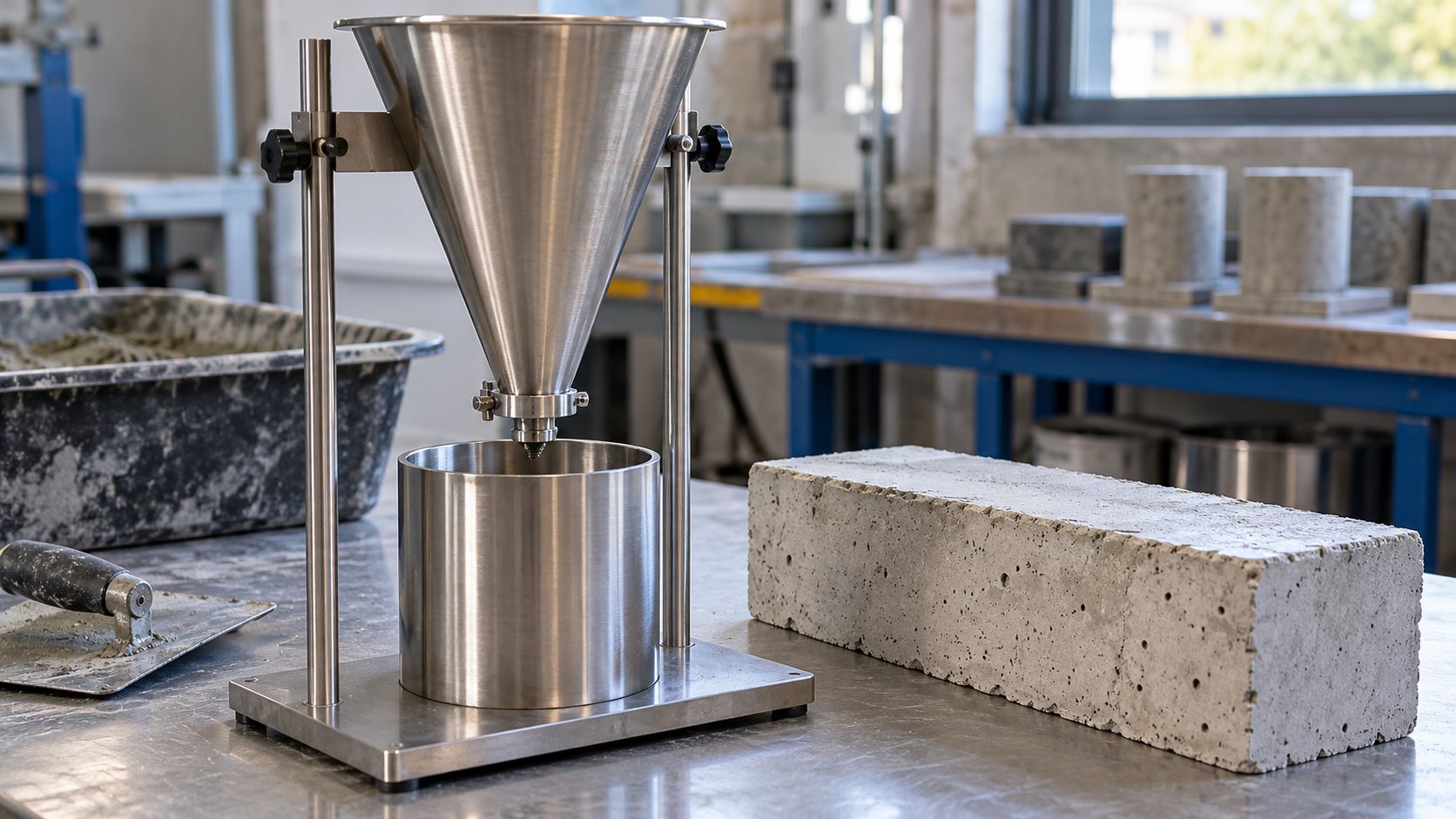
Flow testing gives a concrete repair team an early check on whether a cementitious grout batch has the consistency specified for its intended placement. A result can help reveal an unexpected change in water content, material temperature, mixing, or elapsed time. It cannot by itself prove that a structural repair is sound, fully filled, or durable.
This guide focuses on field QA/QC for cementitious grout used in concrete rehabilitation. The engineer and project specification determine the approved material, test method, limits, sampling frequency, and response to a failed result. Proprietary repair mortars, post-tensioning grouts and highly thixotropic products may require different methods. Do not transfer a flow limit from another product or project.
Why consistency matters in a concrete repair
Repair grout may need to move through a form, around reinforcement or into a confined recess. If the mixture is too stiff for the placement method, it may be difficult to fill the intended space or release trapped air. If it is excessively fluid, segregation or bleeding may become a concern. The right consistency depends on the material, geometry and placement procedure, not on a universal preference for faster flow.
The FHWA discussion of prefabricated bridge connection grout illustrates this balance: its project-specific flow range was chosen to address both difficulty venting air and segregation observed in its investigations. Those numbers apply to that example and must not be adopted as acceptance criteria for a different repair.
Flow testing belongs alongside the approved repair-material mixing controls, substrate preparation, reinforcement inspection, formwork checks, curing and acceptance testing. A successful flow result is one piece of evidence, not a release of every other hold point.
Choose the test before the crew starts mixing
Confirm the exact test and edition specified for the material. A flow cone measures an efflux time for a suitable fluid grout; a flow table measures spread under its own standardized procedure. Their results use different units and are not interchangeable. Some mixtures do not flow through a standard cone in a meaningful way and require another method or an expressly specified modification.
FHWA’s research on field-cast grout-like materials discusses both ASTM C939 and ASTM C1437 for fresh consistency. Its research concerns field-cast connections; use it to understand the distinction between methods, not as a substitute for the current standard, manufacturer’s instructions, or repair specification.
Before production, the inspector and contractor should agree on:
- The material designation, batch size and approved water range.
- The specified method, equipment, sampling point and timing after mixing.
- Acceptance limits, frequency, retest rules and the person authorized to release or reject a batch.
- How material and ambient temperatures, delays and delivery distance will be recorded.
- How the team will protect the repair opening and prevent unapproved placement while a result is unresolved.
Check that apparatus is clean, undamaged and suitable for the specified test. Use the current project-referenced standard and trained personnel; a short article cannot replace its detailed procedure.
Use a trial to connect the test to the actual repair
A trial batch is most useful when it reflects the job: the same packaged product, mixer, water measurement, crew, expected transport and delivery method. Where the repair geometry is congested or access is restricted, a representative mockup can help the team observe filling and finishing as well as test a sample. See our guide to concrete repair mockup panels for a broader preconstruction workflow.
Record the approved water quantity and mixing time, then test at the specified time. If the project requires a second test near the intended placement time, keep and handle the sample as the governing procedure requires. The FHWA connection-details report describes immediate and later flow tests in its particular trial-batch program. A project must define its own timing and handling; an unattended sample is not automatically representative of material in a pump or mixer.
The trial should also identify the practical time budget for sampling, testing, transferring, transporting and placing material. If a test takes longer than the crew allowed, the plan may need a smaller batch or a different delivery arrangement. Never assume that extra water is the remedy for an expired working time.
A practical field testing sequence
1. Identify the batch and conditions
Link the sample to a batch number, repair location, product, lot, measured water quantity, mixer and operator. Record the start and end of mixing, material temperature and relevant site conditions as required. Check that the material has been stored and conditioned according to its instructions. A result with no traceable batch identity cannot reliably support a placement decision.
2. Collect a representative sample
Take the sample at the location and time defined in the specification. Avoid choosing only the surface or a particularly fluid portion of the mixer. The FHWA connection report cautions that the top of a batch can be more fluid than material below. Follow the applicable sampling and remixing rules rather than improvising a method that changes the material.
3. Perform and record the specified test
Use the prescribed apparatus and procedure, including preparation, filling, timing and measurement. Record the actual measurement and units, not simply “pass.” Note the elapsed time from mixing and any observations of lumps, separation, bleeding or unusual behavior. Visual observations do not replace the numerical test, but they can prompt the engineer to investigate a batch that otherwise appears acceptable.
4. Compare against the approved criteria
Compare like with like: the correct method, test time, units and acceptance range. A standard method describes how to measure; it does not necessarily establish the acceptable range for every product. If the documents conflict, stop and ask for a documented clarification before placing the batch.
5. Release or hold the batch
When the result is outside the limit, identify and hold the affected material. Follow the approved retest and disposition procedure; do not keep testing until one reading happens to pass. Investigate water measurement, mixer condition, batch size, material temperature, timing and equipment. Changes to a mixture require authorization and must remain within the manufacturer’s and project requirements. Discard or replace material when directed.
A flow result is a checkpoint for a particular batch at a particular time, not permission to alter the recipe. The record should show who made the release decision and where the batch was placed.
What the test cannot tell you
A passing consistency result does not demonstrate compressive strength, bond, complete consolidation, absence of voids, resistance to shrinkage or long-term durability. Nor does it confirm the substrate is clean, at the required moisture condition, or free from loose concrete. Review the pre-placement inspection checklist before accepting the repair area.
Likewise, testing a small sample does not guarantee consistent delivery throughout a long placement. Monitor pumping or pouring, vents, form leakage, material changes and placement time under the approved procedure. If access or placement changes, consult the engineer rather than treating the initial flow result as a permanent approval. Plan curing and protection immediately after placement; see concrete repair curing and protection.
Common mistakes and better decisions
- Borrowing a number: use the approved range for the product and method, not a limit from a different bridge detail.
- Confusing cone time with table spread: identify the method and units in every report.
- Testing too late: define the clock reference and document actual elapsed time.
- Adding water without approval: hold the batch and follow the approved disposition process.
- Ignoring the placement: pair the result with mockup evidence, observed filling and the other project hold points.
- Failing to trace the batch: connect the test record to a repair location and release decision.
Frequently asked questions
Is a flow cone suitable for every repair mortar?
No. The material’s consistency and the specified procedure determine whether a cone, flow table or another method is appropriate. A mixture that does not flow as required by a particular test needs the method specified for that material, not an improvised adjustment.
Can a passing flow result replace strength testing?
No. Fresh consistency and hardened strength measure different characteristics. The repair documents should identify the required acceptance tests and their timing.
Should a team add water when grout becomes stiff?
Not without an approved procedure. Water beyond the permitted range can change material properties. Stop, identify the cause and follow the specified retest, adjustment or rejection process.
How often should grout be tested?
Use the project specification and material requirements. Frequency can depend on the consequences of failure, batch size, placement duration and variability. The engineer may require additional checks when conditions or production change.
Plan the repair around evidence
For a successful field decision, connect an appropriate method to a representative batch, a defined time and a documented disposition. Structural Rehab can help owners and project teams review concrete repair QA/QC requirements and develop a practical inspection plan. Book a consultation to discuss the specific structure and repair scope.
Need a professional structural assessment?
Book a consultation with Structural Rehab to evaluate repair priorities, corrosion risks, and rehabilitation options before damage escalates.
Book Consultation