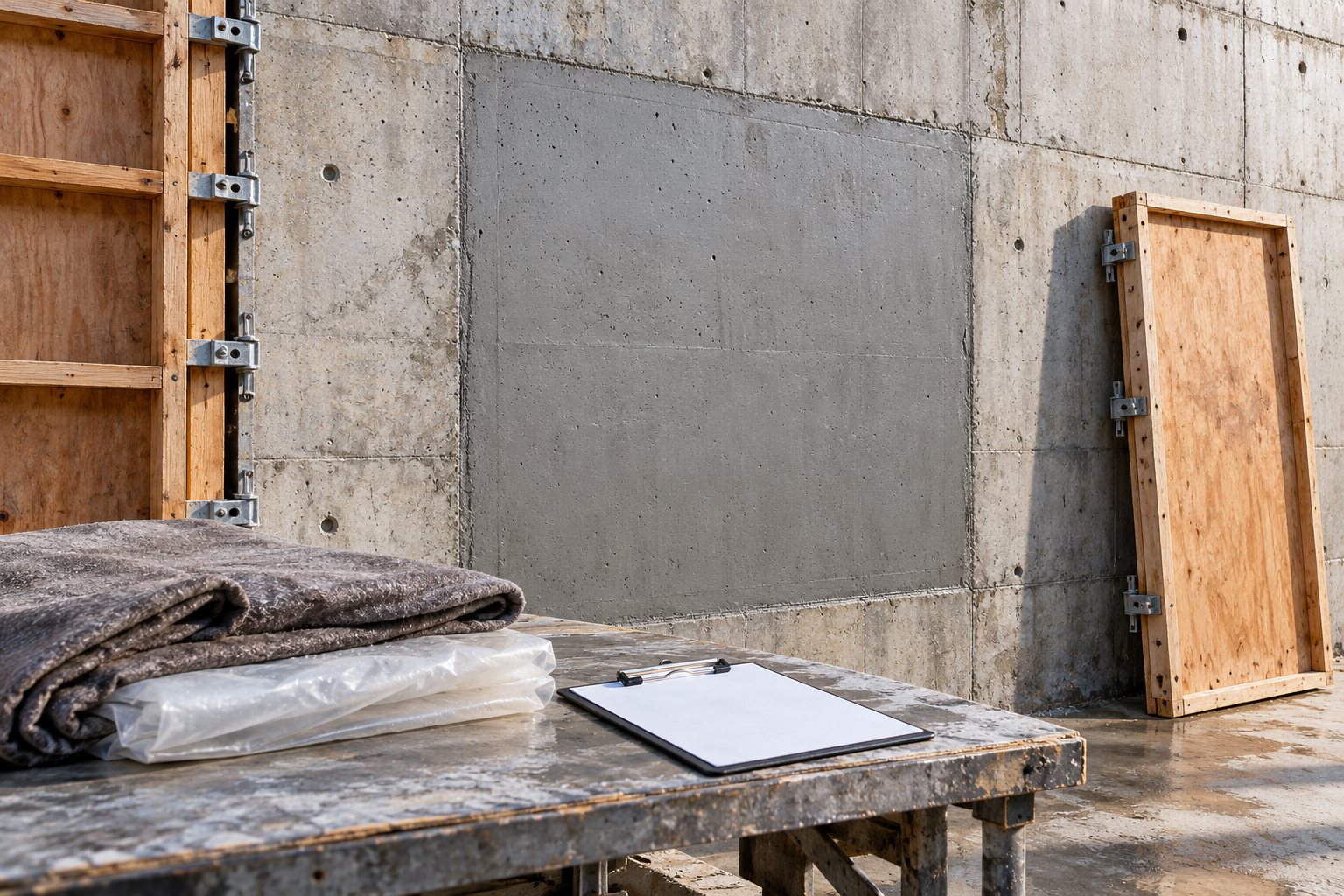
Concrete repair formwork removal is a release decision, not simply the next task after placement. A repair may look firm at an exposed edge while its covered faces, corners, bond interface, or supporting arrangement still need protection. Removing a panel also changes access, moisture retention, and the opportunity to inspect work that was previously concealed.
This guide focuses on approving removal of form faces from formed structural concrete repairs, checking the newly exposed repair, and handing it over to continued curing. It is intended for owners, engineers, contractors, and inspectors. It does not provide a universal stripping time or authorize removal of load-carrying shores. Project drawings, approved material instructions, applicable requirements, and the responsible engineer’s decisions govern each repair.
Separate three decisions before stripping begins
Removing a form face
A side panel may mainly contain the fresh repair and establish its shape. Even where it carries no permanent structural load, stripping can pull on young concrete, break edges, or disturb an interface. The release must identify which panels can be removed and which ties, braces, or adjacent panels must remain. Do not assume every component in one form assembly has the same function.
Releasing structural support
Soffit forms, shores, and other temporary supports may maintain a load path while a member is repaired. Their removal is a separate engineered operation, even if workers can reach the same fasteners during stripping. Consult the broader temporary shoring for concrete repair guide when support or load transfer is involved. Permission to expose a vertical face does not release supports beneath a beam or slab.
Accepting the completed repair
A stripping release means the specified removal operation can proceed. It does not establish that hidden voids, inadequate bond, curing deficiencies, or other defects are absent. Inspection after stripping and any specified tests remain open until their acceptance evidence is reviewed. Keep these decisions separate in the inspection plan so a signed form-removal record is not reused as a final acceptance certificate.
Set the release criteria before concrete placement
Define the panel-removal sequence, release evidence, curing handover, and person authorized to approve each stage while planning the repair. This avoids a familiar problem: the crew is ready to reuse the forms, but the specification does not clearly state what evidence is needed. The form-and-pour concrete repair guide covers placement planning; the stripping plan should be part of that same package.
ACI PRC-347-14(21), Guide to Formwork for Concrete, covers formwork design, construction, inspection, removal of forms and supports, and shoring. Its public summary is a useful route to the relevant guidance; it does not establish a project-specific release threshold. Specify the applicable documents and edition in the project package instead of relying on a general article or a product brochure alone.
A practical release request should identify the repair location, material and batch, placement completion time, panel identifiers, environmental history, and the exact criterion being demonstrated. Include relevant test reports where required, confirmation that curing has been maintained, and the next protection method. If the planned operation changes a load path, refer it back to the approved temporary-works procedure.
Use evidence appropriate to the repair
Do not choose a standard waiting period merely because it worked on a previous project. Material type, temperature history, repair geometry, exposure, stripping forces, and the role of the forms can change the decision. A published strength value from a manufacturer’s laboratory is not a measurement of the installed repair. Likewise, initial set or a hard surface is not proof that every release requirement has been met.
Where the project requires strength evidence, the responsible engineer should define the accepted method, specimen preparation and conditioning, timing, and acceptance threshold. The records must connect the evidence to the actual repair. A test from another batch or a differently conditioned specimen should not be substituted without an approved technical basis. If a maturity method is proposed, its mixture-specific relationship and the project acceptance procedure need to be established before relying on it.
For US work subject to OSHA, 29 CFR 1926.703(e) addresses the strength needed before removal of forms and shores, with stated exceptions. It permits determination through specified removal conditions that have been followed or appropriate strength testing. This is a jurisdiction-specific safety requirement, not a universal repair-design rule. Projects elsewhere must follow their applicable requirements and engineered procedures.
Plan the curing handover before exposing the surface
Forms may help retain moisture on covered faces. Removing them can expose young repair material to wind, sun, or a dry interior environment within minutes. Have the approved curing materials, access, and protection ready before the first panel is released. A release should be deferred if the next curing stage cannot start as required.
TxDOT’s Concrete Repair Manual provides a useful example of method-specific requirements: its major-spall and concrete-replacement procedure commonly retains forms during curing of batched concrete repairs and protects exposed openings. That procedure should not be converted into a blanket stripping schedule for every proprietary mortar or structural repair. Confirm the actual contract and material requirements.
Record which faces were exposed and when protection resumed. If a curing compound is planned, confirm compatibility with later coatings or bonded finishes. Where wet coverings or sheets are specified, plan how they will remain effective without damaging the young surface. The separate concrete repair curing and protection guide explains the broader protection choices.
Inspect the face as the forms come off
The removal method should protect corners, the repair perimeter, and the bond line. The Concrete Society distinguishes vertical-face stripping from soffit release and emphasizes avoiding surface and edge damage. Use the approved method to separate and handle panels; do not improvise levering against young repair edges. Unplanned resistance, movement, or damage is a reason to stop the operation and obtain a disposition.
Inspect each exposed area before it is hidden again by coverings or finishing work, while maintaining the required curing. Look for leakage tracks, honeycombing, incomplete filling near the top of the cavity, cracking, torn edges, exposed reinforcement, and an irregular interface. Document location and scale with photographs. Observations should be tied to a marked-up repair map, not a collection of unlocated close-ups.
Visual inspection cannot establish internal continuity or bond throughout a repair. If the specification calls for sounding, nondestructive evaluation, bond testing, or other checks, use the approved timing and method. Do not apply an aggressive test to immature material simply to complete an inspection form. The engineer should determine whether an observation needs monitoring, further investigation, local treatment, or replacement.
A concise formwork-removal hold-point record
The following record structure is an editorial checklist for organizing the project evidence. It is not a substitute for the project’s acceptance criteria:
- Identity: repair reference, member and face, panel identifiers, placement record, and proposed removal time.
- Scope: components permitted to be removed, components to remain, and the approved sequence or drawing revision.
- Evidence: applicable release criterion, supporting test or condition records, curing history, and unresolved deviations.
- Handover: curing materials ready, access available, inspection responsibility, and protection of adjacent work.
- Decision: approval, hold, or limited release; the authorized person’s name; conditions; and recorded time.
- After removal: exposed-face observations, photographs, actual protection times, and references to any nonconformance or engineering disposition.
A form-face release is not a load-transfer certificate or a final repair acceptance. Use separate records where those decisions have different criteria or approvers. Link the release to the daily concrete repair log so the placement, inspection, and curing history can be reconstructed later.
Resolve deviations without hiding evidence
If forms were removed before authorization, document the actual event, protect the repair, and notify the responsible parties under the project procedure. Do not backdate the release or assume that additional curing automatically corrects every consequence. The disposition should consider what was removed, whether load changed, the material’s condition, and the observed damage.
If stripping reveals a defect, avoid cosmetic filling before the required inspection. For example, an incomplete top corner may be a local surface issue or evidence that the cavity did not fill. Its appearance alone does not settle that question. Record the finding and obtain the specified review before applying a repair that would conceal it. Where a proposed stripping sequence changes, revise the release scope and communicate it to the crew.
Frequently asked questions
Can forms be stripped as soon as the repair feels hard?
No. Surface hardness does not demonstrate the release criterion. Use the approved material, curing, strength, support, and inspection requirements for the specific operation.
Does removing side forms allow shores to be removed?
No. Side-form removal and support removal may have different engineering consequences. A release should expressly identify what may be removed and what must stay in place.
Can a clean-looking face prove the repair is accepted?
No. A clean face is only one observation. Bond, internal filling, strength, curing records, and other specified acceptance items still need appropriate evidence.
Who should authorize removal?
The project documents should identify the approving roles. Where support, load transfer, or an unexpected structural condition is involved, the responsible engineer’s approved procedure and disposition are essential.
Plan the release before the forms are needed elsewhere
A documented removal decision gives the crew a clear boundary and preserves the evidence needed for acceptance. For help reviewing a concrete repair scope, inspection hold points, or records, book a consultation with Structural Rehab. Educational guidance cannot authorize site work or replace the engineer responsible for the structure.
Sources and further reading
- OSHA 29 CFR 1926.703: cast-in-place concrete, formwork and removal requirements
- ACI PRC-347-14(21): Guide to Formwork for Concrete, official summary and contents
- The Concrete Society: Removal of Formwork
- TxDOT Concrete Repair Manual: Major Spall Repair and Concrete Replacement
Need a professional structural assessment?
Book a consultation with Structural Rehab to evaluate repair priorities, corrosion risks, and rehabilitation options before damage escalates.
Book Consultation