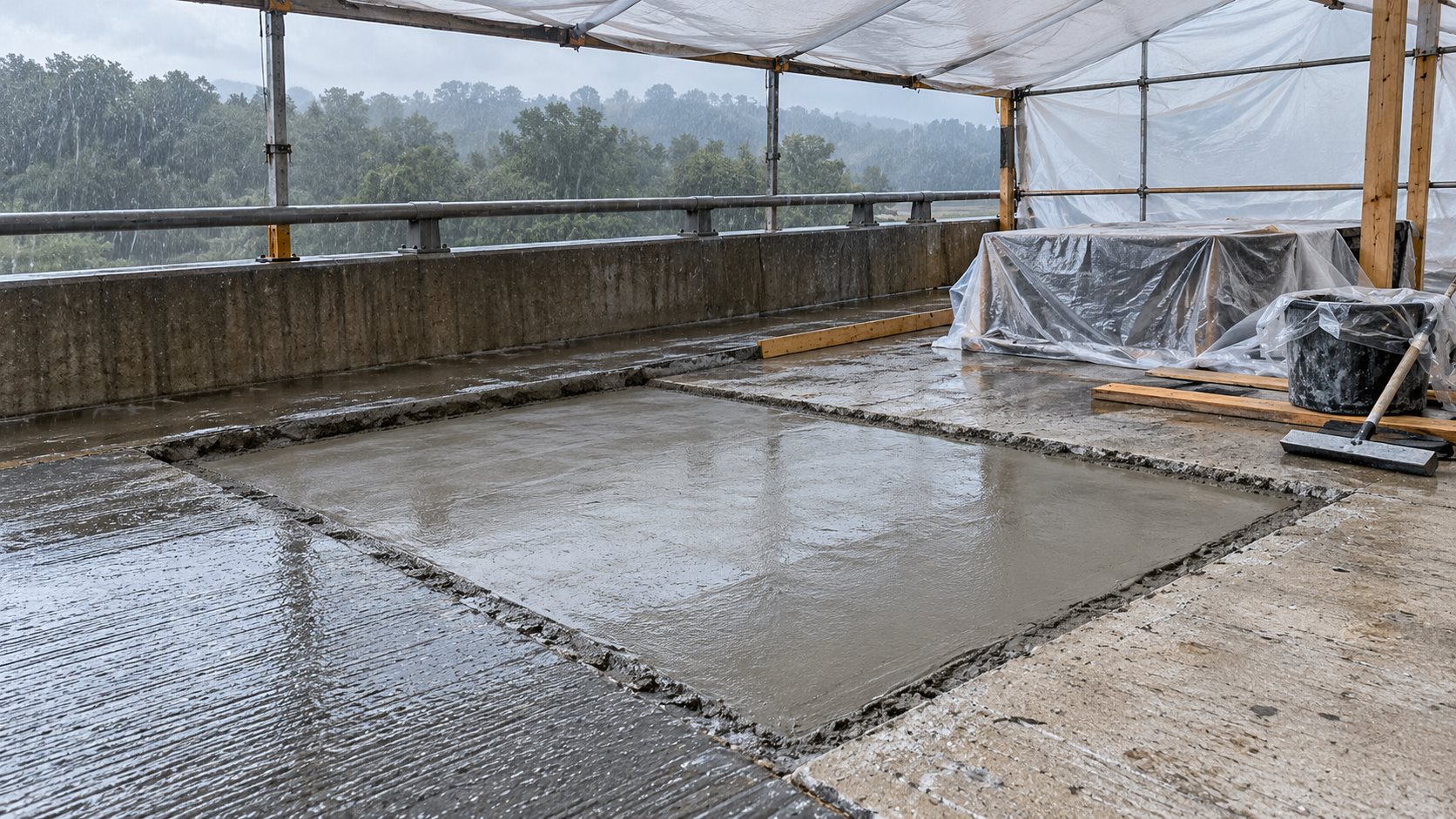
Rain during concrete repair is not a reason to guess, rush finishing, or treat a plastic sheet as a complete quality system. A small cementitious patch can be vulnerable because the prepared substrate, bond treatment, fresh material, finish, and early curing all have different exposure risks. The practical question is not simply whether rain fell. It is whether rainwater could change the approved repair condition, enter the repair material, disturb the surface, or interrupt the required protection.
This guide gives owners, engineers, contractors, and inspectors a field-ready QA/QC framework for rain-event decisions during concrete repair. It applies to planned cementitious patching and similar repair placements. It does not replace the engineer of record, contract documents, or the selected material manufacturer’s instructions.
Why rain needs its own repair hold point
A forecast is useful for planning, but it is not an acceptance record. Rain intensity, wind direction, drainage paths, cover deployment time, and the stage of the placement all affect the risk. A dry substrate immediately before placement may no longer have the required condition after a shower. Fresh repair material can be diluted if rainwater is mixed into it, while a recently finished surface can be marred or weakened if water is worked into the surface.
FHWA’s full-depth concrete-repair guide requires protection of unhardened concrete from rain and calls for covering material to be available before rain becomes imminent. The same principle is useful beyond pavement work: the project needs an agreed response before a weather change starts. The specific trigger and corrective action, however, must come from the project specification, material data, and repair design.
Rain planning complements ordinary readiness checks. The repair still needs sound concrete, suitable reinforcement condition, the specified profile, cleanliness, moisture condition, batch controls, placement method, and curing protection. Begin with the same disciplined record used for pre-placement inspection of concrete repairs; then make weather exposure a visible release item rather than an afterthought.
Build a rain-event plan before a repair starts
Identify the decision authority and triggers
The daily plan should name the person who may stop placement, the person who may release work after a hold, and the route for obtaining an engineering disposition. It should also state what triggers a pause: a forecast threshold, observed rainfall, runoff entering the work area, inability to maintain the specified substrate condition, or loss of safe access. Avoid a vague direction to “cover if needed.” A rain plan is only credible when its protective materials can reach the repair before rainwater reaches the bond line.
Map the site-specific water paths. A repair on an elevated deck may receive wind-driven rain from one side; an interior parking structure may receive water from a leaking joint; a wall repair can be affected by runoff above the work. Protect bagged material, mixers, prepared substrate, bonding-agent stations, fresh placements, and curing supplies separately. A cover that shelters the patch but allows dirty runoff to cross the prepared boundary has not solved the problem.
Stage material and protection without contaminating the work
Protective materials should be available, clean, and sized for the repair geometry. FHWA’s quality reference manual advises contractors to have plastic sheeting ready for sudden rain and cautions against re-finishing unprotected rain-exposed pavement. For a repair job, that supports a simple rule: do not use added water, dry cement, or aggressive finishing to hide rain effects. Those actions can create a different, undocumented surface problem.
Store repair material so rain and ground moisture cannot alter it. Keep sheeting, weights, tape, and temporary drainage tools close enough to deploy safely, but do not allow them to shed dirt, standing water, or loose debris into the repair. The protection plan must be coordinated with the approved curing method. See our guide to concrete repair material storage and shelf life for the separate receiving and handling controls.
Use stage-based hold points during placement
Before batching or mixing
Confirm the current forecast, observed conditions, protection readiness, and the practical time needed to stop and cover the active repair. Inspect drainage, cover attachment points, and access routes. If rain is imminent and the repair cannot be protected in time, do not batch material merely because the crew is assembled. The cost of a documented hold is usually lower than the cost of removing a questionable repair.
Verify the substrate condition again after any rainfall. Cementitious systems commonly require a condition such as saturated-surface-dry, while other approved systems may require a different moisture state. The material instructions and project documents govern. Rainwater, ponding, or runoff is not automatically equivalent to the specified condition. Our article on SSD substrate moisture for concrete repair explains why a visibly wet surface is not a sufficient release criterion.
During placement and consolidation
If rain reaches the active placement before the material has hardened, pause the work according to the approved plan. Prevent rainwater from entering the fresh repair or being incorporated through mixing, consolidation, or finishing. An emergency bulkhead or other planned termination detail may be needed for a larger placement, but it must be compatible with the repair design and be accepted by the responsible authority. Do not invent a cold joint treatment in the field.
Record the time, intensity observed, repair area affected, placement stage, material batch, protection installed, and who made the decision. A photo can help, but it should support—not replace—a written description. If runoff, rainwater, or cover contact changes the work, record the affected limits. This evidence gives the engineer or inspector a defined area to assess instead of a vague statement that the repair “got wet.”
After finishing and during early curing
Once the surface has reached the applicable stage, rain may be compatible with or even helpful to moisture retention, but that conclusion cannot be assumed. The approved curing regime, surface finish, rain intensity, erosion risk, and time since placement all matter. FHWA’s pavement guidance notes that completed patches should be covered with polyethylene when rain threatens. ACI’s curing guidance also recognizes coverings and moisture-retention methods, but those are not permission to substitute an unapproved curing practice.
Use only a protection method that does not damage the surface or trap water where it can cause a problem. Do not remove a cover early because the rain stopped. Continue the specified cure and follow the project’s opening, testing, and inspection requirements. Broader timing and protection coordination is covered in our concrete repair curing and protection guide.
Assess a rain-affected repair before releasing it
A rain event does not automatically mean a repair failed, but it should produce a deliberate assessment. Start by identifying whether water entered fresh material, whether the substrate or bond treatment was altered before placement, whether the fresh surface was disturbed, and whether the curing method was interrupted. Review the weather log, batch record, photographs, and protection timing against the project’s acceptance basis.
Possible next steps depend on the repair system and exposure: cleaning and re-establishing the specified substrate condition before a new placement; removal of clearly compromised fresh material; additional curing; visual inspection; sounding after appropriate cure; or testing and engineer review. Do not claim that a surface is acceptable just because it looks uniform. TxDOT’s repair QA/QC guidance directs the owner to verify preparation, material selection, implementation, curing, and performance, with procedures adjusted for rain and other weather conditions.
When the disposition is uncertain, stop and obtain it from the engineer or authority identified in the plan. Testing locations, criteria, and removal limits should be agreed before intrusive work begins. The repair team should not confuse production pressure with an acceptance criterion.
A concise rain-event record
- Repair identification: location, repair ID, orientation, and work stage.
- Weather observation: forecast reference, observed rain start/stop time, wind, and runoff path.
- Readiness: protection type, location, deployment time, and responsible person.
- Exposure: affected area, substrate/bond/fresh-material condition, batches, and surface disturbance.
- Decision: continue, stop, protect, remove, re-prepare, cure, inspect, or escalate.
- Release evidence: acceptance basis, inspector or engineer authorization, and linked daily-log entry.
Link this record to concrete repair daily logs so later reviewers can connect weather, preparation, batches, decisions, and curing. A concise contemporaneous record is more useful than a reconstructed explanation after a concern appears.
Limitations
This article addresses QA/QC planning for rain exposure; it does not prescribe repair dimensions, material proportions, cure duration, traffic-opening time, or acceptance testing. Those requirements vary by repair material, member function, exposure, and contract. Repairs affecting load paths, prestressing, containment over traffic, or other safety-critical conditions require an engineered repair plan. When the specified system does not state how to manage a rain event, obtain written direction before proceeding.
FAQ
Can a concrete repair proceed if rain is forecast later in the day?
Only if the approved plan shows that the repair can be placed, protected, and cured within the project’s requirements. A forecast alone is not a release; verify actual conditions and protection readiness immediately before work.
Can crews re-finish a rain-affected repair surface?
Do not rework a rain-affected surface simply to improve appearance. Follow the repair system and project requirements, document the exposure, and obtain a disposition when the surface or fresh material may have been altered.
Does plastic sheeting make a rain event acceptable?
No. Sheeting is one protection measure. The team must still prevent contamination, preserve the specified substrate or bond condition, avoid damaging the surface, and maintain the required curing regime.
Need an independent repair QA/QC framework? Structural Rehab can help owners define practical hold points, documentation, and review questions for a concrete repair project. Our guidance supports informed conversations with the responsible design professional; it does not replace site-specific engineering.
Sources
- FHWA: Generic Guide Specifications—Full-Depth Concrete Repairs
- FHWA: Field Reference Manual for Quality Concrete Pavements
- TxDOT Concrete Repair Manual: Quality Control/Quality Assurance
- FHWA: Concrete Pavement Preservation Checklist
Need a professional structural assessment?
Book a consultation with Structural Rehab to evaluate repair priorities, corrosion risks, and rehabilitation options before damage escalates.
Book Consultation