Why patch repairs can create new corrosion risk
Concrete patch repairs often remove loose concrete, clean exposed reinforcing steel, and rebuild cover with a dense repair mortar. That can solve the visible spall, but it can also create an electrochemical imbalance at the edge of the patch. The repaired area may have lower chloride content, higher alkalinity, and different resistivity than the surrounding old concrete. The steel inside the patch becomes more passive, while adjacent steel in contaminated concrete may remain active. The result is sometimes called the ring anode or incipient anode effect: corrosion shifts to the patch perimeter and new spalls appear near the repair.
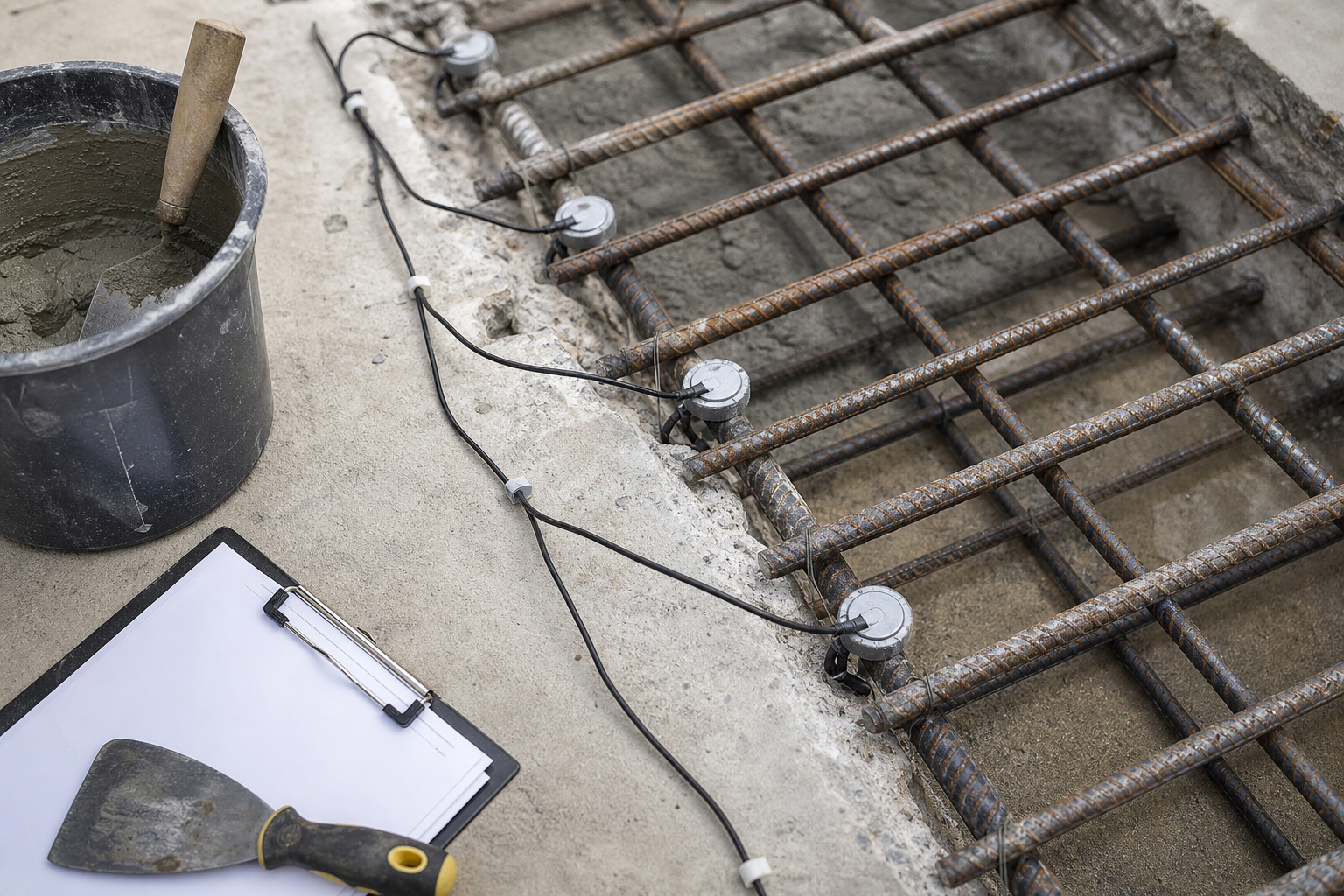
Galvanic anodes in concrete patch repairs are intended to reduce that risk by supplying sacrificial current to the reinforcing steel near the patch. They are typically zinc-based units embedded in the repair material and electrically connected to the reinforcing bar. The anode corrodes preferentially, helping polarize nearby steel and lowering the corrosion tendency in the vulnerable transition zone.
An embedded anode is a corrosion-control detail, not a license to ignore contaminated concrete. If the repair leaves active deterioration, severe chloride contamination, water leakage, or poor cover untreated, the anode may only slow a problem that still needs a broader durability strategy.
How galvanic anodes work in patch repairs
A galvanic anode uses the natural voltage difference between a more active metal and the reinforcing steel. When the anode is connected to the steel and surrounded by a conductive repair environment, current flows from the anode to the steel. The anode is consumed over time. Because the system does not require an external power supply, it is simpler than impressed-current cathodic protection, but it also has lower driving voltage and finite current capacity.
This makes galvanic anodes most useful for localized repairs where the objective is to reduce corrosion risk around the patch perimeter. They are not the same as a full cathodic protection system for a whole deck, pier, garage slab, or marine structure. Our guide to cathodic protection for reinforced concrete repair explains the difference between localized galvanic details and system-level corrosion control.
When they are worth considering
Embedded galvanic anodes are worth considering when a patch repair is made in chloride-contaminated or carbonated concrete and the remaining surrounding concrete is likely to stay in service. Typical examples include parking structures exposed to deicing salts, marine splash zones, bridge substructures, balconies, loading docks, industrial slabs, and facade elements where localized spalls recur near previous repairs.
They are especially relevant when chloride testing shows that the concrete beyond the patch still contains meaningful contamination, but removing all contaminated concrete is not practical. They can also help when the owner wants a more durable patch strategy without installing a powered cathodic protection system. The best candidates have accessible reinforcing steel, defined patch boundaries, and repair material compatible with anode activation.
When anodes are not enough
Anodes do not fix structural section loss. If reinforcement has lost area, the engineer must address capacity with replacement bars, supplemental reinforcement, enlargement, strengthening, or load restrictions. Anodes also do not bridge cracks, stop leaks, restore bond, or rebuild cover by themselves.
They may be ineffective if electrical continuity is poor, if the concrete or repair material has very high resistivity, if the anodes are spaced too far apart, if they are not tied correctly to steel, or if active corrosion is spread across a large area. In those cases, a broader corrosion mitigation plan may be needed, such as chloride extraction, realkalization, coatings, waterproofing, overlays, or impressed-current cathodic protection.
Assessment before specifying anodes
The design should start with corrosion diagnostics. Half-cell potential mapping can help locate areas where corrosion is likely active. Chloride testing can show whether the patch edge will remain in contaminated concrete. Concrete resistivity testing can help judge whether galvanic current can move effectively through the repair environment. Visual survey, sounding, cover measurements, carbonation depth, leakage mapping, and reinforcement section-loss checks complete the picture.
Structural Rehab has separate guides on half-cell potential testing, chloride testing before concrete repair, and concrete resistivity testing. Those tests should be interpreted together. No single test proves that anodes are required or unnecessary.
Design decisions that matter
Anode type and spacing
Manufacturers provide spacing guidance, but the engineer should check it against exposure, chloride level, patch size, bar layout, cover, and desired service life. Wider spacing may reduce cost but can leave unprotected zones. Tighter spacing increases material cost but may be appropriate at severe exposure, patch edges, and bar intersections.
Electrical continuity
The anode must be electrically connected to the reinforcing steel it is intended to protect. Continuity should be tested before placement. If bars are isolated, epoxy-coated, heavily corroded at connections, or discontinuous across a joint, the anode may not protect the intended area.
Repair material compatibility
The repair mortar must allow ionic current flow and maintain the anode environment. Some dense, polymer-rich, or very high-resistivity materials may limit current. The repair system should be compatible with the anode manufacturer’s requirements and with the surrounding concrete.
Moisture and exposure
Galvanic action requires an electrolyte path. Very dry concrete can reduce current, while wet chloride exposure can increase corrosion demand. The design should consider drainage, waterproofing, coatings, and future exposure. A patch below a leaking expansion joint needs water control as much as it needs embedded anodes.
Installation QA/QC
Anodes should be placed at the specified locations and tied securely to clean reinforcing steel. The crew should verify continuity, pre-wet or condition the units if required, maintain cover, and fully encapsulate the anode in repair material without voids. Inspectors should record anode locations before closure because the detail will be hidden after placement.
Repair edges must still be cut and prepared properly, unsound concrete removed, reinforcement cleaned, and cover restored. Our guide to concrete spalling repair explains why corrosion repair fails when it is treated as surface patching only.
Monitoring after repair
Owners should not expect embedded anodes to eliminate future inspection. The repaired area should be included in routine condition surveys. Useful checks include visual inspection, sounding, moisture-source review, crack mapping, half-cell mapping where appropriate, and targeted resistivity or corrosion-rate testing. If new distress appears at patch edges, the team should determine whether the issue is installation, exposure, insufficient anode design, or a wider corrosion cell.
Owner checklist
- Were chloride, half-cell, resistivity, and cover data reviewed before choosing anodes?
- Has the engineer defined whether the anodes are for localized patch protection or part of a larger corrosion plan?
- Are anode spacing, bar connection, and repair material compatibility specified?
- Will continuity be tested before repair material is placed?
- Are moisture sources, joints, coatings, and drainage being addressed at the same time?
- Will anode locations and batch information be recorded for future maintenance?
Sources and standards to review
- ACI CODE-562-25: Assessment, Repair, and Rehabilitation of Existing Concrete Structures
- AMPP standards and corrosion-control resources
- FHWA Long-Term Bridge Performance and infrastructure durability resources
FAQ
Do galvanic anodes stop corrosion permanently?
No. They are consumed over time and their output depends on exposure, resistivity, spacing, and connection quality. They can extend repair life when designed correctly, but they are not permanent.
Can anodes replace chloride removal?
No. If chloride contamination is severe and widespread, the engineer may need larger removal limits, overlays, waterproofing, cathodic protection, or other measures.
Are they useful in every patch repair?
No. They add value mainly where corrosion risk remains around the patch. Clean, dry, low-chloride interior repairs may not justify them.
What is the most common installation mistake?
Poor electrical connection to the reinforcing steel is one of the most serious mistakes. Without continuity, the anode cannot protect the intended steel.
Need a corrosion-aware patch specification?
Structural Rehab can help interpret corrosion test data and decide whether embedded galvanic anodes belong in your repair scope. Book a consultation before repeating patch repairs in the same exposure zone.
Need a professional structural assessment?
Book a consultation with Structural Rehab to evaluate repair priorities, corrosion risks, and rehabilitation options before damage escalates.
Book Consultation